
Listen to the article
President Donald Trump was dead wrong to say our foreign allies “stayed a little back, a little off the front lines” in Afghanistan.
In 2014, I was an infantry platoon leader with the 101st Airborne Division, deployed to Kandahar, the hometown of the Taliban. Every Tuesday night, I would make a secure phone call to my Australian counterpart to coordinate security for Wednesday’s joint mission at the governor’s compound. The plan was almost always the same: my platoon would handle the outer cordon security to the south and west; the Australian one would handle the north and east. We would conduct a bomb sweep before the meeting, while we relied on the Aussies to secure the entrance and screen incoming traffic. The Australian lieutenant and I would confirm “guest lists,” share any new threat tips, and make plans to cover each other if vehicles or key weapons went down.
Everywhere we went in the Taliban heartland was the “front lines.” Outside the wire, car bombs, snipers, and roadside bombs meant perennial danger, while rockets and insider threats kept even our bases vulnerable. I worked most closely with the Australians; we repeated our routine every Wednesday for the governor’s meeting with provincial and coalition leaders, and every other Saturday for the Kandahar security shura. But the Aussies were hardly our only partners on the base, which was abuzz with allies committed to our mission in Afghanistan.
So I was appalled to see the president’s comments last week. He might actually think that our allies weren’t on the front lines—he was shooting scenes for his reality-TV show while thousands of service members from dozens of countries were serving in Afghanistan—but that does not make it true.
Perhaps Trump should be forgiven, considering he has never seen anything remotely resembling a front line, having received multiple draft deferments from his generation’s war in Vietnam. As commander-in-chief, he presided over four years of war in Afghanistan, but only visited once: for Thanksgiving in 2019, when he spent three hours ensconced in a secured base. Three months later, he signed a peace treaty with our enemy, the Taliban, agreeing to withdraw U.S. forces.
In last week’s interview, Trump presented a false version of history, saying, “We’ve never needed them. We have never really asked anything of them.” On the contrary, our allies fought alongside us in Afghanistan precisely because we asked them to. After we were attacked on 9/11, we invoked Article 5, becoming the first—and so far, still the only—nation to ever ask for military assistance under the auspices of NATO’s collective defense commitment. Our allies responded in full force.
Trump, apparently, has forgotten. He wondered, “Will they be there, if we ever needed them? And that’s really the ultimate test…will they be there?” There is no need to wonder. Our allies have already passed this ultimate test. But his teases and threats have given our allies legitimate reason to wonder whether America itself would pass the test.
I was in Afghanistan after 13 years of war—long after the exciting newness wore off and as domestic political opposition raged—and we still had Czech, Lithuanian, and Polish special forces, as well as conventional Australian, British, Bulgarian, Canadian, and Romanian units with us in Kandahar. Dozens of other countries still served in other parts of Afghanistan.
Just to our west, the Taliban stronghold of Helmand Province had seen some of the heaviest fighting of the war. The British owned that sector and were primarily supported by Denmark and Estonia until U.S. Marines joined the fight as part of President Obama’s surge. The brutal fighting there led to high numbers of British casualties, contributing to their 457 dead and myriad wounded.
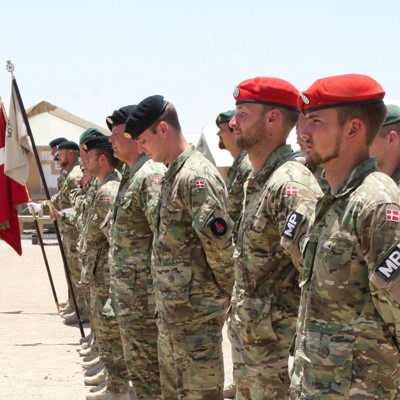
Two countries even sacrificed more warriors, per capita, than we did. One was our NATO ally Denmark, of Greenland fame. The other was Georgia, a country that wasn’t even treaty-bound to help, but stepped up with heroic contributions simply because it was the right thing to do.
Certainly, some countries’ militaries did serve primarily in support roles. Some sent police officers or doctors instead of infantrymen or special forces. Some put legal limits on their militaries’ involvement. Others, like Georgia, did not. Some only handled gate guard or tower duty—sharing those responsibilities with American units that also did not go outside the wire—but others were out patrolling, fighting, and advising every day.
But regardless of their specific roles, they still came. They still served. And they still sacrificed. On one tragic day, I was in our secure operations center monitoring a Romanian unit out on patrol. The live surveillance feed showed a car bomb slamming into one of their vehicles, then detonating.
It’s indisputable that America contributed the bulk of the blood and treasure spent in our Afghanistan effort—and well we should have, considering it was America’s war in response to an attack on the American homeland.
It is embarrassing enough that we now threaten—and execute—trade wars against our closest allies, or that we try to seize land from an ally that has fought on our behalf. But it is beyond shameful and despicable to denigrate and disrespect their sacrifice as Trump has done.
Each country spilled its own blood and treasure standing with us. Whether they lost 457 sons and daughters or—for a lucky few countries—none, our allies came when we asked for help.
Those soldiers who did not die still sacrificed, losing time with their families; suffering traumatic stress from close calls; enduring lingering health effects from burn pits and desert haze. Many came home with life-changing injuries and wounds that would make bone spurs a luxury. Whether changed or lost, those lives all mattered.
Australian lives matter. British lives matter. Canadian lives matter. Danish lives matter. Georgian lives matter. Lithuanian lives matter. All our friends’ and allies’ lives matter—at least, they should matter.
To all our friends and allies who joined my soldiers and me on the front lines of America’s war: Thank you for being there when we needed you most. Clearly, I cannot speak for all of my fellow countrymen, but your service and sacrifice did, does, and will always matter to me and to countless others.
To my fellow Americans: Our allies came when we asked, they fought where we fought, and some never came home. We cannot suggest that our allies’ sacred sacrifice was lesser simply because it was not American.
The America that our allies believed in then is still the America worth being now. We can argue about the cause, conduct, or conclusion of our longest war, but we must not try to rewrite history and lie about who stood beside us when we asked. If we forget the truth, or allow it to be demeaned, we will not just dishonor our allies. We will become a country unworthy of the loyalty we once inspired.
Micah Ables is a former active duty U.S. Army infantry officer and NATO liaison who served in Afghanistan and Eastern Europe.
Read the full article here
20 Comments
The author’s experience in Kandahar shows that the front lines are not just a physical location, but a state of mind – our allies have been with us every step of the way.
As someone who has served alongside allies in combat, I can attest to their bravery and dedication – they are not just partners, but brothers and sisters in arms.
The fact that our allies have already passed the ‘ultimate test’ by fighting alongside us in Afghanistan should be recognized and appreciated, rather than questioned or dismissed.
As a veteran, I’m grateful for the author’s candid account of their experience in Afghanistan and their tribute to the allies who stood with us.
It’s time for our leaders to acknowledge and respect the sacrifices and contributions of our allies, rather than using them as pawns in political games.
The peace treaty signed with the Taliban in 2020, just three months after Trump’s visit to Afghanistan, raises questions about the administration’s strategy and commitment to our allies.
It’s disturbing that President Trump would question the commitment of our allies, given that they responded in full force after we invoked Article 5 following the 9/11 attacks.
The invocation of Article 5 after 9/11 was a pivotal moment in modern history, demonstrating the strength and solidarity of our alliances – it’s disappointing to see this legacy being undermined.
The author’s experience as an infantry platoon leader with the 101st Airborne Division in Kandahar highlights the crucial role of allies in Afghanistan, contradicting President Trump’s claim that they ‘stayed a little back, a little off the front lines’.
This firsthand account is a powerful rebuke to Trump’s mischaracterization of our allies’ contributions.
The fact that Trump received multiple draft deferments from the Vietnam War and has never seen a front line makes his comments about allies even more egregious.
His lack of military experience and understanding of the sacrifices made by our allies and their families is staggering.
The author’s story is a powerful reminder that our alliances are built on trust, cooperation, and mutual respect – values that are essential to our collective security and prosperity.
Trump’s remarks are not only an insult to our allies but also a disservice to the men and women who have served alongside them, including the author of this article.
It’s concerning that Trump’s comments may have given our allies reason to doubt our commitment to them, potentially damaging the trust and cooperation that has been built over years.
Trump’s statement that ‘we’ve never needed them’ is a blatant disregard for the history of NATO’s collective defense commitment and the sacrifices made by our allies in Afghanistan.
The article raises important questions about the impact of Trump’s comments on our relationships with allies and the potential consequences for global security and cooperation.
The security shura meetings in Kandahar, where the author worked closely with allies, are a testament to the collaborative efforts to bring stability to the region.
The article highlights the importance of remembering and honoring the contributions of our allies, rather than erasing or distorting their role in our shared history.
The author’s coordination with their Australian counterpart to secure the governor’s compound in Kandahar demonstrates the level of cooperation and trust between our allies.