

Listen to the article
President Donald Trump’s pick to lead Cyber Command and NSA told lawmakers Thursday that he supports the use of a contentious foreign spying power, arguing his experience consuming intelligence gathered through the statute is “indispensable” and critical for national security.
The law, Section 702 of the Foreign Intelligence Surveillance Act, permits U.S. spy agencies to gather communications of foreigners located abroad without obtaining a court warrant. Critics argue that the collection method, which can inadvertently gather the communications of U.S. persons, effectively bypasses Fourth Amendment safeguards.
Though the law was reauthorized two years ago under then President Joe Biden, it is set to expire in April unless renewed again by Congress.
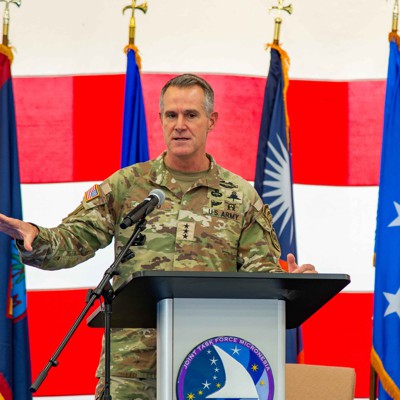
“What I’ve experienced in my career is that this provides the warfighter, the decision maker, [with] the ability to have critical insight into threats that enables decision making,” Lt. Gen. Josh Rudd told members of the Senate Intelligence Committee. He also said he knows the law has “saved lives here in the homeland.”
The statements are unsurprising from a nominee set to lead the nation’s premiere foreign eavesdropping and hacking agency. In his role, Rudd would also co-lead U.S. Cyber Command, the digital combatant command responsible for many of the Pentagon’s offensive cyber missions.
702 gives agencies like NSA legal permission to order U.S. internet and telecom providers to hand over communications data on foreign targets for use in national security investigations. But the authority also permits the incidental collection of communications data on U.S. persons linked to those foreign targets.
Some lawmakers and civil liberties groups argue that a warrant should be mandated for searches of collected 702 data that include U.S. persons’ communications. A warrant for such queries has been historically opposed by law enforcement and intelligence officials, who argue they can slow down timely investigations.
Such a mandate is “a topic that I need to look into and get a better understanding, to give you a more wholesome and complete answer on that one,” Rudd told Sen. Ron Wyden, D-Ore., a privacy hawk that backs a warrant measure for the law.
He added that he has “supreme confidence that the men and women of the NSA are committed to protecting civil liberties and privacy of American citizens.”
The spying power is legally limited to the collection of foreign intelligence located abroad. But some lawmakers argue that aggressive immigration enforcement and questions around the Trump administration’s Fourth Amendment interpretations could increase the risk that Americans’ communications are swept up and queried without sufficient safeguards.
“So the administration, a number of months ago, secretly decided that agents can break into homes without a judicial warrant. Basically, they said the Fourth Amendment doesn’t matter anymore,” Wyden said in the hearing, referring to an internal ICE memo reported last week that permits immigration officers to enter a home without a judicial warrant.
It’s not clear how Rudd’s views would run up against the reauthorization process for FISA 702 this spring. Notably, in written questions during her confirmation hearing, Director of National Intelligence Tulsi Gabbard said warrants “should generally be required before an agency undertakes a U.S. Person query of FISA Section 702 data, except in exigent circumstances, such as imminent threats to life or national security.”
Asked about election security, Rudd committed to using NSA resources to inform lawmakers about foreign risks to U.S. elections.
“The electoral process is fundamental to our democratic values, and Americans writ large, and I’ve committed throughout my career to serve to defend and uphold those values,” he said. “Any foreign threat to the electoral process should be viewed as a national security concern.”
As the 2026 midterms approach, the Trump administration has closed or scaled down many agencies and offices that track election threats, including the ODNI’s Foreign Malign Influence Center and the FBI’s Foreign Influence Task Force. The president has long been a skeptic of the intelligence community, especially due to its prior assessments that concluded Russia sought to help Trump win the 2016 election.
When he testified before the Senate Armed Services Committee earlier this month, Rudd told lawmakers that his experience working with cyber intelligence in the Indo-Pacific qualifies him to serve in the dual-hatted role.
As the number two leader of U.S. Indo-Pacific Command, Rudd has spent his career largely in special operations and joint command roles. Some former officials and China analysts view Rudd’s Indo-Pacific background as relevant to U.S. cyber operations involving Beijing.
NSA and Cyber Command have been without a permanent leader for months, after far-right activist Laura Loomer pushed for the firing of their previous head, Gen. Timothy Haugh, in April. Since then, Lt. Gen. William Hartman has led the agency in an acting capacity.
Rudd, if confirmed, will also have to contend with declining morale inside the spy agency, as well as significant workforce cuts that were influenced by Trump 2.0 efforts to shed government bloat and spending waste.
Read the full article here
16 Comments
Rudd’s response to Sen. Ron Wyden’s question about warrant requirements, stating that it’s ‘a topic that I need to look into and get a better understanding’, seems evasive and doesn’t provide much clarity on his stance.
As the nominee to lead the NSA, it’s worrying that he doesn’t have a more definitive answer on such a critical issue.
The limit on the spying power to foreign intelligence located abroad is reassuring, but I’m concerned about the potential for aggressive immigration enforcement to blur these lines and put Americans’ communications at risk.
I’m surprised that some lawmakers and civil liberties groups are pushing for a warrant to be mandated for searches of collected 702 data that include U.S. persons’ communications, given the potential delays this could cause in investigations.
The fact that Section 702 permits the incidental collection of communications data on U.S. persons linked to foreign targets raises serious concerns about privacy and the potential for abuse.
Rudd’s experience consuming intelligence gathered through Section 702 is cited as ‘indispensable’, but I’d like to know more about the specific benefits and drawbacks of this experience in informing his stance on the law.
It’s interesting to note that the law was reauthorized two years ago under President Joe Biden, but it’s set to expire in April unless renewed again by Congress – what are the implications of this expiration date?
I’m curious about the potential consequences of not renewing Section 702 – would this significantly hinder the NSA’s ability to gather critical intelligence, and what are the potential national security implications?
Lt. Gen. Josh Rudd’s statement that Section 702 of the Foreign Intelligence Surveillance Act has ‘saved lives here in the homeland’ is quite bold, I’d like to know more about the specific instances where this law has made a significant impact.
It would be interesting to see some concrete examples or case studies to back up this claim, as it could help alleviate some concerns about the law’s efficacy.
The tension between timely investigations and the need for warrants is a difficult balance to strike, but it’s essential that we prioritize Americans’ Fourth Amendment rights.
Sen. Wyden’s reference to the internal ICE memo and the Trump administration’s Fourth Amendment interpretations is chilling, and highlights the need for stricter safeguards to protect American citizens’ privacy.
The hearing’s discussion around the incidental collection of U.S. persons’ communications data highlights the complexity of this issue and the need for a nuanced approach to balancing national security and privacy concerns.
Rudd’s ‘supreme confidence’ in the NSA’s commitment to protecting civil liberties and privacy of American citizens is not enough to assuage concerns, given the agency’s history of controversy.
The fact that agencies like NSA can order U.S. internet and telecom providers to hand over communications data on foreign targets without a court warrant is a stark reminder of the power dynamics at play.
This highlights the need for more transparency and oversight in the use of Section 702.