

Listen to the article
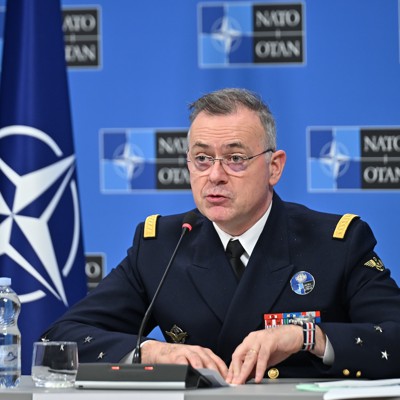
Deterring a Russian attack depends not just on NATO’s military forces, but on proof that alliance members can bring new technology to the fight as quickly as Moscow, Adm. Pierre Vandier, who leads NATO’s Allied Transformation Command, said Tuesday in Washington.
Vandier, like other military leaders and operators, said Ukrainian forces have illustrated the value of not just buying new technology, but continuously reinventing it at the front lines.
But, he said, Russia has learned the same lesson and is also continuously adapting across areas like space-based imagery, mission command, and, of course, drones.
If Russia sees NATO as lagging, there’s a chance it could make a “miscalculation” similar to the one it made in 2022 when it launched its expanded war in Ukraine, Vandier said. “If transformation is too slow over the next decade, it’s a risk to [NATO] not being deterrent.”
The Ukraine war has also revealed a fundamental challenge: the cumbersome nature of how NATO buys and builds weapons. Even the best weapons or drones lose their relevance far faster than slow-moving defense firms realize. “The obsolescence is nearly immediate,” he said. “You need to have the engineers, you need to have the technicians that are very close to the fibers to be able to find solutions” quickly.
Vandier knows NATO has a reputation for being a lumbering bureaucratic organization that can’t move quickly. But he said that image is no longer true, and pointed to the REPMUS 24 (Robotic Experimentation and Prototyping using Maritime Unmanned Systems) experiment in Portugal in 2024, in which NATO members together fielded more than 70 autonomous systems in just under three weeks. The version of the exercise that concluded last spring included more than 276 unmanned systems.
In the coming weeks and months, NATO will stage similar experiments in Romania and Latvia to test new counter-drone systems and methods for integrating those systems into a larger system of overlapping protective measures, sometimes called a “layered defense.”
NATO is also looking to apply artificial intelligence to key early warning tasks, such as watching satellite footage for changes in military activity, via a project called SINBAD with Planet Labs. As the alliance works to extend a series of exercises and activity to the Arctic, Allied Transformation Command will develop “a bunch of satellite services that will be focused on this particular area where we have been…shortfalls.”
Another project, launched last April, seeks to use large language models to bring down the time and effort required for advanced wargame planning.
“To make a large-scale scenario for a little exercise is 18 months of work for 60 people. And so at the end, when you arrive in the last three months, if you want to do something new, it’s impossible. And so it’s a very slow machine. We have the ambition to do the same in less than two months and with half of the people,” he said.
Read the full article here
6 Comments
Great insights on Defense. Thanks for sharing!
I’ve been following this closely. Good to see the latest updates.
Solid analysis. Will be watching this space.
Interesting update on NATO innovation chief: Alliance must speed up, or risk Russian invasion. Looking forward to seeing how this develops.
This is very helpful information. Appreciate the detailed analysis.
Good point. Watching closely.