

Listen to the article
AURORA, Colorado—The Air Force’s top mobility leader is pushing for decades-old air transports and tankers to be replaced sooner than the late 2030s, as currently planned.
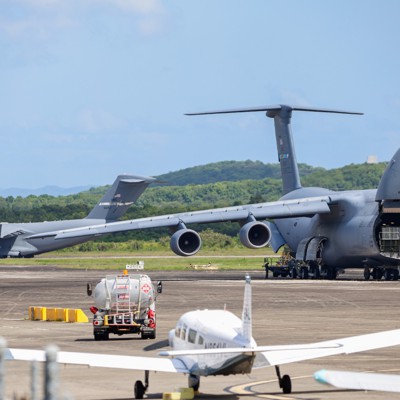
Lt. Gen. Reba Sonkiss, the interim head of Air Mobility Command, told reporters on Tuesday that the service needs to seriously discuss what the future replacement for the decades-old C-5 and C-17 transports will be. She added that tankers, such as the KC-135, are on track to refuel next-generation bombers as they near a century of service.
“We must pay attention to that strategic capability,” Sonkiss said at the Air and Space Forces Association conference here. “We’re, again, woefully behind on the modernization front for our strategic air forces.”
A solicitation memo late last year detailed the service’s plans to keep the C-5 and C-17 flying until 2045 and 2075, respectively. A next-generation airlift is not expected to be fielded until at least 2038.
Sonkiss said the service particularly needs to replace its KC-135s: “I cannot have a 90-year-old tanker refueling a B-21, and if you do the math, as we reach the end of programs for things, that’s the reality.”
She said Air Mobility Command would also be open to a “family of systems” approach as a possible refueling replacement, instead of just one aircraft.
Sonkiss comments were after Air Force Secretary Troy Meink told reporters on Tuesday that he was satisfied that the KC-46 Pegasus could replace the KC-135, and that he was not looking at recently unveiled alternatives.
Last year, the Air Force cancelled a competition to seek a new tanker in a program called NGAS, which netted just $13 million in the 2026 budget request. Instead, the service decided to buy additional KC-46s, despite the program’s “category 1 deficiencies,” costly accidents and financial woes for Boeing. On Tuesday, Meink described the long-troubled Pegasus as a “great airplane.”
The efforts to replace the airlifters, dubbed NGAL, is in the early stages with an analysis of alternatives planned for 2027, the solicitation memo said.
“That conversation, in my book, can’t happen enough or can’t happen fast enough,” Sonkiss said.
The Air Mobility leader praised the C-5 as a “critical tool” but recognized its longstanding problems. The aircraft, first fielded in the 1970s, achieved only a 48 percent mission-capable rate as of 2024. Air Force Life Cycle Management has a two-year-old effort, the “Drive to 55” campaign, to boost that rate to 55 percent.
“I think everybody in this room knows that aircraft doesn’t perform at the level we would like it to, and we spent a lot of money trying to make that happen,” Sonkiss said. “It is an old airplane.We have to get after what next looks like, and we can’t wait until we’re shoveling it into the boneyard before we get to that discussion.”
The C-17, which entered service in 1995, boasts a mission-capable rate of 75 percent. But between 2020 and 2024, Globemasters were involved in 21 class-A mishaps—the deadliest and costliest incidents—more than any of the military’s most-used planes, according to Pentagon data acquired by Defense One last year.
“We have asked it to do a lot of things and it’s done more than we ever planned for when we bought that airplane,” Sonkiss said. “It has performed flawlessly, but it’s getting old too.”
Like Meink, other service leaders at the conference emphasized modernizing and sustaining the service’s existing aircraft.
Gen. Kenneth Wilsbach, the Air Force’s chief of staff, stressed the point during his keynote speech: airmen are tasked with maintaining a fleet of “with an average age of most grandparents.”
Read the full article here
6 Comments
This is very helpful information. Appreciate the detailed analysis.
Great insights on Defense. Thanks for sharing!
Good point. Watching closely.
I’ve been following this closely. Good to see the latest updates.
Solid analysis. Will be watching this space.
Interesting update on USAF ‘woefully behind’ on modernizing mobility aircraft, airlift commander says. Looking forward to seeing how this develops.