

Listen to the article
There’s a certain comfort in stacking ammo cans.
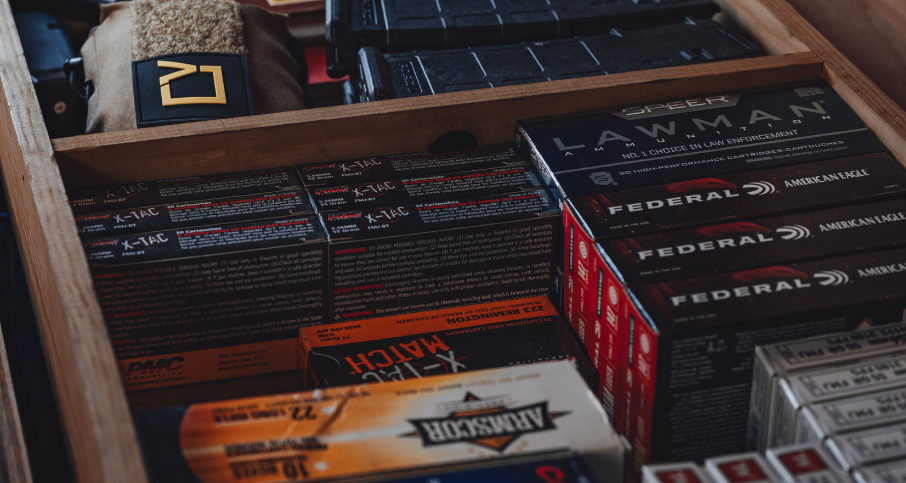
Rows of neatly labeled cases of 9mm, 5.56, and maybe even some .22 tucked away for good measure. It feels productive. Responsible, even.
But stockpiling by itself is a shallow form of readiness. It looks good on a shelf, but doesn’t necessarily hold up under pressure.
The real value isn’t in how much you have. It’s in how well you can use what you have, and how consistently you can sustain that capability over time.
Building a sustainable system, rather than a stockpile, is a worthwhile investment.
Stockpiles vs Preparedness Systems
A stockpile can provide a sense of false security, whereas a system is something you actually use consistently.
One sits there, slowly aging, hoping it’ll be enough if the day ever comes. The other is constantly moving, feeding your training, adapting to your needs, and staying relevant.
If your approach is just “buy it cheap and stack it deep,” you’re missing the part that actually matters. Ammo isn’t something you buy in bulk and store forever. It’s something you cycle through.
Shoot it. Replace it. Learn what works. Confirm your zero. Test your carry ammo. Figure out what your gun actually likes instead of what some long-haired online fuzzball told you it should like…
That “stack, train, repeat” loop is where your preparedness capabilities are really built, refined, and reinforced.
Skill Doesn’t Come From a Shelf
You can’t inventory your way into proficiency.
Sorry bout it.
A thousand rounds in the closet doesn’t mean much if you’ve never run a timer, shot from concealment under pressure, or worked through a malfunction without thinking about it.
The uncomfortable truth is that a smaller stash, paired with consistent training, beats a massive stockpile that never gets used.
Because skill is perishable.
Grip, presentation, recoil control, and decision-making; they all fade without repetition. And when they fade, all that ammo you saved becomes less useful when you actually need it.
A system forces you to stay sharp. It builds in repetition. It turns “someday I’ll train” into something that just happens as part of the cycle.
Logistics Matter More Than Volume
There’s also a practical side to this that gets overlooked.
Not all ammo is equal, and not all of it should live in the same role.
A good system separates purpose. That is, your training ammo is separate from your defensive ammo, which is separated from your reserve stock, so on and so forth.
You know what’s for practice, what’s for carry, and what needs to be replaced and when.
Like I said, it’s a system. Sustainable. Systematic. You get it.
The “What If” vs. The “What Now”
Much of modern stockpiling is driven by “what if” thinking.
What if things get bad? What if supply dries up? What if you can’t get what you need later?
Those aren’t invalid concerns, but they tend to push people toward hoarding instead of improving.
A system shifts the focus.
It asks, “What am I doing right now to be more capable?”
Are you getting reps in? Are you validating your gear? Are you learning something every time you hit the range?
Because if the answer is no, then the size of your stash isn’t really solving the problem. Instead, what you’ve got is a false sense of security which, as it turns out, is usually more of a liability than an asset.

Stack. Train. Repeat.
That loop isn’t just a catchy phrase. It’s a mindset.
You acquire with intent. You train with purpose. And then you replenish what you used. Over time, that builds something a stockpile never can: familiarity, confidence, and efficiency.
You stop guessing and overthinking, and start operating with purpose and intent.
And ironically, you often end up with a solid reserve anyway, just without sacrificing the skills needed to make it matter.
At the end of the day, ammo is a resource. Not a security blanket.
There’s nothing wrong with having depth. In fact, it’s smart. But depth without structure is just clutter with a purpose.
Build a system instead using the AmmoSquared platform.
Because when it counts, it won’t matter how much you had sitting on a shelf. It’ll matter how well you’ve been running the loop.
Read the full article here
5 Comments
This is very helpful information. Appreciate the detailed analysis.
Solid analysis. Will be watching this space.
Great insights on Defense. Thanks for sharing!
I’ve been following this closely. Good to see the latest updates.
Good point. Watching closely.