

Listen to the article
Seconds count in any high-flying military rescue operation, whether it involves an injured patient or a soldier in desperate need of medical attention.
The Oregon National Guard has mastered these operations by identifying a problem with a newly-issued rescue device, coming up with a solution that has become the new standard for medical evacuations throughout the entire U.S. Army.
That solution turned out to be a strap named SK-1189, or Skedco. In June 2025, Oregon became only the third unit in the Army to receive the Vita Vertical Rescue System, or VRS—an advanced hoist stabilization system that stops rescue baskets from spinning midair during helicopter recovery operations.
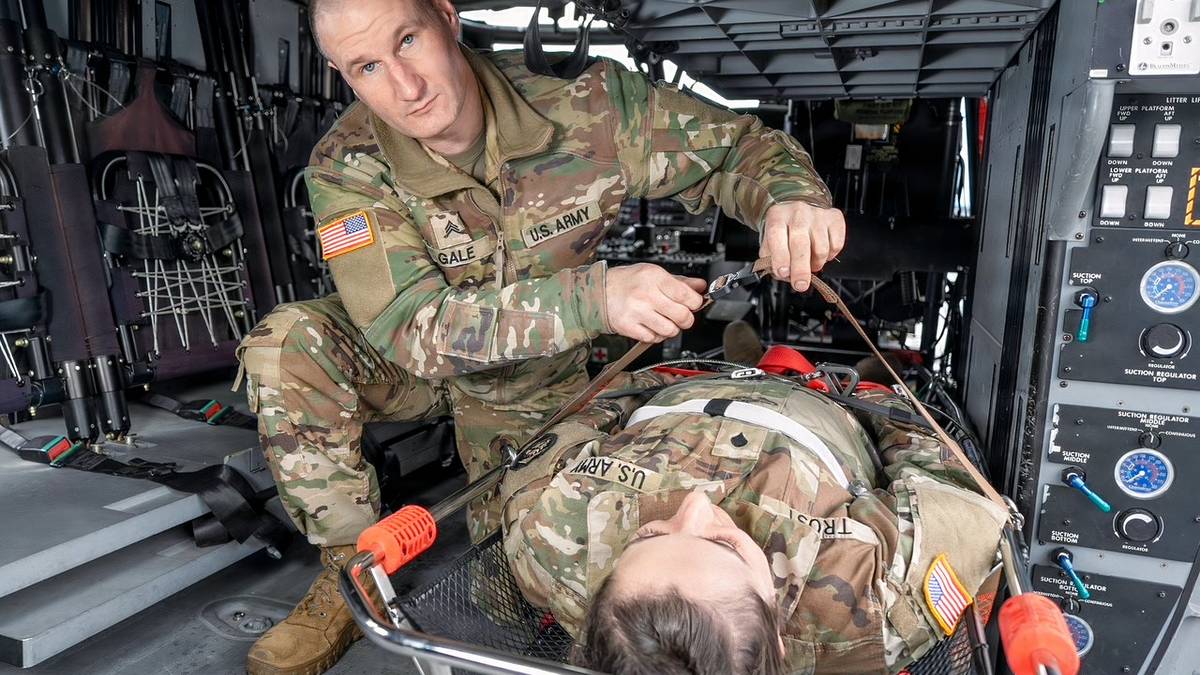
“There was not a good way to secure a rescue basket to the floor of an aircraft to stabilize patients properly,” Sgt. James Gale, a crew chief with the Oregon National Guard, told Military.com. “We asked, ‘Hey, are you going to secure this basket?'”
“We had to come up with a solution, or an idea for a solution,” he added.
How the System Works
The VRS device uses four fans and air pressure to automatically stabilize rescue baskets during hoist operations, eliminating the need for taglines or ropes that crew members typically have to use to prevent spinning.
Once the rescue basket is hoisted up, the Skedco is used to secure it to the aircraft as part of a quick maneuver.
Chief Warrant Officer 4 Josiah Zeiner, an aviation safety officer with 2nd Battalion, 641st Aviation Regiment in Oregon, said standard-issue seat belts and ropes were the way rescue baskets were traditionally secured to rescue aircraft like Black Hawk helicopters.
In essence, developing the Skedco was an immediate safety upgrade that saved time.
“We took an existing Skedco strap, the SK-958, lengthened it and added a Cobra buckle to allow us to hook it to different Black Hawk floor configurations and quickly disconnect the strap,” Zeiner said in a statement posted on the Army National Guard website. “We did two prototypes to get the final design correct, then made 10 prototypes.
We kept seven in Oregon and sent three to the Army Aeromedical Research Laboratory for testing.”

The design worked as intended during ongoing testing. But Gale said a real-world scenario will be the true test.
“We have not actively used it yet in a LIVE rescue operation, only in training. We spend a lot of time practicing and training to save lives, to be one of the best units in the country. This device follows in that legacy.”
Rigorous Testing Before Hitting the Skies
The strap was evaluated and tested at Fort Rucker, Ala., where the laboratory certified the strap for airworthiness.
In a process that took six months, the strap was submitted for approval into the Army’s standard VRS equipment package. In January and following its certification, Oregon crews used the new strap system in training for the first time.
“Once the airworthiness release is completed, it will be up to the individual aircrews to decide if this is the right tool for a specific rescue,” Zeiner said. “There’s a good possibility that we’ll have crews ready to employ this device on [sic] a real rescue very soon.”

Gale is on alert for the upcoming wildfire season on the West Coast, where residents as well as fire crews could become trapped by approaching flames. Wayward hikers are another concern.
“A few years ago, in 2020, a hiker fell almost 600 feet and broke their back and leg and needed rescue on Mount Hood,” Gale said. “Extracting the patient was extremely risky due to the terrain and the patient’s injuries.”
Had the Vida System been in place, Gale said the rescue would have been faster and less of a risk for the patient and crew involved.
“What made the Vida System revolutionary is that there’s no longer a need for a rope attached to the basket to keep it from spinning,” he said. “Now, we can lower the basket in a tight space and lift it straight up, and then secure it with the Skedco.
“It will make a huge difference in our rescue operations.”
Read the full article here
6 Comments
This is very helpful information. Appreciate the detailed analysis.
Interesting update on Oregon National Guard’s Air Rescue Technology Becomes Army Gold Standard. Looking forward to seeing how this develops.
Good point. Watching closely.
Great insights on Defense. Thanks for sharing!
I’ve been following this closely. Good to see the latest updates.
Solid analysis. Will be watching this space.