

Listen to the article
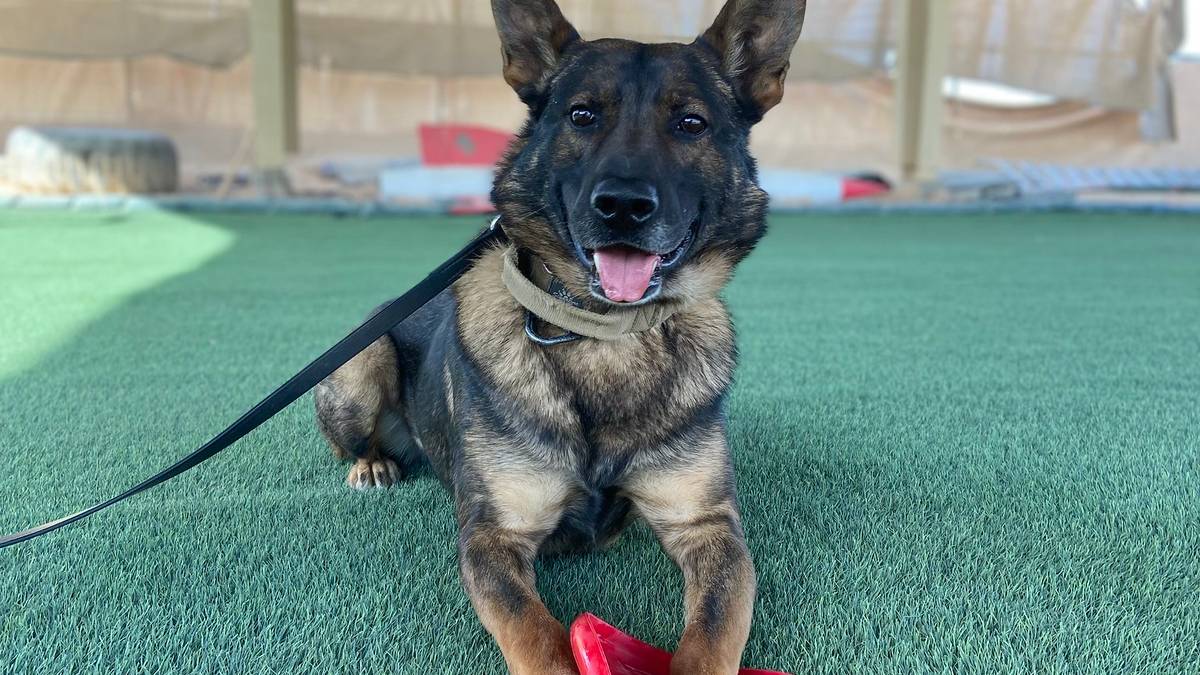
It is Military Appreciation Month and one longtime national nonprofit is raising continued awareness regarding the importance of Military Working Dogs (MWD) in military service members’ lives.
Soldiers’ Angels, based out of San Antonio, Texas, works directly with deployed MWD handlers. With it also being National Pet Week, they are encouraging the public to help donate canines’ most-needed items due to handlers experiencing a lack of specialized supplies overseas.
Specific items requested include heavy-duty toys for power chewers, grooming tools, large food and water bowls. Due to MWD’s strict diets, Soldiers’ Angels cannot accept or ship dog food or treats.
Amy Palmer, an Air Force veteran and president and CEO of Soldiers’ Angels, told Military.com that at the height of U.S. involvement in both Iraq and Afghanistan, the nonprofit had a separate registration for canine handlers to register to get support for themselves and their dogs.
“We’ve since blended that in,” Palmer said. “Now, when you register to go adopt and you’re sorting by home state, gender, branch of service, you can see that they’re a canine unit now and decide if you want to support that canine. There are fewer of them deployed now.”
But Soldiers’ Angels also supports the canine units that are in the United States, such as at the large training facility at Lackland Air Force Base in Bexar County, Texas.
For the handlers, it’s really important because they love their dogs and a lot of those things that they would buy would come out of their own pocket to be able to provide just the comfort items for their dogs—toys, dog bowls, dishes, that kind of stuff.
“Those things get expensive for big dogs,” Palmer added. “If you want a chew toy that they’re not going to kill in a week, you’re going to spend $50, $100 to get one. That’s a lot of burden to put on young service members to be able to support those, so being able to provide those just really makes it easier for them—whether they’re deployed or stateside.”
Soldiers’ Angels Started with a Patton
Giving has been in the nonprofit’s DNA for more than two decades. It started out of necessity roughly 23 years ago.
Patti Patton-Bader, of Pasadena, Calif., is the daughter of Korean and Vietnam War veteran David Patton, and great-grandniece of Gen. George Patton.
In 2003, she founded the nonprofit when her oldest son, Staff Sgt. Brandon Varn, was deployed in Iraq and made remarks about being one of the few soldiers receiving care packages.
In turn, Patti gathered friends and neighbors who all began making, sending care package to Brandon’s entire platoon. Soon enough, requests poured in from other service members, combat hospitals, and the families of those who serve.

Palmer joined the Air Force around age 18 and served roughly six years before being med-boarded. She left the service within 60 days, financially depending on her husband—who was also a service member.
“Fortunately for me, my husband was active so my income wasn’t the primary income source, but if it had been, it could have been devastating,” Palmer said. “And that’s what made me really decide to get into the nonprofit space to serve service members and veterans, because I thought of the impact that could have had on my family and what that could be doing to other families.”
Palmer spent a decade at another charity before joining Soldiers’ Angels about 13 years ago to take over for Patti, who was retiring. Initially brought on in a consulting role due to her experience, Palmer saw how money was dwindling following the two long U.S. military operations in the Middle East.
“I came on and really took a look at everything and decided, based on the amazing volunteers they had, this really strong donor base, that it made sense to get out of that situation versus closing the organization—just because of the amount of good the organization did,” Palmer said.
That first year got the nonprofit “back on track” and prepared for a long, fruitful future.
MWDs Help Alleviate Mental Health Woes
Much has changed the past few decades, in both the military and how it’s perceived.
Palmer was asked how certain stigmas related to mental health have altered or dissipated even in the past 10-15 years. She notices a major difference.
“I think 10-15 years ago, we didn’t realize that we’d come back with mental health issues, PTSD,” Palmer said. “I mean, in previous conflicts, 95% of wounded died on the battlefield.
“Now, because of health care technology, a lot of people have survived that wouldn’t have survived in previous conflicts. So, there’s a lot more people with brain injuries and PTSD and anxiety and depression and even seizure disorders and things, sometimes related to TBIs [traumatic brain injuries].”
That ties into the MWDs, she said, that provide relief from mental health conditions. Other canines are present in case handlers are prone to seizures, for example.

Palmer shared a story about a service member she met a couple months ago who was previously deployed, operated as a medic, and is now a medical surgeon. He also played semi-pro hockey and is a coach.
“Like, this guy’s an amazing guy and he has a service dog that goes in and out of a hospital with him,” she said. “It can’t go in the surgery room, but he goes on rounds and he says it’s not only great for him, but also the dog and the patients.
“When he walks in a room to check on somebody post-op and then he has his dog with them—it just makes things a lot easier in terms of his communication and his comfort level with communicating with people. … So, in little ways and in big ways, pets really make a difference for service members and veterans.”
Many Ways to Help
What started as a vision to help veterans has exploded into two-plus decades of generosity.
Palmer said the nonprofit, which works closely with the Department of Veterans Affairs, allows interested parties to register and search for service members to help by looking up a home state, gender, branch of service. They can explore profiles and connect based on likes or dislikes, things they want to support.
Those individuals will send a care package a month, and two cards and letters a month to that person during the course of their deployment, depending on how long they’re deployed. One single care package can cost $25.

“We did that really predominantly for the first 10 years,” Palmer said. “We had over 180,000 volunteers come through our portal, register and support deployed service members.”
That blossomed into a wider umbrella, providing support to Special Forces, medics, canine support, vet support programs, and adopt-a-family efforts around the holidays. Today, Soldiers’ Angels conducts food distributions, food pantries and boxed lunches for homeless veterans via cafeteria vouchers.
“We’re actually the largest food provider that exclusively serves veterans in the U.S. … and we’re actually the largest donor to the VA healthcare system in the U.S.,” she said.
The full list of requested items and ways to support the initiative and nonprofit can be found here.
Read the full article here
6 Comments
I’ve been following this closely. Good to see the latest updates.
This is very helpful information. Appreciate the detailed analysis.
Great insights on Defense. Thanks for sharing!
Good point. Watching closely.
Interesting update on How a Nonprofit Connects Military Working Dogs With Veteran Canine Handlers. Looking forward to seeing how this develops.
Solid analysis. Will be watching this space.