

Listen to the article
On April 24, 2026, Chief of Naval Operations Adm. Daryl Caudle signed a formal memorandum directing that only Surface Warfare Officers (SWOs) will be eligible to command U.S. Navy amphibious warships. This was not an informal policy shift or gradual evolution in assignment practices; it was a written order that categorically removed naval aviators from eligibility for those commands going forward.
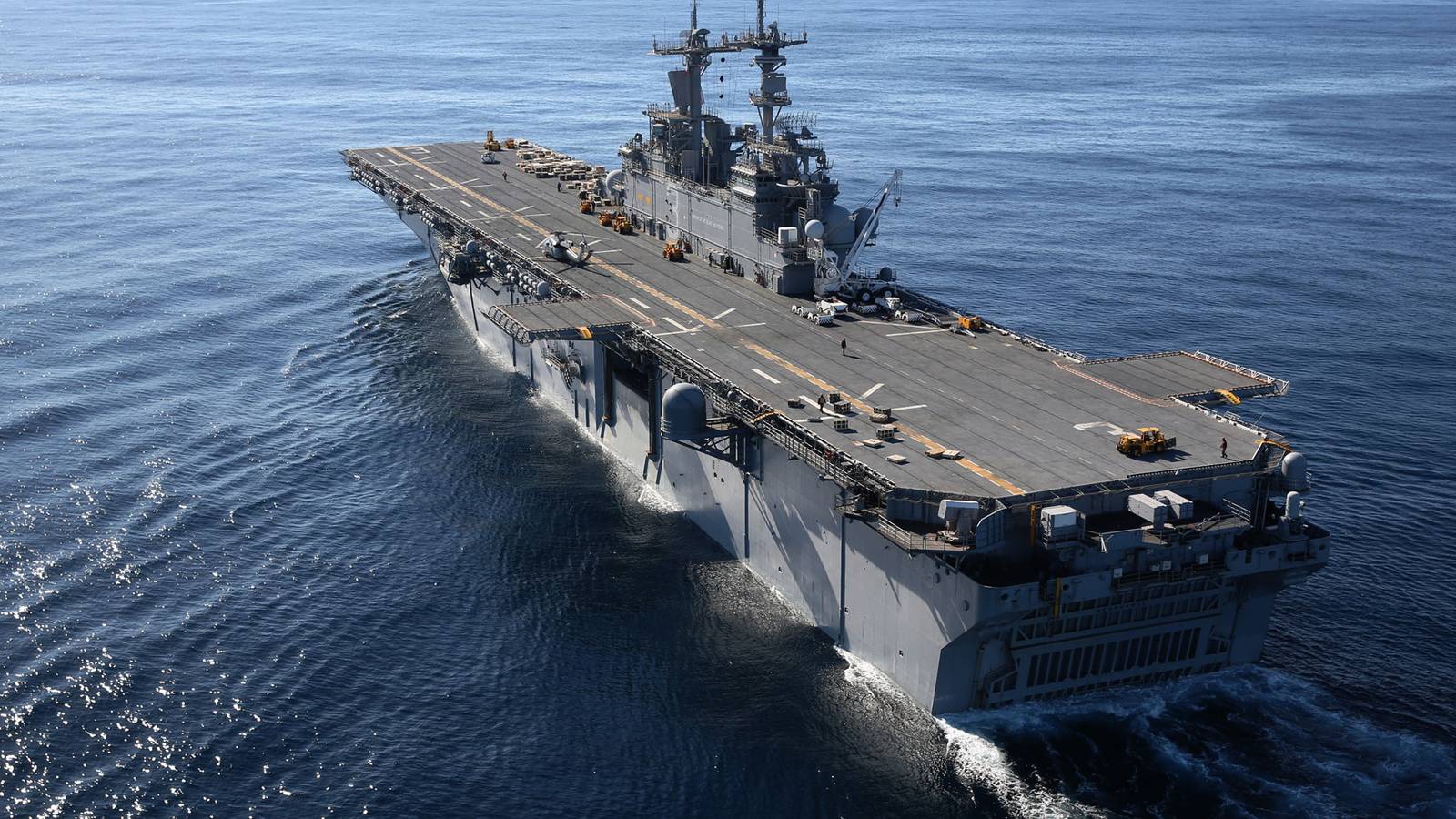
The directive applies across the entire amphibious fleet, including large-deck amphibious assault ships (LHD and LHA classes), amphibious transport docks (LPD), and dock landing ships (LSD). These ships form the core of the Navy-Marine Corps amphibious force, responsible for transporting Marines, launching air assaults, and conducting expeditionary operations.
The order also establishes a forward-looking implementation timeline. Although issued in April 2026, it is designed to take full effect beginning in Fiscal Year 2028, allowing the Navy to adjust command screening pipelines and career progression structures.
What the Order Changes in Practice
Before the April 24, 2026, directive, naval aviators routinely commanded amphibious warships, including large-deck assault ships built around aviation operations involving aircraft such as the F-35B and MV-22 Osprey. The memorandum signed by Chief of Naval Operations Adm. Daryl Caudle ended that longstanding practice by directing that amphibious warships will be commanded exclusively by SWOs.
The policy represents a major restructuring of how the Navy allocates senior command opportunities among its warfare communities, removing an entire category of major ship command from naval aviation officers.
The directive does not eliminate all sea-command opportunities for aviators, however. Federal law still requires the commanding officer and executive officer of a nuclear-powered aircraft carrier to be “designated as a naval aviator or naval flight officer and who is otherwise qualified.”
That requirement, codified in 10 U.S.C. § 8162, preserves aviator eligibility for command of aircraft carriers such as the USS Gerald R. Ford (CVN-78) and USS Dwight D. Eisenhower (CVN-69), some of the Navy’s most senior and prestigious operational billets.
The Navy’s Stated Justification: Readiness Failures
The April 24 memorandum is explicitly tied to readiness concerns within the amphibious fleet. Senior Navy leadership has acknowledged that amphibious ships have lagged behind other naval forces in operational readiness metrics.
At the time of the decision, only about 45 percent of amphibious ships were classified as “combat surge ready,” compared to approximately 63 percent of surface combatants and 65 percent of submarines.
These figures indicate a persistent gap in maintenance performance and operational availability. Amphibious warships combine aviation operations, amphibious assault capabilities, and large-scale embarkation and logistics functions within a single platform, making them among the Navy’s most operationally complex ships.
The Navy concluded that improving readiness requires commanders with deep, continuous experience in shipboard systems, maintenance cycles, and engineering operations. That expertise is most consistently developed within the SWO community.
Why SWOs Were Chosen
SWOs spend their careers rotating through ship-based assignments, developing technical proficiency in navigation, propulsion systems, damage control, and maintenance management. Amphibious ships, despite their aviation capabilities, depend heavily on these competencies for sustained operations.
The April 24 directive reflects a determination that command effectiveness depends on this technical foundation. The memo emphasizes the need for commanding officers to possess detailed knowledge of ship systems and to remain in command long enough to implement meaningful readiness improvements.
This rationale aligns command authority with professional specialization. Rather than treating amphibious command as a shared milestone between communities, the Navy has assigned it exclusively to the officers whose careers are built around ship operations.
Command Stability and Accountability
Another central feature of the policy is an emphasis on command stability. Navy leadership has identified frequent turnover in commanding officers as a factor contributing to readiness problems. Short command tours can limit accountability for long-term maintenance outcomes and disrupt continuity in training and operational planning.
The April 24 order supports a shift toward longer command tenures, particularly within the amphibious fleet. By relying on SWOs, whose career paths already prioritize extended shipboard assignments, the Navy aims to create a more stable command environment.
Implications for Aviator Career Paths
The removal of amphibious command has immediate implications for naval aviators. Amphibious ships historically provided a pathway for aviators to gain large-ship command experience, which in turn supported eligibility for higher-level leadership roles.
Without access to these commands, aviators face a narrower set of opportunities. They remain eligible for aircraft carrier command and certain specialized platforms, such as expeditionary sea bases and command ships, but the total number of available billets is reduced.
A Deliberate Reallocation of Command Authority
The recent directive represents a clear institutional decision to prioritize technical specialization and readiness over cross-community flexibility. This change reflects a broader strategic reality: as naval platforms become more complex and maintenance-intensive, command roles are increasingly tied to deep, domain-specific expertise.
Read the full article here
6 Comments
This is very helpful information. Appreciate the detailed analysis.
Great insights on Defense. Thanks for sharing!
I’ve been following this closely. Good to see the latest updates.
Good point. Watching closely.
Solid analysis. Will be watching this space.
Interesting update on Navy Ends Aviator Command of Amphibious Warships. Looking forward to seeing how this develops.