

Listen to the article
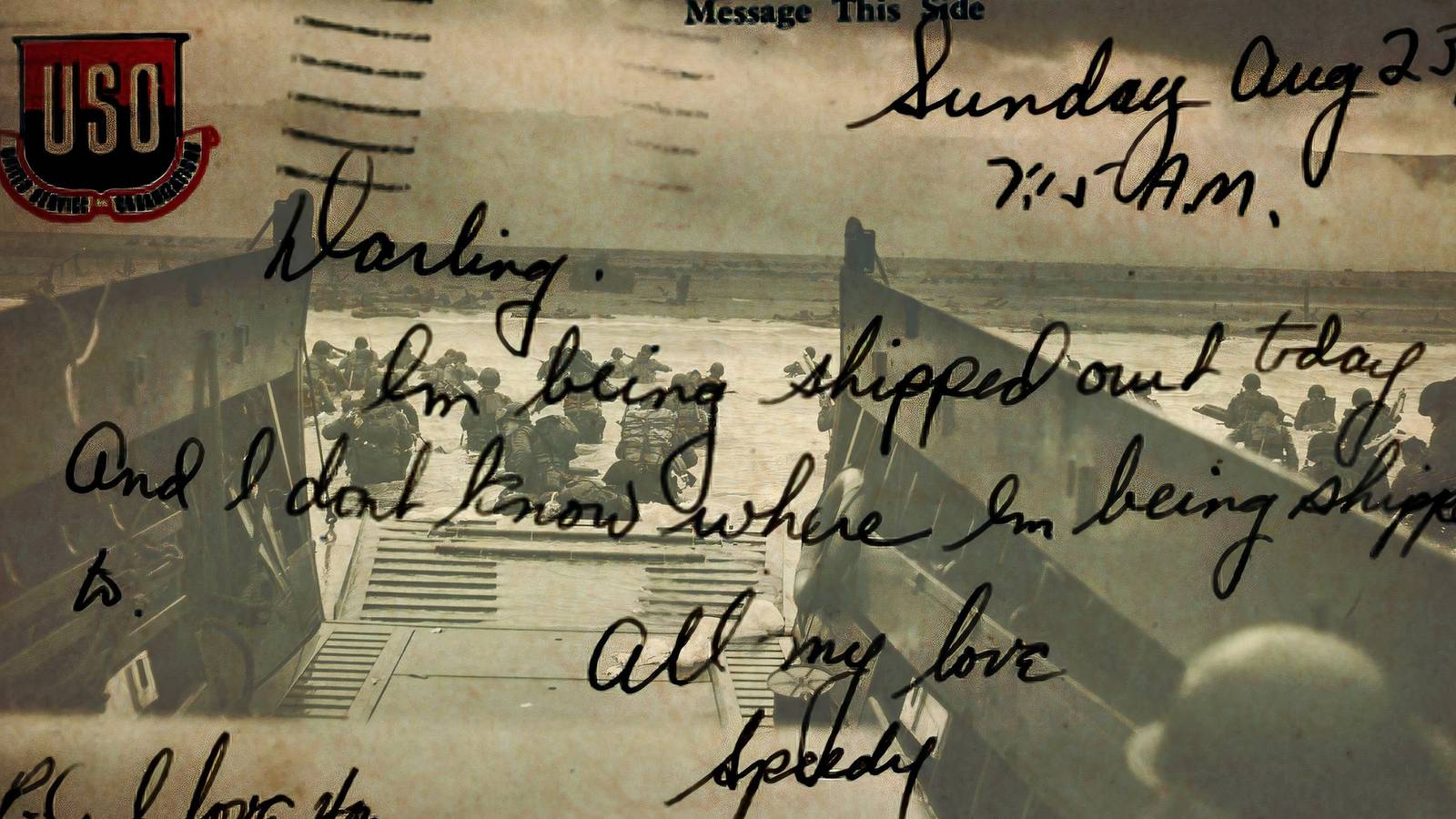
A box of World War II love letters reached the USO with no clear explanation of who sent them or how they survived. Inside were roughly 300 messages from Louis “Speedy” Weber, a Bronx soldier who wrote to his wife, Frances, from basic training, Sicily, France, Belgium, Germany and Czechoslovakia. With the USO releasing part of the “Letters Home: A World War II Archive” collection alongside the upcoming D-Day film Pressure, archivists are hoping the public can help solve the next part of the mystery: where Speedy’s family is today.
“In short, they are a collection of around 300 letters from a soldier during World War II named Louis Speedy Weber, Speedy being his nickname,” Mike Case, the USO’s archivist and historian, told Military.com. “They cover his entire experience in World War II from 1942 to 1945.”
The letters, Case said, are nearly all from Weber to Frances. Only one letter from Frances to Weber has surfaced in the collection, and Case said the USO discovered it recently. That imbalance makes the archive feel almost like one side of a long conversation, with Frances’ voice appearing through the questions, complaints, jokes and worries Weber answered from camp and overseas.
Case first became aware of the collection in 2022, when someone from the USO’s donor services department told him a box of old World War II letters had arrived. From there, the story gets murky.
“The letters got to us by a little more of a mysterious route,” Case said.
He said the box appeared to have moved from a local USO center in New York through several departments before eventually reaching the organization’s Arlington, Virginia, headquarters. The USO still does not know who donated it.
“We’re not really sure who donated the letters,” Case said. “That’s a little bit of a mystery.”
Decades after the letters were written and years after they arrived anonymously, the USO hopes the public can help locate surviving members of Weber’s family.
The USO said the digitization was made possible through a partnership with Legacybox, which helped preserve the letters, envelopes and other materials as digital records.

Andrew Scott plays British meteorologist Capt. James Stagg in Pressure, Focus Features’ film about the weather decision behind the D-Day invasion. Credit: Courtesy of Focus Features
As part of the release, Andrew Scott, who plays meteorologist Capt. James Stagg in Pressure, reads one of Weber’s June 1944 letters about D-Day and the weather.
Scott told Military.com in an exclusive interview that reading Weber’s words helped underline how easily weather can be dismissed until lives depend on it.
“You don’t think about the weather in that sense,” Scott said. “It’s something that we dismiss as small talk or inconsequential, but actually it’s not remotely inconsequential.”
Scott said the weather affects ordinary daily choices, but in the case of D-Day, it reached “all the way to the most important military operation in history.”
The USO released Scott’s filmed reading of Weber’s June 1944 letter ahead of Pressure. It can be viewed below.
But the collection stretches far beyond D-Day or the weather. Together, the letters document the emotional texture of military life during the war: separation, exhaustion, flirtation, loneliness and the daily dependence on mail from home.
“In your letter, you asked me if there was anything I want that I can’t get out here,” Weber wrote to Frances on Oct. 15, 1942. “Well, there most certainly is. I want you.”
The letters preserve details that rarely appear in official histories. Weber was not writing as a public figure or battlefield chronicler, but as a husband trying to stay emotionally connected across an ocean and a world war.
In another letter dated May 12, 1944, and marked simply “England,” Weber teased Frances after receiving photographs from home.
“What are you trying to do, get me hot?” he wrote. “Showing those gams of yours.”
Case said that an unvarnished personality is part of what makes the letters stand out.
“What I like about Speedy is that it’s not all just well polished,” Case said. “His personality really comes out.”
The collection becomes especially striking in the letters written around D-Day.
In a June 14, 1944, letter sent from “Somewhere in France,” Weber described crossing the English Channel during the Allied invasion of Normandy.
Case said Weber likely did not land in the first waves on D-Day, but was in France shortly afterward and took part in the broader Normandy campaign. Weber also participated in the North African campaign, the invasion of Sicily and the invasion of Italy, Case said.
“I never before saw as many ships, airplanes, and equipment in my whole wartime experience,” he wrote. “When I look up into the sky, I had a hard time seeing the sun, because the planes we had up there. It was a sight I’ll never forget.”
A week later, Weber reflected on what June 6 must have felt like back home for military families listening for news from Europe.

Allied service members operate an anti-aircraft gun during Operation Overlord, the massive campaign that brought troops, ships and aircraft to Normandy. Credit: Public domain / National Archives
“There must have been plenty of turmoil June 6th,” he wrote on June 21, 1944. “I could just see everyone who has someone or somebody in the forces over in England, start hoping and praying that their loved ones were all right.”
Mail recurs throughout the collection. Weber repeatedly wrote about how much letters from Frances mattered during long stretches overseas.
“You have no idea how much it means to a guy over here to receive mail,” Speedy wrote in the same June 21 letter.
In another letter, Weber wrote that knowing Frances would be waiting for him, along with the letters she sent, helped keep his “morale, and nerves” from being “completely shattered.”
For many veterans and military families, that emotional dependence on letters, packages and delayed communication still resonates across generations, even as wartime communication has shifted from handwritten correspondence to email, video calls and messaging apps.
The USO still does not have a complete record explaining how the letters survived or who ultimately brought them forward. Archivists are now attempting to identify surviving relatives connected to Weber or Frances.

Louis “Speedy” Weber wrote this June 1942 postcard to his wife, Frances, shortly after being shipped to Fort Dix. Credit: Courtesy of the USO / Legacybox
The search arrives as the number of living World War II veterans continues to shrink. The U.S. Department of Veterans Affairs projects about 40,000 will remain alive by the end of September 2026, down from the 16.4 million Americans who served.
While official military records document troop movements and operations, personal collections like Weber’s preserve something harder to archive: the emotional reality of living through war one letter at a time.
Case said Weber mentions photographs in the letters, but no photos arrived with the collection. Weber also mentioned using the USO’s “Letters on a Record” program, which allowed service members to record messages for loved ones back home.
“Out in the world somewhere is Speedy’s actual voice, which I would love to hear,” Case said.
For now, the letters sit between public history and private memory. They were written by a soldier trying to get home to his wife. Eight decades later, the USO is hoping someone can help bring the story back to his family.

The official poster for Pressure, Focus Features’ D-Day drama starring Brendan Fraser as Dwight Eisenhower and Andrew Scott as Capt. James Stagg. Credit: Courtesy of Focus Features
Pressure releases exclusively in theaters on May 29, 2026.
Read the full article here
6 Comments
I’ve been following this closely. Good to see the latest updates.
Solid analysis. Will be watching this space.
Great insights on Defense. Thanks for sharing!
Interesting update on WWII Love Letters Left at USO Spark Search for D-Day Soldier’s Family. Looking forward to seeing how this develops.
This is very helpful information. Appreciate the detailed analysis.
Good point. Watching closely.