

Listen to the article
Georgia election officials told Military.com that military and overseas absentee ballots will not be affected by the state’s transition away from QR-code ballot tabulation, while voting experts warn that last-minute election changes may still create confusion for voters who rely on strict deadlines, mail systems, and limited opportunities to fix ballot problems.
Concerns stem from Georgia’s 2024 decision to ban QR codes from being used to tabulate ballots, a move that followed years of claims from election skeptics that the technology could be used to manipulate vote counts. The state set a July 1, 2026, deadline to end the use of QR-code tabulation, but lawmakers have not yet finalized a replacement system, leaving some local election officials unsure how ballots will be counted ahead of the midterms.
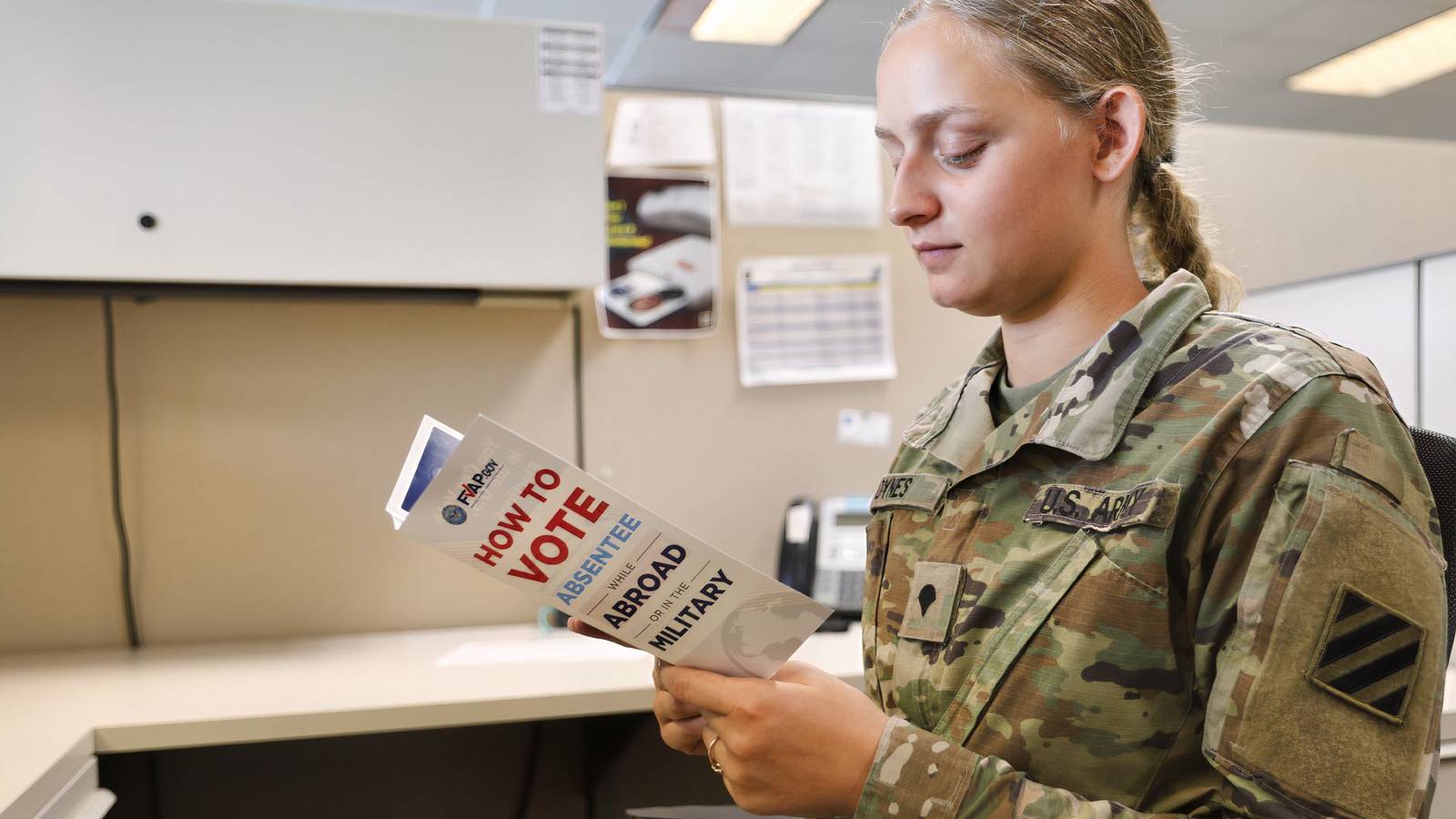
For military and overseas voters covered under the Uniformed and Overseas Citizens Absentee Voting Act, more commonly known as UOCAVA, the immediate question was whether that uncertainty could affect service members, military spouses and other eligible voters casting ballots from outside Georgia.
Robert Sinners, a spokesperson for the Georgia Secretary of State’s office, said it would not.
“The process for UOCAVA ballots is completely different than in person voting,” Sinners told Military.com. “UOCAVA is not impacted in any way.”
A Pentagon spokesperson referred questions about Georgia’s voting transition back to the state.
Georgia Voters ‘Left in Limbo’
The broader QR-code debate has created some confusion for local election officials.
Georgia’s current system has voters make selections on a touchscreen machine, which prints a paper ballot with a human-readable summary and a QR code encoding the voter’s choices. The voter can review the printed text before feeding the ballot into a tabulator, which reads the QR code.
Critics argue voters cannot personally read or verify the QR code. Election security experts quoted by WIRED said the state’s post-election audits rely on the human-readable text, reducing the security concerns. But the political push to ban the codes moved ahead, and Georgia now faces a looming deadline without a clear replacement in place.
Michael McNulty, director of the nonpartisan, Washington D.C.-based election reform group Issue One, told Military.com that local election officials are being left in a difficult position.
“Georgia election officials are being left in limbo,” McNulty told Military.com. “Local election officials need clear rules, adequate funding, and enough lead time. They don’t need conflicting mandates and last-minute changes that they cannot resolve themselves.”

Spc. Nathan Stepp, assigned to the 724th Engineer Battalion, feeds absentee ballots into a voting machine May 12, 2020, in Amery, Wisconsin. Approximately 160 Wisconsin National Guard Citizen-Soldiers mobilized to suppor
McNulty said election officials are already focused on administering May primaries and possible June runoffs. Adding a rushed system overhaul soon after could create serious operational strain, he said.
He also warned that military and overseas voters are especially dependent on predictable rules and timelines, or “certainty and deadlines.”
Last-minute changes in Georgia create unnecessary risk for voters already navigating distance and mail delays. UOCAVA voters are often hit hardest by confusion because they have fewer opportunities to correct errors in person or re-cast a ballot quickly.
Military, Overseas Voters Face Unique Challenges
Sarah Gonski, an election attorney and director of state policy with the Institute for Responsive Government, told Military.com that military and overseas voters are often among the first to feel the effects of election administration uncertainty because they already face obstacles most stateside voters do not, such as long mail timelines, shifting duty stations, overseas postal delays and time-zone barriers.
“Things that are simple stateside, like picking up the phone to ask a local election official to clarify a confusing ballot instruction, become so much harder while overseas,” Gonski told Military.com. “When rules or systems change late in the process, there’s far less room for error.”
Gonski said predictability is especially important under UOCAVA, the federal law that protects voting access for military and overseas voters.
“Even small procedural confusion can create outsized problems for voters casting ballots from overseas,” Gonski said.
If counties do not have clear guidance on how ballots will ultimately be counted, she added, that may raise concerns about voter education, ballot tracking, and whether the rules are applied consistently across jurisdictions.
“Military families are used to adapting. I’m an Air Force kid myself, married to a Coast Guard kid, so I know this firsthand,” Gonski said. “But election systems shouldn’t require voters to navigate avoidable uncertainty.”

Barbara Smith Warner, a senior adviser with the Institute for Responsive Government, said UOCAVA voting is separate from standard vote-at-home systems and varies by state.
“You’d think it’s the same thing as voting at home, but it’s not,” Smith Warner told Military.com, adding that states have different rules for how UOCAVA voters can cast ballots, including electronic voting options not available to other voters.
She said UOCAVA voters also face different timelines, due dates and postmark rules.
Voters in Question Represent ‘Small’ Minority
The dispute raises two issues for UOCAVA voters: public uncertainty over the election system and the practical question of how those ballots would be counted, according to Charles Stewart III, director of the MIT Election Data and Science Lab and co-director of the Caltech/MIT Voting Technology Project.
Stewart told Military.com that military and overseas voters from Georgia may hypothetically gather information from state election officials, the state election board or lawmakers—concluding that their ballots “will possibly not be counted, even if they get them in on time.”
But the caveat, per Stewart, is that UOCAVA voters make up a small fraction of Georgia’s electorate.

“Because the number of UOCAVA voters is so small compared to the overall Georgia electorate, it would be much less of a lift for the counties to count these ballots in a less-than-optimal setting, either by hand or by a limited set of scanners,” Stewart said. “This may delay the reporting of UOCAVA ballots to the state, but that’s not the same as undermining the votes to count.”
Georgia Secretary of State Brad Raffensperger’s office has previously expressed confidence in election officials’ ability to run successful elections, according to WIRED, even as county officials wait for more clarity on the replacement system.
Still, voters want their voices heard. Making changes at this juncture may not hinder that directly, but it could impact how individuals view whether their votes are rightly cast.
“The focus now should be practical problem-solving that provides clear, stable rules for election officials and protects access, accuracy, and confidence in the voting process,” McNulty said.
Read the full article here
6 Comments
Solid analysis. Will be watching this space.
Interesting update on How New Georgia Election Changes May Impact Military, Overseas Voters. Looking forward to seeing how this develops.
Great insights on Defense. Thanks for sharing!
Good point. Watching closely.
I’ve been following this closely. Good to see the latest updates.
This is very helpful information. Appreciate the detailed analysis.