
Listen to the article
Memorial Day is a federal holiday observed on the last Monday in May to honor Americans who died in military service. It began as Decoration Day, a post-Civil War tradition of placing flowers on soldiers’ graves.
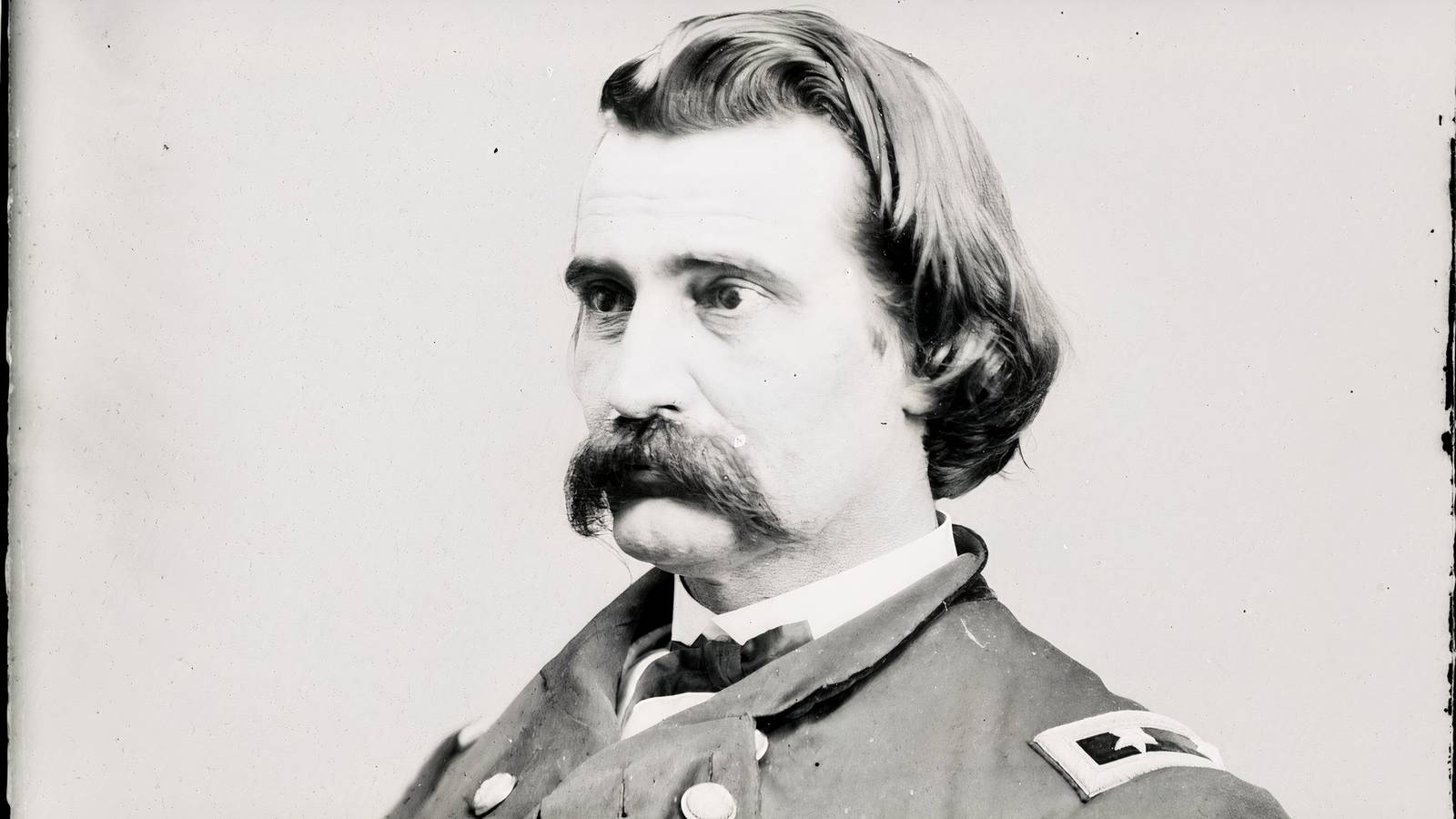
The man who formalized that tradition into a national observance was Maj. Gen. John A. Logan, a Union commander who fought in eight major campaigns, took over an army on the battlefield after its general was killed and went from defending slavery in Congress to voting for the Constitutional amendments that ended it.
He left the war as one of the Union’s most successful generals, but the professional military establishment that passed him over during the conflict largely wrote him out of the history that followed.
A Pro-Slavery Democrat From Illinois
John Alexander Logan was born on Feb. 9, 1826, in what is now Murphysboro, in the pro-slavery region of southern Illinois known as “Little Egypt.” His father, Dr. John Logan, was a physician, farmer and three-term member of the Illinois General Assembly. Many members of the community, including Logan’s father, were Jacksonian Democrats, which influenced his early views on slavery.
Logan later attended Shiloh College, then served briefly in the Mexican-American War without engaging in combat. After the war, he earned a law degree from the University of Louisville in 1851.
He won a seat in the Illinois legislature in 1853, where he authored a bill barring free Black people from settling in the state.
“It was never intended that whites and blacks should stand in equal relation,” Logan said during a debate, according to the National Park Service.
Voters approved the measure by a two-to-one margin, and it became known as “Logan’s Black Law.”
Logan won the election to the U.S. House of Representatives in 1858 with nearly 80% of the vote. He defended the Fugitive Slave Act and aligned himself with Southern Democrats at a time when tensions between the North and South were reaching a breaking point.
But unlike hundreds of officers and politicians who followed their pro-slavery convictions into the Confederacy after Abraham Lincoln’s election, Logan refused to break with the Union.
From Congressman to Combat Commander
Logan was still a sitting congressman when the war started in April 1861. That July, he joined a crowd of politicians and civilians who traveled to Manassas, Virginia, expecting to watch a quick Union victory over the Confederate Army.
The First Battle of Bull Run quickly turned into a disaster, with thousands of Union troops being killed or wounded. The remaining troops and civilians alike were routed, fleeing back to Washington.
Logan, who had promised his wife he would keep a safe distance, picked up a rifle and fought alongside the 2nd Michigan Infantry as a civilian volunteer.
He returned to Illinois and organized the 31st Illinois Volunteer Infantry, which mustered at Cairo in September 1861. The unit later earned the nickname the “Dirty-First” for its aggressive fighting spirit. However, nearly all of the recruits were Democrats from his congressional district.
To preserve their morale, Col. Logan made it clear they were fighting to save the Union, not to abolish slavery. He officially resigned his seat in Congress on April 2, 1862, devoting himself completely to the war.

Seven months after Bull Run, Logan was no longer a spectator. At the Battle of Fort Donelson on Feb. 15, 1862, Confederate forces launched a breakout attempt to escape Gen. Ulysses S. Grant’s siege. The 31st held its ground while other units around it buckled and fled. The unit suffered 260 casualties in a single day, including 58 killed.
Logan was hit multiple times while leading from the front. He took rounds through his left shoulder and right thigh and collapsed on the field. He was so badly wounded that Grant’s headquarters received word he was dead. Upon learning that Logan survived, Grant recommended his promotion to brigadier general.
In January 1863, Lincoln issued the Emancipation Proclamation. Logan had built his entire political career on the argument that Black people were not equal. He had personally promised his recruits that this was not an abolitionist war. Now Lincoln had made it one.
Some of the Democrats Logan had recruited deserted. Logan stayed and urged the others to do the same. He managed to keep the rest of his men in the field and even urged them to accept the enlistment of Black volunteers.

By spring 1863, Logan held the rank of major general and commanded the 3rd Division of the XVII Corps in Grant’s Army of the Tennessee. At the Battle of Raymond on May 12, his troops nearly broke under a surprise Confederate attack. Logan rode along the firing line himself to hold them together. The division recovered and won the engagement.
The 47-day siege of Vicksburg that followed tested Logan and his men even further. He directed operations against Fort Hill, where Union engineers tunneled beneath the Confederate defenses and detonated a mine on June 25. Logan’s troops then poured into the crater and fought hand-to-hand with Confederate troops using grenades and bayonets.
On July 4, 1863, Grant gave Logan the honor of leading the first Union troops into the city after it surrendered. He was appointed military governor and oversaw food distribution to the residents who had been under siege for nearly seven weeks.
Sidelined by Politics, Shaped by War
Logan then took command of the XV Corps in late 1863 and led it into Georgia the following year. On July 22, 1864, Maj. Gen. James B. McPherson was killed by Confederate fire during the Battle of Atlanta. Logan took command of the entire Army of the Tennessee on the field.
When Confederate Gen. Benjamin Cheatham’s corps broke through Logan’s old XV Corps line that afternoon, capturing Union artillery, Logan rallied his troops, rushed reinforcements to the breach and personally directed a counterattack that drove the Confederates back.
Despite Logan’s performance at Atlanta, Maj. Gen. William T. Sherman replaced him a few days later. The job went to Maj. Gen. Oliver O. Howard, who had graduated from West Point before the war. Sherman did not believe volunteer generals belonged in army-level command. The decision fueled a hostility toward the professional officer class that Logan carried for the rest of his life, according to the Army Historical Foundation.

By the fall of 1864, the man who had entered Congress as a pro-slavery Democrat was back in Illinois campaigning for Lincoln’s re-election as a Republican.
When the president was assassinated the following spring, Logan was serving as the final commander of the Army of the Tennessee in Raleigh, North Carolina. When roughly 2,000 enraged Union soldiers marched on the city to burn it in retaliation, Logan confronted them and threatened to open fire. They turned back. North Carolinians credited Logan with saving their capital.
Sherman later arranged for Logan to lead the Army of the Tennessee in the Grand Review down Pennsylvania Avenue on May 24, 1865.
The Man Behind Memorial Day
Logan returned to Congress in 1866, this time as a Republican. After experiencing thousands of deaths on the field of battle and personally witnessing the combat exploits of Black troops under his command, his views on race had flipped. He voted for the Constitutional amendments abolishing slavery and granting citizenship and voting rights to African Americans.
By 1867, the man who had once told the Illinois legislature that Black and white people were never meant to stand as equals was telling audiences, “I don’t care whether a man is black, red, blue, or white … he has the right to say who the men shall be that control the Government,” according to the Mining Gazette.
He served as one of seven House managers who prosecuted the 1868 impeachment trial of President Andrew Johnson, who had vetoed civil rights legislation and clashed with Congress over Reconstruction policy. Logan was among the most aggressive of the managers, arguing that Johnson’s obstruction of Congressional authority warranted removal from office. The Senate fell one vote short of conviction.

Logan also chaired the House Military Affairs Committee and won three elections to the U.S. Senate, where he became one of the chamber’s most influential Republicans. He also authored two books before his death, including “The Great Conspiracy,” a history of the secession movement.
Logan was a founding member and three-term commander-in-chief of the Grand Army of the Republic, the nation’s first major veterans’ organization. On May 5, 1868, he issued General Order No. 11, designating May 30 as a national day of remembrance “for the purpose of strewing with flowers or otherwise decorating the graves of comrades who died in defense of their country during the late rebellion.”
The first national Decoration Day observance took place at Arlington National Cemetery on May 30, 1868. The holiday expanded after World War I to honor all American war dead and became a federal holiday in 1971.
In 1884, Logan ran for vice president alongside James G. Blaine and lost to Grover Cleveland. By 1886, he was widely considered the front-runner for the Republican presidential nomination.
Logan died at his home in Washington on Dec. 26, 1886, from complications of rheumatism. He was only 60. His body lay in state in the Capitol Rotunda, making him just the seventh person in American history to receive that honor.

Frederick Douglass even mourned his passing and called him “a brave man.”
Equestrian statues of Logan stand in Grant Park in Chicago and at Logan Circle in Washington, which Congress renamed from Iowa Circle in his honor in 1930.
His son, John A. Logan Jr., went on to receive the Medal of Honor posthumously for actions during the Philippine-American War. The elder Logan is one of only three people named in the Illinois state song, alongside President Lincoln and Gen. Grant.
Throughout the 1900s, the legend of one of the most successful Civil War generals who also helped establish Memorial Day has largely disappeared from the public memory. But thanks to his efforts, millions of Americans pause every May to honor the fallen service members from American conflicts throughout history.
Read the full article here
6 Comments
Solid analysis. Will be watching this space.
Great insights on Defense. Thanks for sharing!
I’ve been following this closely. Good to see the latest updates.
Good point. Watching closely.
Interesting update on Gen. John A. Logan Gave America Memorial Day. Why He Was Forgotten. Looking forward to seeing how this develops.
This is very helpful information. Appreciate the detailed analysis.