

Listen to the article
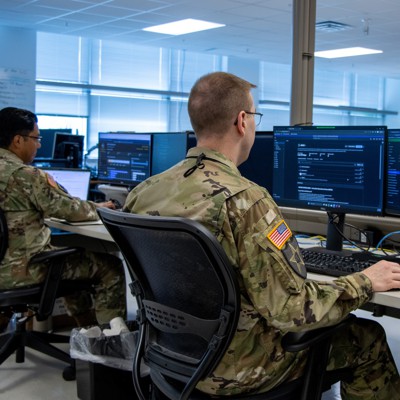
ABERDEEN PROVING GROUND, Maryland—Much has been made of the new systems the Army is bringing online as part of its Continuous Transformation efforts, but getting old systems into shape is also part of the effort. In a small office space at Combat Capabilities Development Command, a group of 25 soldiers and civilian engineers, on loan from local units, is fielding requests from across the service to make its many data systems talk to each other.
The pilot Army Data Operations Center, launched on April 3, is to run until the end of September, when the Army will decide whether and how it will continue. To date, the team has fielded 68 tickets—from next-generation command-and-control testing, to radios for a deploying unit, to behavioral health data for soldiers and families at home.
Maj. Becky Boorbach, a data officer with the 25th Infantry Division, vouched for the ADOC’s work. Part of her job includes prepping for Exercise Balikatan in the Philippines by pulling Air Force-compiled international weather data into soldiers’ C2 screens.
“We made a similar connection last year, predating the ADOC. That connection took us three months to make,” Boorbach told reporters Wednesday.
It went much more smoothly at this year’s Balikatan, she said: “So being able to do this during the exercise and having that connection come online was really critical to be able to work with our joint partners and complete that exercise.”
Fulfilling some requests takes just a few hours, according to ADOC’s dashboard, while the average is about two to three weeks. Most of those delays are caused by waiting on managers to sign off on the administrative permissions to send the data through new channels, the ADOC boss said.
“We do know some of these are long-term Army challenges that we’re tackling now, that will take weeks,” said Brig. Gen. Mike Kaloostian, whose main job is leading the Command and Control Future Capability Directorate at Army Transformation and Training Command.
More urgent requests are fielded through a 24-hour Warrior Engagement Cell, like a request for organizing 82nd Airborne Division radio data as they prepared to deploy for Operation Epic Fury.
So far, ADOC hasn’t had any tickets from troops in combat, Kaloostian said, but they are prepared to field them.
The ADOC is one of several ways the service is trying to open all of its information silos. Right now at Fort Carson, Colo., engineers from a range of defense contractors are in the midst of a “hackathon sprint” to enable data-sharing among their varying systems.
Kaloostian’s team is thinking longer-term.
“I think we can get to that point in our Army’s future, or in the joint force’s future, where you don’t need an organization that’s really doing this, because you’re going to have the automation…that’s going to be doing these connections for us and helping solve, and we won’t need as much human interaction,” he said.
Eventually there may be AI applications that can grant permissions and deconflict data channels, but for now, it requires human beings to straighten out.
“We’re not going to get to that level in the next two to three years,” he said. “So I think this capability is absolutely necessary…and we’ll see—maybe beyond two, three years—where we are at that point.”
Ultimately, ADOC’s goal is to put itself out of business, while NGC2 comes online integrating data to begin with. In the meantime, they’re looking for the funding and permanent staffing to keep the mission going.
“Come 30 September, that’s the last day—then the Army needs to make a decision whether they’re going to pay for the people side of this,” Kaloostian said.
Read the full article here
6 Comments
I’ve been following this closely. Good to see the latest updates.
Interesting update on Army’s data-merging cell needs a few years to untangle the mess. Looking forward to seeing how this develops.
Solid analysis. Will be watching this space.
Good point. Watching closely.
Great insights on Defense. Thanks for sharing!
This is very helpful information. Appreciate the detailed analysis.