

Listen to the article
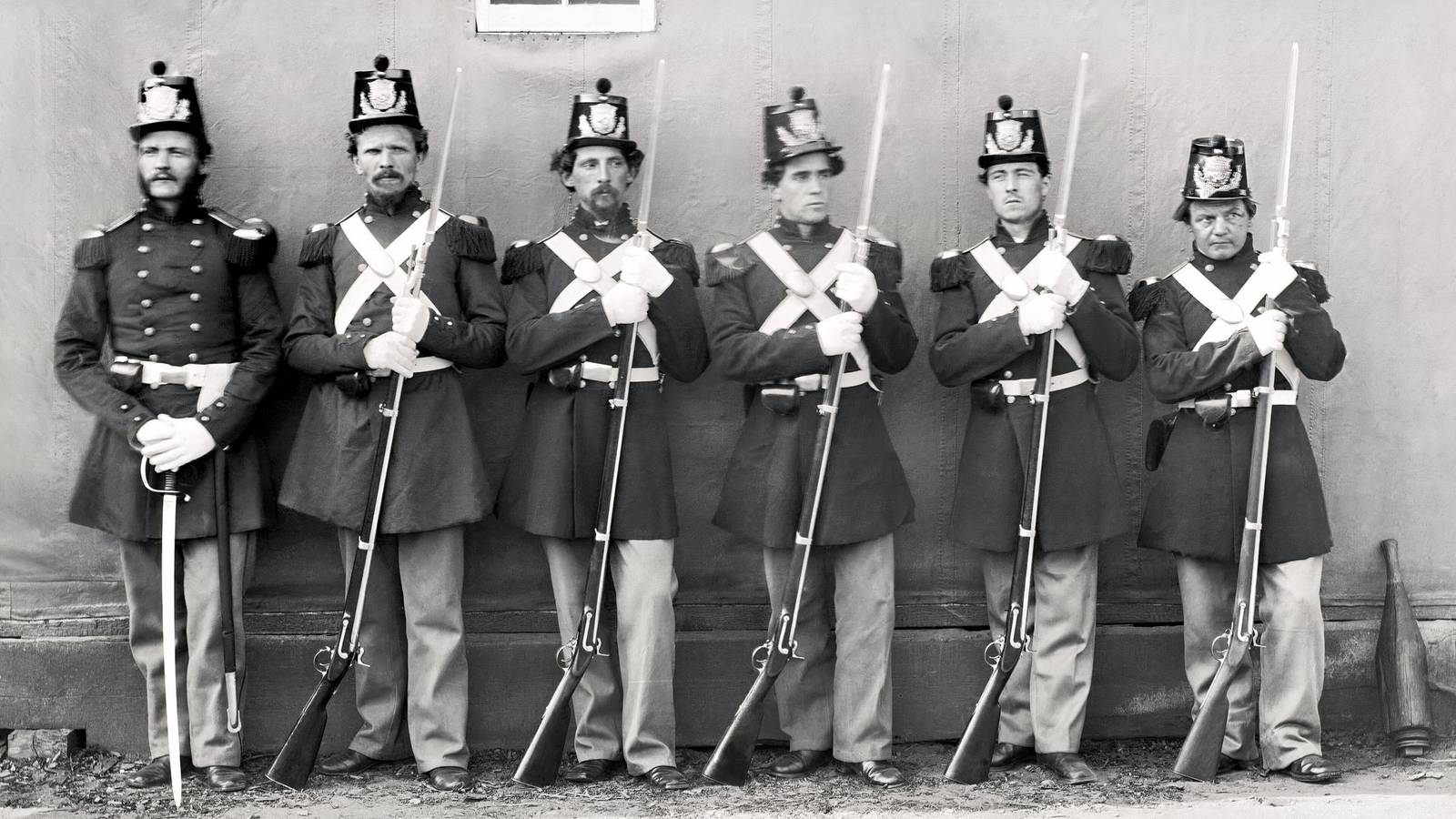
Cpl. John F. Mackie spent the years before the Civil War as a silversmith in New York City. Thirteen months after he enlisted in the Marine Corps, he was aboard the ironclad USS Galena on the James River when Confederate fire killed and wounded the gun crew beside him.
Without waiting for orders, Mackie pulled the casualties aside and got the gun back into the fight, leading a handful of Marines who kept it firing until the ship had run out of ammunition.
That act, in a losing fight at Drewry’s Bluff, made him the first Marine in the nation’s history to receive the Medal of Honor.
He earned it on a ship the Navy itself had serious doubts about. The battle, by most accounts, was the only Civil War engagement pitting the United States Marine Corps against Confederate Marines who had broken away from the ranks.
Mackie Enlists in a Divided Marine Corps
Born in New York City on Oct. 1, 1835, Mackie made his living as a silversmith until the firing on Fort Sumter brought the nation into conflict. He enlisted a few months later at the Brooklyn Navy Yard on April 24, 1861, just 12 days after the first shots were fired in the Civil War. He was only 25.
The Corps that took him in had just been gutted. About 20 of its officers, many of them its most seasoned leaders, had resigned to fight for the South and help build a new Confederate States Marine Corps. The rest of the Marine Corps, under a 68-year-old commandant, Col. John Harris, was spread thin across the U.S. Navy’s ships and posts around the country.
The Confederate Marines set up their training camp on the James River at Drewry’s Bluff, a 90-foot hill the Confederates had fortified and named Fort Darling. By the spring of 1862, the bluff was the last barrier on the river between the Union fleet and Richmond. The Navy’s job was to push past it and link up with Maj. Gen. George B. McClellan’s army, which was advancing on the city from the east.
On May 11, the Confederates scuttled their ironclad, the CSS Virginia, rather than let her be captured. Her crew came ashore to the bluff and joined the soldiers and Confederate Marines already working the guns and rifle pits above the water.
The Galena Fights Fort Darling Alone
Cmdr. John Rodgers brought five warships up the James on the morning of May 15, 1862. His flagship, the Galena, was one of the U.S. Navy’s first three ironclads. Rodgers felt the ship’s thin armor was a major detriment, while its crew and combat capabilities were still untested. Behind her was the famous Monitor, the experimental Naugatuck and two wooden gunboats, the Port Royal and the Aroostook.
The squadron found the river blocked with sunken hulls below the fort. The Monitor could not raise her guns high enough to reach the heights and dropped back. The Naugatuck’s main gun exploded at the start of the engagement and put her out of the fight. The two wooden gunboats were driven off by Confederate fire. That left the Galena to take on Fort Darling largely alone while anchored about 600 yards out.
For close to three hours, the Confederate gunners pounded the Galena, the largest target in the narrow channel. They hit her 28 times, but her armor stopped just 10 of them. The rest punched through, knocking out weapons and crew alike.
Mackie was a corporal in the Galena’s Marine guard. He kept firing his musket at the Confederate rifle pits along the riverbank. When enemy fire cut down the crew of one of the ship’s guns, he stepped in.
Acting on his own, he cleared the casualties away, scattered sand across the deck to keep his footing and rallied about a dozen Marines to keep the gun firing. Their first shot managed to knock out one of the Confederate cannons. With ammunition running low, Mackie and the other Marines went back to firing their muskets to keep Confederate forces pinned down.

By late morning, the Galena had fired off her last rounds and suffered about 13 of her crew dead and 11 wounded. Rodgers called off the attack and took his ships back down the river.
Rodgers and his officers came away convinced that a fort on high ground like Drewry’s Bluff could not be leveled by ships alone and that only the Union Army could take it in a ground assault. With that, Richmond remained in Confederate hands until the end of the war. The Confederates held the fort against a second Union attack in 1864, though it finally surrendered when the city fell in April 1865.
Word of the Galena’s fight reached President Abraham Lincoln. According to the Congressional Medal of Honor Society, Lincoln and Navy Secretary Gideon Welles boarded the battered ship at Harrison’s Landing on July 8, 1862. Lincoln then ordered that three of her crew, including Mackie, be promoted and awarded the Medal of Honor. By that account, it was the only time a president has ever personally recommended individual troops for the medal.
Mackie’s Later Life and Legacy
The medal was not authorized until the following year, on July 10, 1863. By then, Mackie was a sergeant, posted to the Norfolk Navy Yard and later the USS Seminole. By the Marine Corps History Division’s account, Cmdr. Henry Rolando presented the award to Mackie aboard the Seminole while it served near Sabine Pass, Texas, in the fall of 1863.
Commodore Percival Drayton later told Mackie, “Sergeant, I would give a stripe off my sleeves to get one of those in the manner as you got that.”
Mackie was nearly killed a few months later when a riot erupted at Sabine Pass in January 1864. He was helping to put it down when one of the rioters, a ship’s fireman, swung a chain hook into his skull and fractured it.

After four years and four months of service, Mackie returned to civilian life with his discharge from the Boston Navy Yard on Aug. 23, 1865. He later married and settled near Philadelphia, where he joined the Grand Army of the Republic, the fraternal order of Union veterans.
Mackie died on June 18, 1910, at the age of 74. He is buried alongside his wife, Hannah Rosalba, at Arlington Cemetery in Drexel Hill, Pa., a small private burial ground outside Philadelphia with no connection to Arlington National Cemetery. Their graves are in the Melrose section.
Mackie was the first of 17 Marines to earn the Medal of Honor before the Civil War ended. Hundreds have followed in the wars since. At Drewry’s Bluff, now part of Richmond National Battlefield Park, a marker records the heroic actions he performed on the Galena’s deck that day.
One of Fort Darling’s old guns still overlooks the bend in the James where Confederate gunners turned the Union fleet back and where the first U.S. Marine earned the Medal of Honor.
Read the full article here
6 Comments
Great insights on Defense. Thanks for sharing!
This is very helpful information. Appreciate the detailed analysis.
Good point. Watching closely.
Solid analysis. Will be watching this space.
Interesting update on How the First Marine Ever Awarded the Medal of Honor Earned It in the Civil War. Looking forward to seeing how this develops.
I’ve been following this closely. Good to see the latest updates.