

Listen to the article
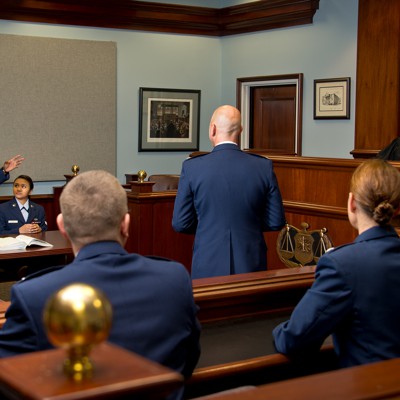
House Republicans axed a provision to the annual defense policy bill that would have ended the Trump administration’s practice of using the military’s uniformed lawyers from serving as immigration judges and special U.S. attorneys in Democrat-run cities.
Rep. Jason Crow, D-Colo, proposed the amendment during the House Armed Service Committee’s markup of the National Defense Authorization Act on Thursday afternoon. The provision would have amended U.S. law to clarify that the judge advocate generals corps could only be assigned to military-related duties. Republican lawmakers, including HASC Chairman Mike Rogers, ultimately batted down the provision in a 31-26 vote, according to the committee’s website. It’s not clear if a similar provision is being debated in the Senate.
“Our JAGs advise commanders in some of the most consequential decisions our military makes, from combat operations, to targeting authorities, to rules of engagement, military justice, personnel matters, and international law,” Crow said. “They are a limited and specialized resource. Their time should be focused on matters that directly affect military operations, unit cohesion, command authority, and mission effectiveness. Assigning them elsewhere takes them away from this critical military work, especially in a time as is as much conflict as we are seeing right now.”
Former uniformed attorneys told Defense One that the amendment would’ve relieved overworked military lawyers. Under the Trump administration, JAGs have been assigned to oversee immigration courts, appointed as special U.S. attorneys to investigate “fraud and abuse” in Minneapolis, and prosecuted violent crimes during domestic National Guard deployments. This year, Defense Secretary Pete Hegseth has scrutinized the JAG corps with a series of wide-ranging reforms and has fired the military’s top lawyers and trimmed the civilian legal staff.
Rogers, R-Ala., defended the administration’s unprecedented use of the military’s lawyers.
“This is a direct attack on the administration, which has used judge advocates in multiple ways to protect national security priorities for the president. Judge advocates have served as special assistants to U.S. attorneys for years,” he said. “That role has been expanded in the current administration to assist other agencies in defense of the homeland national security priority, and great experience and training for our uniformed officers. I trust that the Secretary of Defense, with the help of the Joint Staff, may deploy judge advocates across the United States and the world to ensure the rule of law is followed.”
Rep. Pat Fallon, R-Texas, also criticized the provision, saying Hegseth “has determined that the homeland mission is essential” and that the extra lawyers are crucial to it.
“The National Security Strategy places a great deal of emphasis on homeland defense, and in order to meet these needs, an increase in attorneys has been needed to litigate in U.S. courts and aid in the administrative hearings across the Department of Justice and Homeland,” Fallon said. “Our uniformed attorneys have the ability to surge into positions when the country needs them.”
Military legal experts have previously told Defense One that there is precedent for uniformed lawyers to prosecute U.S. citizens, but the Trump administration’s wide-spread use of the JAGs has raised fears that it could violate the Posse Comitatus Act which forbids the military to be used for federal law enforcement.
Steve Lepper, a retired Air Force lawyer and a member of a group of former JAGs that has spoken out about the administration’s legal actions, said he wasn’t surprised that the amendment wasn’t passed by the committee.
“I think it’s basically restoration of the limits that posse comitatus places on the military,” Lepper said. “When you come right down to it, using the military in a prosecutorial or judicial capacity for cases that have nothing to do with the military is basically a violation of posse comitatus.”
Aaron Brynildson, a University of Mississippi law professor and retired Air Force JAG, also said that uniformed lawyers should be focused on military-related missions when serving as special U.S. attorneys
“Having been previously appointed as a SAUSA while on active duty, the sole reason JAGs should be detailed to these positions is to prosecute civilians committing criminal offenses on military bases. JAGs should not be used to prosecute immigration crimes or as fill-ins for overburdened federal prosecutors.”
Brynildson and Lepper said that the wide-ranging use of the JAGs appears to be at odds with Hegseth’s complaint in March that “military lawyers are sometimes stuck doing civilian side work.”
“What Mr. Crow offered was basically a way to achieve what Hegseth said he wants, which is JAGs to do JAG jobs,” Lepper said. “In this case, I guess the majority in the House Armed Services Committee felt that JAGs should be used for things other than what they are in the military to do.”
Read the full article here
5 Comments
Great insights on Defense. Thanks for sharing!
Interesting update on GOP lawmakers axe provision to limit the use of JAGs in civilian roles. Looking forward to seeing how this develops.
Good point. Watching closely.
This is very helpful information. Appreciate the detailed analysis.
Solid analysis. Will be watching this space.