

Listen to the article
At an age when many people step away from demanding careers, U.S. Navy Lt. Cdr. David Westerberg chose the opposite route.
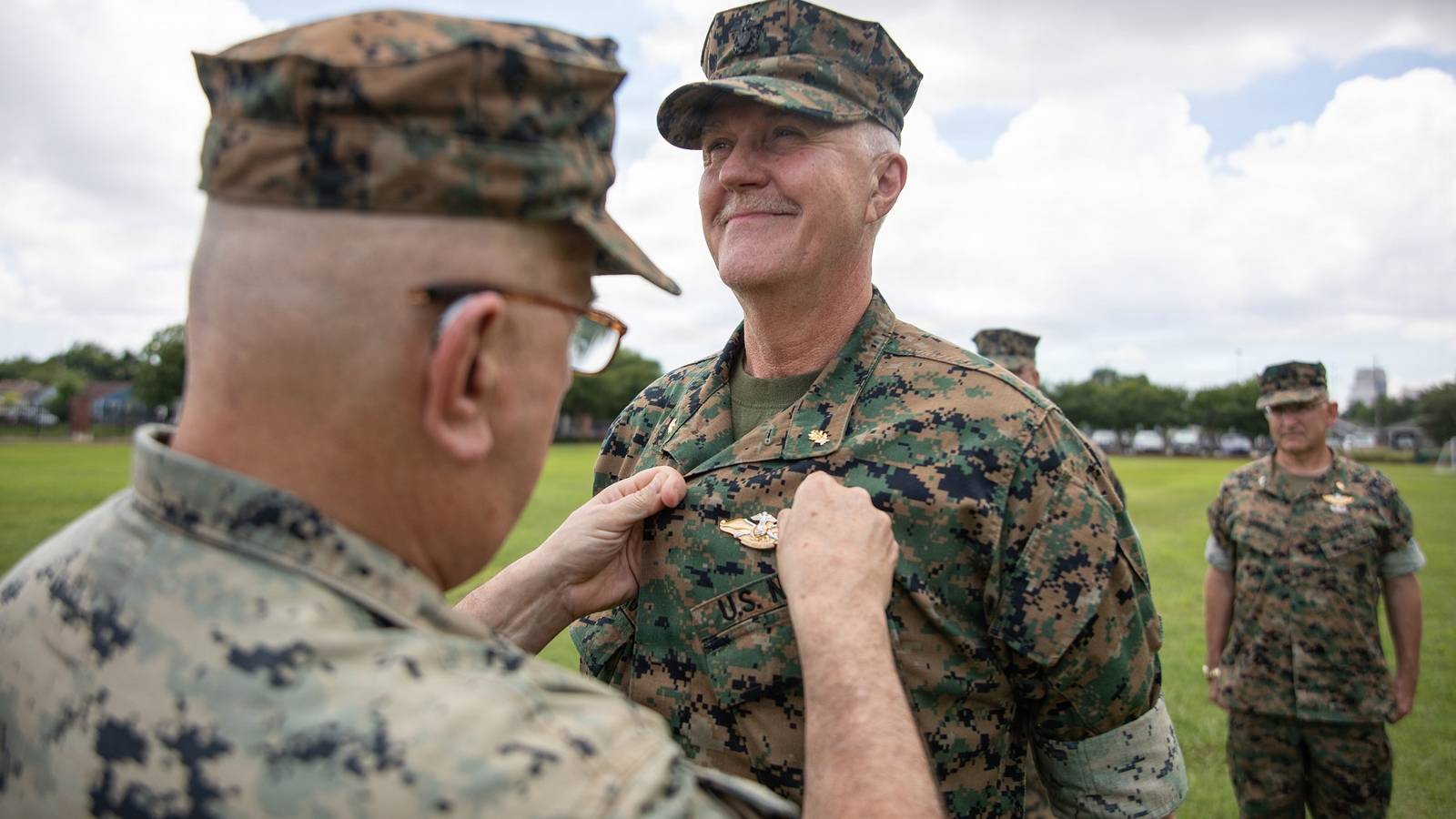
The dentist with Marine Forces Reserve earned the Fleet Marine Forces (FMF) qualification insignia pin on June 11 at Marine Force Support Facility New Orleans. At age 67, the service said he is the oldest sailor on record to ever receive it.
Westerberg had already built a 38-year career as a civilian dentist in Southern California, according to a press release. Retirement did not appeal to him.
In 2022, at age 64, he was commissioned as a Navy officer. His son’s graduation from Officer Development School provided the spark. One year later, the father who had pinned his son in a private ceremony stood on the graduation field himself as a newly commissioned officer.
A Dentist’s Path to Marine Forces Reserve
Westerberg’s assignment took him to 4th Dental Battalion, a unit that provides dental care to Marines in the reserve component. The move placed him in daily contact with the very Marines whose culture and mission he would soon study in depth.
The decision to pursue his FMF pin carried practical weight in his assignment. As a dentist treating Marines, Westerberg wanted to understand the demands they face and the environment for which they train. The FMF qualification offered a structured way to gain that perspective.
His wife of more than 40 years, Kim Westerberg, stood beside him through months of study and preparation, according to the service. She said that “he’s always been the one to embrace a challenge.”
Once I understood his reasons, I knew it was a journey worth supporting.
She watched him rise early and give up weekends to the material.
“He is very determined once he has an idea to do something,” she added. “He always puts his mind to it. Watching the process, it showed how committed he is.”
The June 11 Pinning Ceremony
Westerberg received the pin during a June 11 ceremony at Marine Force Support Facility New Orleans. The moment marked the end of a deliberate qualification process and the beginning of a clearer view into Marine Corps life.
U.S. Navy Capt. Robert Reeves, force dental officer and interim director for health services support at Marine Forces Reserve, served as a mentor during the effort. He described the impact of having someone like Westerberg in such a capacity.
I’m always encouraging my sisters and brothers to raise their hand. I knew that Westerberg never looked at his age as a limitation. Every opportunity that came up, he was the first one willing to step forward.
Westerberg also described the personal payoff in his own remarks.
“Through the FMF qualification, I was able to understand the Marines and encourage them in a more meaningful way,” he said. “Especially helping as their dental care provider.”
FMF Insignia: History and Requirements
The FMF insignia, commonly called the FMF pin, recognizes Navy personnel who serve with Marine units and master the knowledge required to operate effectively alongside them.
It exists in both enlisted and officer versions and carries the same core values of honor, courage, and commitment that define the Navy-Marine Corps team.
The insignia builds on decades of close operational partnership. An FMF Ribbon was first authorized in the 1980s. Later, modern warfare insignia programs for enlisted sailors and officers took shape in the early and mid-2000s through Navy instructions. The devices formally acknowledge the additional skills and understanding gained while embedded with Marine commands.

For a Navy officer, earning the pin typically requires a period of service with a Marine unit, completion of a written examination on Marine Corps history, organization, customs and warfighting doctrine, passage of the Marine physical fitness test, demonstration of practical skills such as weapons handling and land navigation, and an oral board conducted by already-qualified personnel.
The process also demands both academic study and hands-on proficiency.
Medical officers, dentists, chaplains and other support specialists most commonly pursue the qualification because their roles place them directly with Marine units in the garrison and in the field.
‘Take That Step’
Westerberg said the pin gave him a broader frame of reference for the Marines in his care.
“The FMF pin helped me see beyond the dental chair—where my Marines are going and what they’re preparing for,” he said. “That made me better.”

The knowledge translates into more informed conversations, better anticipation of operational stressors, and a stronger sense of shared purpose. For a provider whose patients are preparing for the same missions and hardships as the Marines around them, that perspective matters.
Westerberg is scheduled to leave the Navy later this year, yet he continues to look for ways to serve. His message to others is straightforward.
“I would encourage anyone to better themselves and always strive to do a step up from what your comfort level is,” he said. “Be uncomfortable and take that step.”
Read the full article here
6 Comments
Solid analysis. Will be watching this space.
Interesting update on US Navy Dentist, 67, Becomes Oldest Fleet Marine Forces Pin Recipient. Looking forward to seeing how this develops.
Good point. Watching closely.
This is very helpful information. Appreciate the detailed analysis.
I’ve been following this closely. Good to see the latest updates.
Great insights on Defense. Thanks for sharing!