

Listen to the article
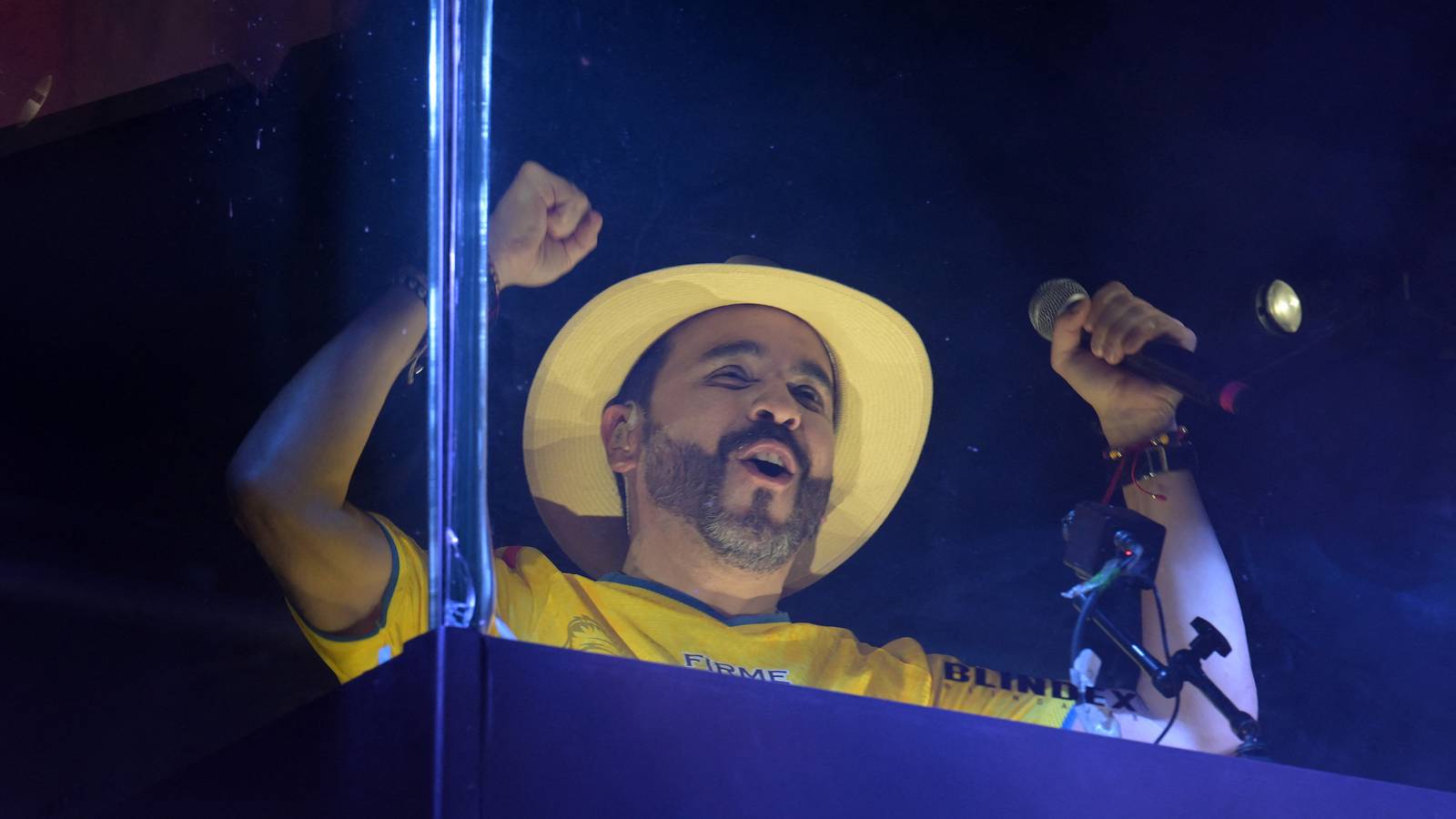
In a victory speech delivered from behind a bulletproof screen, on a barge in a Caribbean river estuary, Abelardo de la Espriella vowed to hunt down Colombia’s worst criminals.
“Here is a tiger who defends the law with claws and teeth,” he told cheering supporters last month in Barranquilla, many dressed like him in the national soccer shirt. “We deserve a Colombia in which bandits are in prison.”
De la Espriella is now the heavy favorite to be Colombia’s next president after a first-round vote in which he unexpectedly beat a leftist protégé of President Gustavo Petro. In a campaign marked by showmanship and provocations, voters rallied behind his plans to fight corruption and build mega-prisons for drug traffickers, which also helped win him an endorsement from Donald Trump. Some were also attracted by his pledges to slash taxes and government spending.
Colombians, accustomed to decades of on-again, off-again peace talks with illegal groups, are fed up with a recent surge in violence as armed factions expand into new territory, fueled by record cocaine production.
De la Espriella’s support reflects voters’ exhaustion with talks to appease the gangs, a desire to see them annihilated militarily and a bet that a political outsider is the best hope to change the system, according to Sandra Borda, a professor at Bogota’s Universidad de los Andes.
“This country swings between seeking peace talks due to a terrible fatigue with the war, and then seeking war due to an infinite tiredness with peace talks,” she said.
De la Espriella’s opponent in the June 21 runoff, Iván Cepeda, is one of the architects of President Gustavo Petro’s “Total Peace” strategy. It’s brought seven militias to the negotiating table, though so far failed to bring significant demobilizations. Term limits mean Petro can’t run again, but Cepeda wants to continue talks with the groups.
De la Espriella says he wants the military to bomb them into oblivion.
Investors’ pick
Investors favor a De la Espriella presidency. The nation’s stocks, bonds and currency soared after the candidate won a record 10.4 million votes in the first round. Money managers have warned that Cepeda’s proposals would run up debt and fan inflation.
One of De la Espriella’s first priorities would be to unwind Petro’s environmental agenda and reopen the Andean nation to oil exploration and fracking, according to José Manuel Restrepo, his running mate.
Cepeda, who has praised Cuba’s former leader Fidel Castro and Venezuela’s Hugo Chávez, would ban fracking, raise taxes on the wealthy and redistribute land to poor farmers. He’s argued that the fiscal deficit must be solved by fighting corruption, and that revenue from state oil producer Ecopetrol can help finance his reforms.
Ángel Beccassino, an Argentine political strategist who wrote a biography of De la Espriella, said he’s likely to implement economic policies similar to those adopted by Argentina’s Javier Milei, a libertarian at the forefront of a conservative political movement in Latin America.
De la Espriella joins a group of Latin American populists who have aligned with Trump — Jair Bolsonaro in Brazil, who was convicted over a coup plot; El Salvador’s Nayib Bukele; and Ecuador’s Daniel Noboa. Some, like De la Espriella, adopt a style that is often coarse or provocative.
La Dolce Vita
De la Espriella, who refers to himself as “the tiger,” embraces his status as an outsider, and dresses the part. He often appears wearing brightly colored jackets, pocket squares, sunglasses and a fedora, a strikingly different look from the sober style of Cepeda and most other Colombian politicians.
His fashion and lifestyle website, De la Espriella Style, celebrates “la Dolce Vita and good taste.” It doubles as a sales platform for $100 bottles of rum, $55 bottles of wine and men’s shirts, jackets, ties and scarves similar in style to the candidate’s garb. Also on offer are tiger-head sculptures, a $6,000 watch and albums of him singing Italian classics such as O Sole Mio.
His boorish behavior is a relatively new phenomenon in Colombia, which is a socially conservative nation compared to its neighbors.
Last month, he apologized for causing offense when he showed a female reporter a photo of himself with a bulge in his trousers.
During the campaign, he sometimes struggled to control his temper in interviews. Opponents have circulated an old clip in which he reminisces about having tortured cats when he was a boy.
However, voters’ support for his hardline security stance may ultimately be the election’s deciding factor.
Legal career
De la Espriella, 47, comes from a wealthy family on Colombia’s Caribbean coast, and achieved fame as an attorney in high-profile cases.
Among his best-known clients was Alex Saab, a businessman and close ally of the Venezuelan regime, who was extradited to the U.S. last month to face money laundering charges.
De la Espriella also represented Natalia Paris, one of Colombia’s most famous models; David Murcia, who was sentenced to prison in the U.S. for money laundering; and Dania Londoño, the woman at the center of the 2012 scandal in which Secret Service agents consorted with prostitutes in Cartagena ahead of a visit to the city by U.S. President Barack Obama.
He also defended politicians accused of links to cocaine-trafficking militias of the kind he now wants to round up in jails.
“From a young age, he had access to the media and a taste for notoriety,” Beccassino, his biographer, said.
Early in his career, when he was still in his 20s, De la Espriella founded a nonprofit that was involved in the peace process between far-right paramilitary factions and the government of Álvaro Uribe.
This brought him into contact with some of Colombia’s most dangerous people, including several classified as terrorists by the U.S. In December 2005, for example, he attended a dinner near the mining town of Remedios with “Macaco,” the alias of a man who was then a contender to be Colombia’s biggest cocaine trafficker, and two other warlords, known as Julián Bolívar and Ramón Mojana.
Some civilians were also present, including the government’s chief peace negotiator, as well as one journalist.
The following day, Macaco oversaw the demobilization of almost 2,000 fighters.
When challenged about his relationship with people who were later extradited to the U.S. on drug charges, De la Espriella has consistently maintained that his contact with such people was rooted in his involvement in the peace process.
Still, critics have used it to question his tough-on-crime posture. Cepeda is seeking to have him prosecuted by both local authorities and the International Criminal Court for alleged crimes including “financing terrorism.”
In a post on X, De la Espriella dismissed Cepeda’s allegations as a “smoke screen.” The campaign didn’t reply to additional written requests for comment about his presence at the event in Remedios or his role in the peace process with the paramilitaries.
Colombian voters have never faced a starker choice than they have this month: whether to extend Petro’s leftist policies under Cepeda, or take the nation in a dramatically different direction with De la Espriella.
“The center of the dispute is continuity or change,” said Sergio Guzmán, director of the geopolitical consulting group Colombia Risk Analysis. “The health care system, the implementation of Petro’s Total Peace plan and the future of the economic system” are all at stake.
—With assistance from Philip Sanders.
___
©2026 Bloomberg L.P. Visit bloomberg.com. Distributed by Tribune Content Agency, LLC.
Read the full article here
6 Comments
I’ve been following this closely. Good to see the latest updates.
Solid analysis. Will be watching this space.
Interesting update on Trump Ally Vowing Death to Cartels Closes in on Colombia Presidency. Looking forward to seeing how this develops.
Good point. Watching closely.
This is very helpful information. Appreciate the detailed analysis.
Great insights on Defense. Thanks for sharing!