

Listen to the article
As the Navy continues to move forward with plans to reopen its Red Hill well and reconnect it to its Oahu water system five years after it was contaminated with jet fuel, the service faces ongoing skepticism over its insistence the water will be safe to drink.
The Navy released its environmental assessment for its planned Red Hill Water Treatment Facility this month with a “finding of no significant impact” for the project — or FONSI — issued May 26 by Rear Adm. B.J. Collins, commander of Navy Region Hawaii.
The FONSI said that reconnecting the Red Hill water shaft will “restore it as a drinking water source to provide adequate resiliency and redundancy to the Navy’s drinking water system for consumers and multiple Department of War operations at Joint Base Pearl Harbor-Hickam.”
The Navy has been relying solely on its Waiawa Shaft since the closures of the Red Hill and Aiea-Halawa shafts, the latter of which was closed as a precaution after the Red Hill Shaft was contaminated. The state Department of Health has warned it is unsafe to rely on a single source of drinking water, and the Navy is working toward reopening both.
But years after the fuel contamination crisis that led to their closure, for many it’s still hard to take the Navy at its word that it can safely reopen the affected wells.
Eva Davis, a retired hydrologist who spent nearly 35 years with the U.S. Environmental Protection Agency before leaving last year, told the Honolulu Star-Advertiser: “What I have seen for myself when looking at the water data is that the Navy is not being honest about this.”
Mandy Feindt, an Army officer who lived on Ford Island with her family at the time of the contamination, echoed that mistrust. “The reality is that many families simply do not trust the Navy,” she said. “They lied to the community, downplayed the significance of the contamination and spent years dismissing the concerns of impacted residents.
“Parents of sick children have not forgotten that.”
The quality of the drinking water in the Navy’s Oahu system has continued to be a hot-button issue. For years after the contamination crisis, some residents on the waterline have reported mysterious ailments they insist are tied to the water pouring from their faucets, and at various times tests have come back showing contamination.
“Even now, families continue to report concerns about their water while many longstanding questions about infrastructure, testing protocols, health monitoring and accountability remain unanswered,” Feindt said. “Many affected families still have significant unanswered questions regarding the long-term health implications of the contamination, the adequacy of testing and monitoring, and the data being used to support this decision.”
Navy officials say those concerns are overblown and blame misinformation. In many cases, they have also done follow-up tests and said many detections of contaminants were either false alarms or weren’t the result of fuel spills.
But Davis said, “There’s too many times when there is a detection, it’s legitimate, and if they want to say that it’s not jet fuel, then they need to say what it is. If it shows up on a (total petroleum hydrocarbons) analysis, it’s probably not something you want in drinking water.”
The navy built its massive underground Red Hill fuel farm during World War II to protect its fuel reserves from enemy attacks. But it was built just 100 feet above a critical aquifer.
The facility also was co-located with the Red Hill well, the main water source for the Navy’s Oahu water system that serves 93,000 people, including service members, military families and civilians living in former military housing areas, along with several schools and businesses.
For years, the Navy waved off concerns that storing fuel above a vital source of potable water threatened the island’s water supply, insisting the facility was critical to national security and was well maintained enough to prevent major leaks.
After a May 6, 2021, spill, jet fuel entered a drain that was part of the facility’s fire suppression line, and on Nov. 20, 2021, a worker at the facility accidentally ruptured the line, spilling the fuel into a tunnel. The accident was not reported to regulators or the public. The fuel entered the well and was pumped into the water system.
Navy officials smelled fuel at the site of the spill but chose not to inform state officials or the public. Residents began complaining a week later about fuel and chemical odors in their household water.
At the time, Navy officials insisted there was no reason to believe there was anything wrong with the water. The Navy ultimately shut down the Red Hill Shaft on Nov. 28, 2021, but Navy officials didn’t publicly acknowledge the spill until Dec. 2, 2021.
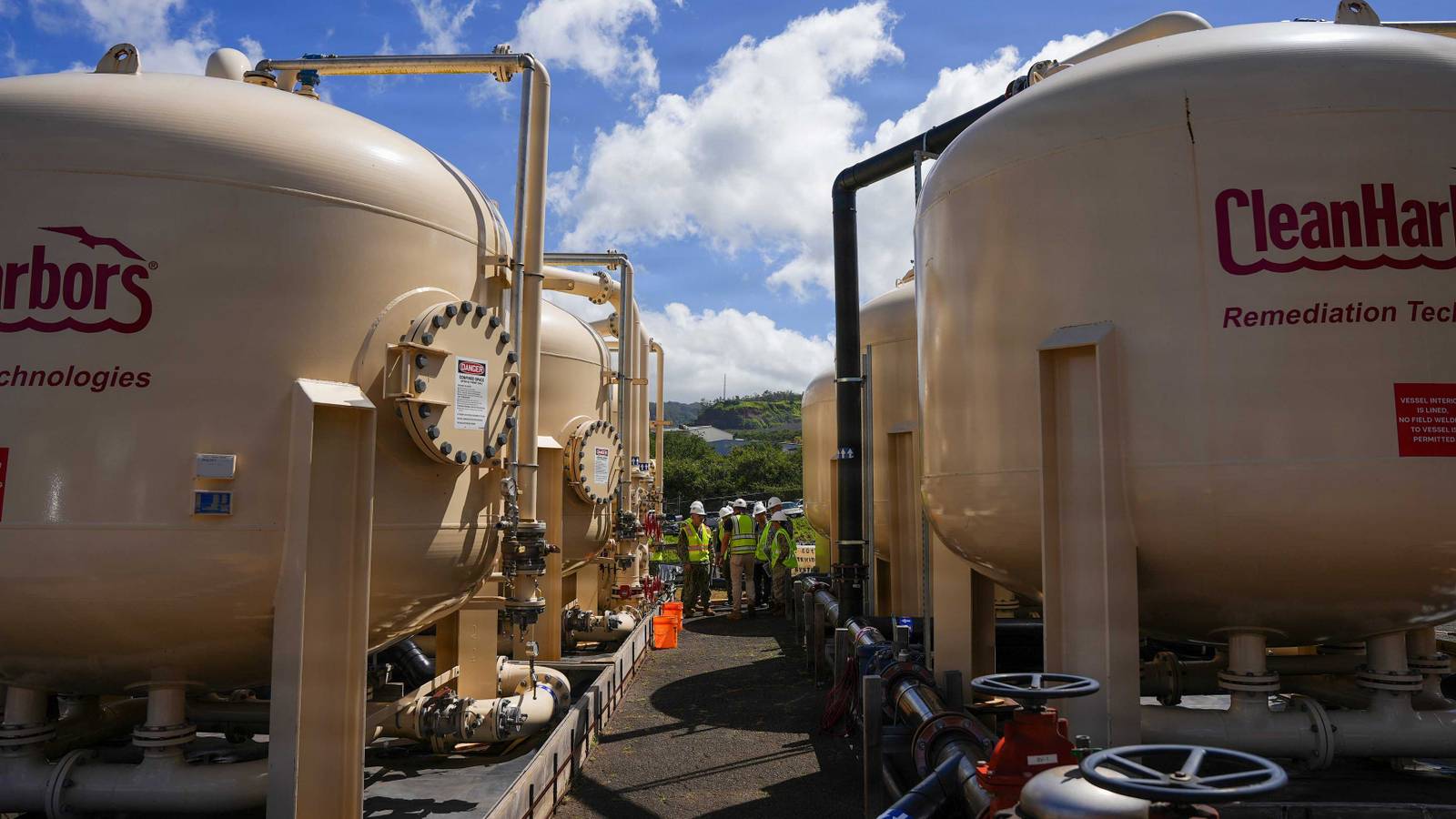
After acknowledging the spill, the Navy began treating water from the Red Hill Shaft using an onsite granular activated carbon (GAC) water treatment system and discharging that water into Halawa Stream.
Its new plan is to build a permanent onsite GAC water treatment system, associated utilities, infrastructure and site improvements and put it back into the drinking water system.
Among Davis’s concerns is that based on her experience with the EPA, she argues that much of the testing and proposed solutions the Navy is putting forward are related to heavily contaminated water sources — not those intended for human consumption.
She said “to a certain extent, when they say the total petroleum hydrocarbons, which is kind of their main screening here, that’s not supposed to be a drinking water analysis,” and that from her experience “GAC removes water to make it safe enough to discharge, not drink.”
The Navy, for its part, has defended its methods and insists the EPA has determined that GAC can effectively remove fuel oil from water.
In a statement, the Health Department said that while the Navy is making its way through the National Environmental Policy Act process required by federal law, it also needs to satisfy state regulations, including a review of the planned water treatment plant by the DOH Drinking Water Branch.
“To date, a formal written request to the Department to reactivate Red Hill Shaft for drinking water purposes has not been made,” the agency said. “If such a request is made, the Department’s position would be grounded strictly in science and public health. Water treatment is a proven, safe method to restore non-compliant water resources.”
However, DOH also said “the Navy will not receive permission to put treated water from its Red Hill Shaft back into circulation until it has completed exhaustive pilot testing, established robust inline monitoring systems, and satisfied every criterion of the DOH’s stringent conditional approval process.”
© 2026 The Honolulu Star-Advertiser. Visit www.staradvertiser.com. Distributed by Tribune Content Agency, LLC.
Read the full article here
6 Comments
Solid analysis. Will be watching this space.
This is very helpful information. Appreciate the detailed analysis.
Great insights on Defense. Thanks for sharing!
Good point. Watching closely.
I’ve been following this closely. Good to see the latest updates.
Interesting update on Distrust, Uncertainty as Navy Moves to Reopen Red Hill Well. Looking forward to seeing how this develops.