

Listen to the article
The United States’ third-largest police force has let its contract with Flock Safety expire.
On July 11, the Los Angeles Police Department (LAPD)—which, until recently, was one of Flock’s largest government customers—walked away from their contract. They cited that it wasn’t about cost; rather, they walked away due to data ownership.
“This contract is not being renewed because of serious concerns around civil liberties and civil rights issues, particularly around privacy and the data that is being collected from these cameras,” Dean Gialamas, the department’s chief information officer, told ABC7 after the decision was made public.
The LAPD will stay out, Gialamas said, until questions about data, privacy, security and sharing could be “ironed out through a contractual relationship.”
Flock’s position on data has been that the data belongs to the agencies.
“Our customers own the data, not Flock,” the company’s chief communications officer, Josh Thomas, told Government Technology.
The LAPD is not the first entity to distance itself from this specific technology. Between August 2021 and May 2026, 82 Flock contracts were terminated across 28 states, according to reporting by the San Francisco Standard. Thirty-nine of those came in the first five months of 2026 alone.
The cities of Mountain View, Calif., and South Portland, Maine, ditched their contracts, as did Bloomington, Ind.—which let its contract expire in March. Cleveland City Council is expected to vote this week on whether to keep its 100 cameras.
In Suffolk, Va., an Air Force engineer faces 25 criminal counts for allegedly taking 13 of the cameras down with a saw.
Jeffrey Sovern, 41, described by his defense attorney as an engineer and mechanic in the U.S. Air Force, has pleaded not guilty to 13 felony counts of destruction of property, six counts of petit larceny, and six counts of possession of burglary tools.
Sovern is alleged to have spent six months working his way through the surveillance cameras in his city, taking them apart on their poles and even throwing some from an overpass onto Interstate 664, watching them shatter on the pavement below. He told a detective they violated the Fourth Amendment.
A judge certified all charges in late June. Sovern told a detective the cameras were unconstitutional, according to testimony, while strangers have donated more than $15,000 to his defense fund.
What Flock Cameras Do
A Flock camera is not a red-light camera or a speed trap.
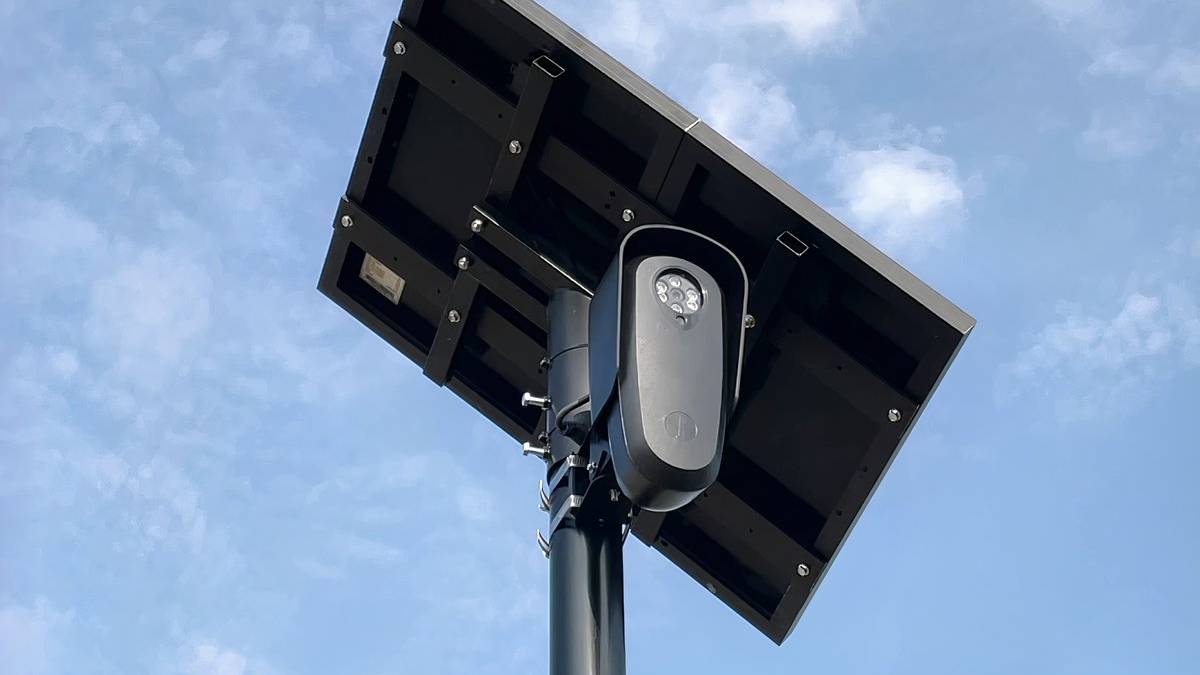
It is a solar-powered automated license plate reader (ALPR) mounted on a pole roughly 10 to 15 feet high that photographs every vehicle that passes. Its software does not only read the plate but Flock’s “Vehicle Fingerprint” system logs make, color, roof racks, bumper stickers, and even body damage.
Afterward, it converts all of it to searchable metadata and uploads it to a central database where records are held for 30 days by default. Every single plate is cross-checked against law-enforcement hotlists, and any match triggers an alert to a patrol car within seconds.

The company said it now has more than 12,000 clients, including over 5,000 law enforcement agencies. Through Flock’s network, agencies can search one another’s data across jurisdictions.
That last feature is what’s causing such fiery pushback.
In August 2025, an audit by Illinois Secretary of State Alexi Giannoulias found that U.S. Customs and Border Protection had gained access to the state’s Flock data despite a state law barring the use of plate data for immigration enforcement.
Reporting on the audit indicated Flock’s own leadership had been unaware of the federal pilot program running on its own network. The company paused the pilots after being made aware.
Nine Officers Fired in 30 Days
A second issue is arising, and it’s coming from inside the police departments themselves.
On July 6, the Georgia Bureau of Investigation arrested five Albany officers on similar allegations. Three Cherokee County deputies were charged last month.
One day later, Greene County, Ga., Deputy Quin’sha Goss was arrested and fired after an audit found that she had accessed Flock without law-enforcement justification over a three-month period. She is charged with violating her oath of office and with violating Georgia’s restrictions on retaining ALPR data.
That translates to nine officers in roughly 30 days, in just one state.
Flock’s response to the Georgia arrests is that the arrests are the system doing its job. Co-founder Paige Todd told FOX 5 Atlanta that many of them stemmed from a new Flock audit tool that automatically flags unusual searches, and that “the technology itself was not creating the misuse. It was human beings.”
Flock does not dispute that misuse happens, however. Chief Legal Officer Dan Haley told The Bulwark that when it does happen, it is rarely elaborate.
Officers using the system “to figure out where an ex-girlfriend is,” he said, is “actually the most common thing.” The Institute for Justice has counted at least 21 documented cases of officers using plate readers to track romantic interests.

Other searches have been trickier to explain.
In Johnson County, Texas, a sheriff’s deputy ran a nationwide query across more than 83,000 cameras, logging the reason as a search for a woman who “had an abortion.”
The office would go on to say it was a welfare check tied to a death investigation. The Electronic Frontier Foundation subsequently published court records supporting that a case was open.
Not a Neutral Test Case
In January, three Christopher Newport University professors published a study using the locations of 614 Hampton Roads Flock cameras, unsealed as evidence in the Norfolk lawsuit. They would map out the cameras against census tracts.
Majority-Black areas had roughly four times as many cameras as majority-white ones. In the most segregated tracts, geography professor Johnny Finn found, the disparity approached eight times their share of the population.

Of the ten Hampton Roads census tracts with the most cameras, eight are majority Black. The heaviest concentration in Norfolk sits around Norfolk State University, the only historically Black university in South Hampton Roads.
“It was actually worse than I expected,” said criminology professor Steven Keener, who co-authored the study.
Researchers did not claim to know why agencies placed the cameras where they did. Keener’s point was about the effect. In some of those tracts, he said, ordinary life cannot happen without being recorded: the commute, the grocery store, the childcare drop-off.
Suffolk and Norfolk lead Virginia in the number of these devices.
Evolving Law
The legal foundation that Flock’s defenders are using is a newer approach.
On Jan. 27, U.S. District Judge Mark Davis ruled that Norfolk’s 176-camera network did not violate the Fourth Amendment. He found that photographs taken 40 to 50 minutes and several miles apart left gaps too large to reconstruct a person’s movements.
But Davis attached a warning to his own ruling. As the number and capability of these cameras expand, he wrote, the constitutional balance “could conceivably tip the other way.”
The plaintiffs, backed by the Institute for Justice, are appealing to the Fourth Circuit.
On June 29, the Supreme Court ruled 6-3 in Chatrie v. United States that obtaining a person’s cellphone location data is a Fourth Amendment search, rejecting the argument that data loses protection because a third party holds it. The decision does not mention license plate readers.
It was remanded to the Fourth Circuit, the same court that will hear Norfolk.
Cleveland’s council is set to vote this week. Flock’s public argument there was made by Josh Thomas, who told a City Club audience that the cameras are not going away regardless of who sells them.
“License plate readers will be a part of our city infrastructure,” he said. “If it’s not Flock, it’ll be somebody else.”
That is the fight now playing out in courtrooms and council chambers. It’s not necessarily about whether the cameras will be there, but who may look through them.
Judge Davis has already warned that the constitutional balance could tip. The Fourth Circuit will decide whether it has. Jeffrey Sovern allegedly did not wait to take the matter into his own hands.
Read the full article here
6 Comments
Interesting update on Flock’s Surveillance Cameras Face Another Blow as LAPD Won’t Renew The Contract. Looking forward to seeing how this develops.
Good point. Watching closely.
Solid analysis. Will be watching this space.
Great insights on Defense. Thanks for sharing!
I’ve been following this closely. Good to see the latest updates.
This is very helpful information. Appreciate the detailed analysis.