

Listen to the article
If you’ve ever introduced yourself as an Army or Air Force member at a joint command and tried to address a sailor by rank, you have probably been corrected — politely, or not. The Navy does not use rank for enlisted personnel the way every other branch does. It uses a system of rate and rating that is more specific, more layered and considerably more confusing until someone explains it clearly.
The Three Terms and What Each One Means
Pay grade is the starting point and the one term that works across all branches. E-1 through E-9 for enlisted, W-1 through W-5 for warrant officers, O-1 through O-10 for commissioned officers. The Navy uses the same DoD pay grade structure as every other branch. That part is not unusual.
Rate is the Navy’s term for an enlisted sailor’s pay grade and where they stand in the chain of command. In the Army you would call this rank. In the Navy, only officers have rank. Enlisted sailors have rate. A sailor at E-5 holds the rate of petty officer second class. Calling it a rank is technically incorrect, though in a joint environment, most people will know what you mean, and no one will get hurt.
Rating is the occupational specialty, the job. Boatswain’s mate. Hospital corpsman. Electronics technician. Machinist’s mate. Intelligence specialist. The rating tells you what a sailor does for a living. Every rating has its own specialty badge worn on the left sleeve of the uniform.
The reason this gets confusing is that the Navy commonly combines rate and rating into a single designation that functions as the sailor’s full identity. A sailor at E-6 whose rating is electronics technician is an electronics technician first class, abbreviated ET1. The ET is the rating. The 1 is the rate. Together they form the rate-rating combination that is how that sailor is properly addressed — not simply as petty officer first class, though that is also acceptable for E-4 through E-6.
Read More: Navy Ranks: A Complete Guide to Enlisted and Officer Ranks
How the Enlisted Structure Is Organized
The Navy’s enlisted structure runs through three tiers. The junior enlisted grades — E-1 through E-3 — are the apprenticeship tier. Sailors in this tier are non-rated, meaning they have not yet been assigned a specific occupational rating. They are identified by color-coded group rate marks on their uniform based on their career field: white for seaman, red for airman, green for constructionman, and so on.
- An E-1 is a seaman recruit.
- An E-2 is a seaman apprentice.
- An E-3 is a seaman in the deck and administrative fields, an airman in aviation fields, or equivalent depending on career track.
The petty officer grades — E-4 through E-6 — are where the rating comes fully into play. Sailors earn their rating through “A school,” which is the Navy’s occupational specialty training pipeline attended after basic training at Recruit Training Command in Great Lakes, Illinois. Some sailors earn a rating by striking — working toward it through on-the-job training in the fleet rather than through formal school.
- An E-4 is a petty officer third class.
- An E-5 is a petty officer second class.
- An E-6 is a petty officer first class.
Combined with the rating, those become — for example — hospital corpsman third class, abbreviated HM3, and so on.
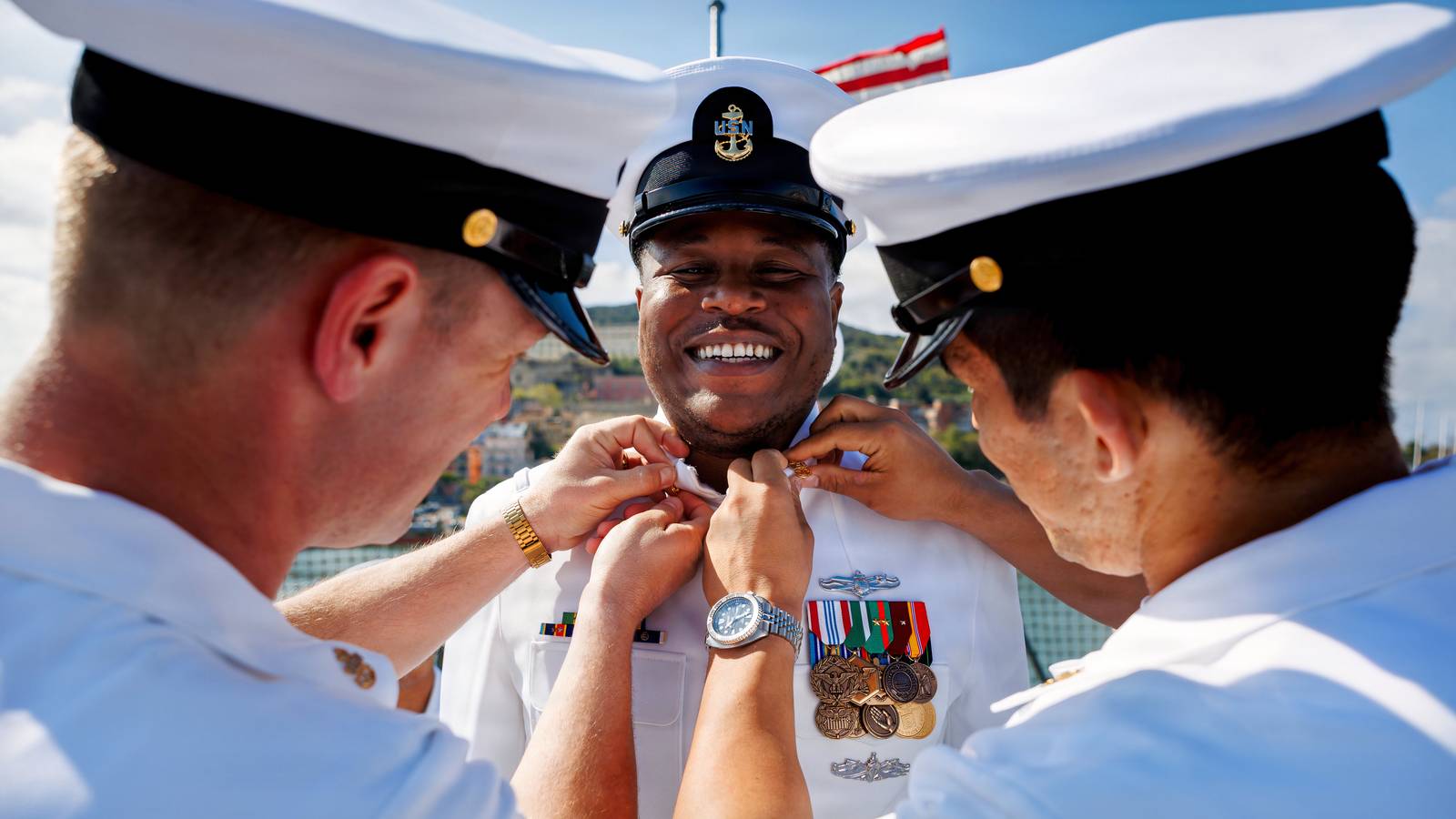
The chief petty officer grades — E-7 through E-9 — represent the Navy’s senior enlisted leadership tier and carry a cultural weight in the Navy that is arguably greater than any equivalent tier in any other branch. Advancement to chief petty officer is not automatic and is not simply a matter of time in service and exam scores. It involves a selection process with an initiation period known as CPO Season, which has its own traditions, mentorship components and institutional significance that Navy insiders take seriously and outsiders often underestimate.
- An E-7 is a chief petty officer.
- An E-8 is a senior chief petty officer.
- An E-9 is a master chief petty officer.
At the top of the entire enlisted structure sits a single billet: the Master Chief Petty Officer of the Navy, the senior enlisted adviser to the Chief of Naval Operations.
The NEC: The Layer Beneath the Rating
Beyond the rating sits one more layer of specificity that matters in advanced billets: the Navy Enlisted Classification code, a four-digit number assigned to sailors who have completed additional specialized training beyond their basic rating. The NEC identifies skills that are more narrow than the rating itself. A hospital corpsman is a broad rating covering thousands of sailors. NEC 8403 identifies specifically a fleet marine force reconnaissance independent duty corpsman — a far more specific and demanding qualification. The NEC essentially says not just what you do but exactly what specialized version of that job you are qualified to perform.
Interested in Joining the Military?
We can put you in touch with recruiters from the different military branches. Learn about the benefits of serving your country, paying for school, military career paths, and more: sign up now and hear from a recruiter near you.
How to Address a Sailor Correctly
In a joint environment, the practical answer is straightforward. E-4 through E-6 can be addressed as “Petty Officer” followed by their last name — Petty Officer Jones — and that is always correct. Using their full rate-rating combination — Boatswain’s Mate Second Class Jones — is more formal and more precise. E-7 through E-9 are Chief, Senior Chief, and Master Chief respectively, followed by their last name. Officers follow standard rank conventions. The word shipmate is used broadly and affectionately within the Navy for fellow sailors at any level and is generally a safe fallback when in doubt.
The system traces its origins to the British Royal Navy, from which the early American Navy adopted its customs and terminology in the late 1700s. Rating marks were used informally until formally approved in 1869. The current structure of first, second, and third class petty officer rates was established in 1885. The terminology has remained largely stable for nearly 140 years, which goes some way toward explaining why the rest of the military has not caught up with it.
Read the full article here
6 Comments
Great insights on Defense. Thanks for sharing!
This is very helpful information. Appreciate the detailed analysis.
Solid analysis. Will be watching this space.
Interesting update on The Difference and How to Correctly Address a Sailor. Looking forward to seeing how this develops.
Good point. Watching closely.
I’ve been following this closely. Good to see the latest updates.