

Listen to the article
The House on Thursday abruptly delayed a vote on the Take Care of America’s Veterans Act (TCAVA), shelving one of the largest veterans legislative packages in years after Republican leaders apparently failed to secure enough support amid a growing fight over disability compensation that has divided many of the nation’s largest veterans organizations.
The legislation combines roughly 60 veterans bills covering disability benefits, caregivers, survivors, education, health care, home loans and oversight of the Department of Veterans Affairs.
While many of those proposals enjoy broad bipartisan support individually, the package has become consumed by debate over one question: Should projected savings from future changes to VA disability ratings be used to help pay for other veterans’ programs?
The House debated the legislation Thursday and narrowly defeated a Democratic motion to recommit the bill to the House Veterans’ Affairs Committee by a vote of 210-211. But rather than proceeding to final passage, House Republican leaders pulled the measure from the floor before a final vote.
House Speaker Mike Johnson later told reporters that Republican leaders decided to delay the vote because “there still remains … a lot of misinformation” surrounding the legislation. Johnson said the House Veterans’ Affairs Committee had done “a great job engaging with veterans” and indicated the bill would likely return after lawmakers reconvene in September.
The delay marks the second time House leaders have postponed action on the legislation, raising new questions about whether Congress can move the package this year or whether lawmakers will ultimately have to separate many of its most popular provisions.
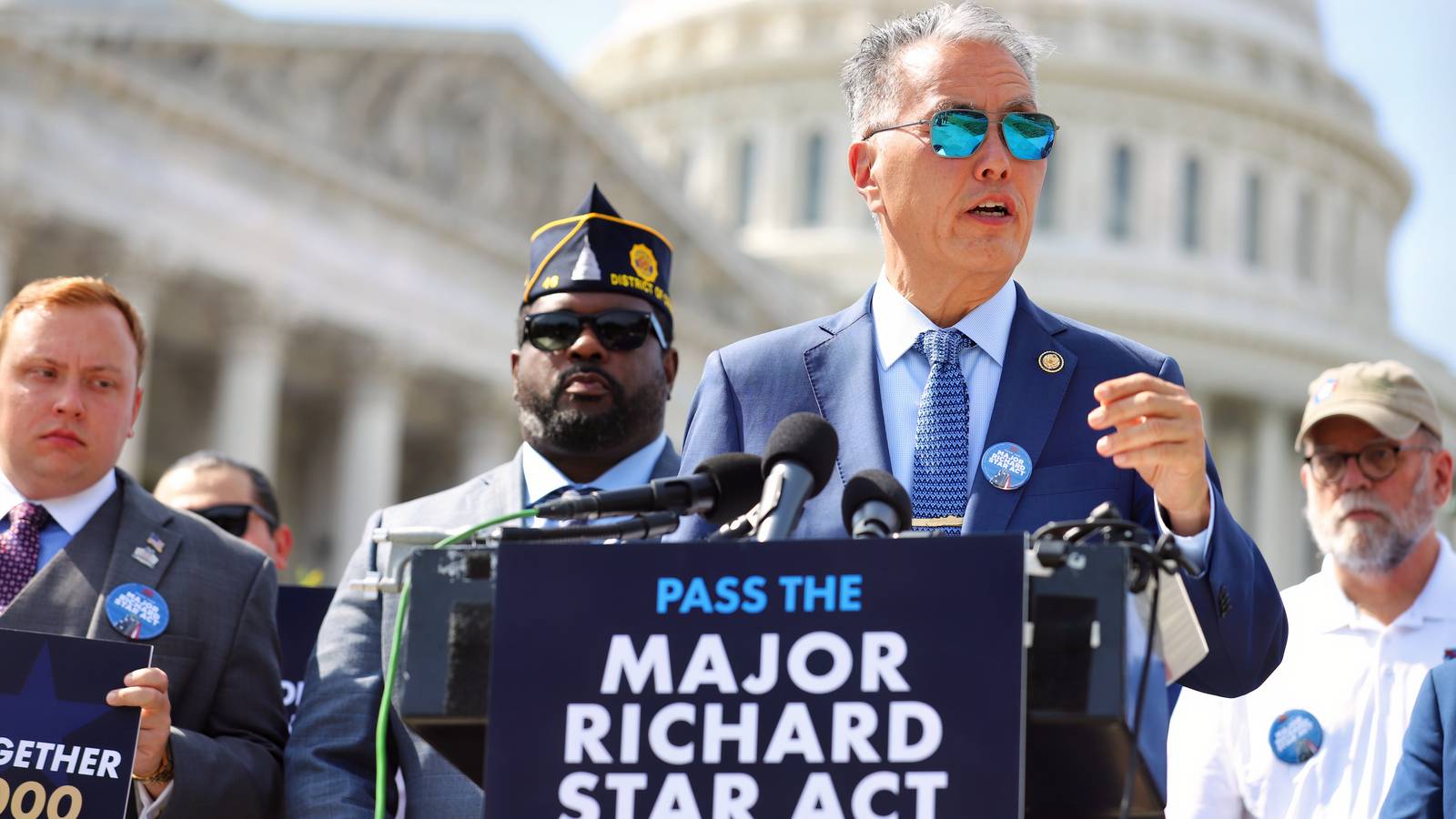
In an exclusive interview with Military.com shortly after the bill was pulled, House Veterans’ Affairs Committee Ranking Member Mark Takano, D-Calif., said the explanation was much simpler.
What that means is that there was not enough support for the bill, Takano said. They were counting votes on the Republican side, and they were short.
“They knew they didn’t want the embarrassment of actually going through the vote because they would lose the vote,” he added. “So they want to live for another day, but the problem is that there’s a limited number of days to do anything.”
A Fight Over How to Pay for Veterans’ Benefits
The TCAVA package includes several of the most sought-after veterans’ bills currently before Congress.
Among them are a modified version of the Major Richard Star Act, which would allow many combat-injured medically retired veterans to receive both military retirement pay and VA disability compensation; the Love Lives On Act, expanding benefits for surviving military spouses; additional caregiver support; education reforms; and numerous measures aimed at improving VA services and oversight.
Few lawmakers dispute the value of many of those bills.
Instead, the disagreement centers on the package’s funding mechanism.
Supporters argue that if the Department of Veterans Affairs ultimately updates disability rating criteria for conditions such as tinnitus and obstructive sleep apnea, any resulting savings should remain within veterans programs rather than returning to the Treasury.
Opponents argue that those savings are speculative and that writing the policy into law could reduce future disability compensation for veterans filing claims under revised standards.
Takano said Congress should not legislate disability ratings based on what the VA might do in the future.
“This is all, to me, smoke and mirrors about a hypothetical action the VA could possibly take in the future,” he said.
He also warned that placing those changes into statute would make future adjustments far more difficult.
What TCAVA would do is put this rating change in statute and law, which is a much harder thing to change.
Supporters of the legislation, including House Veterans’ Affairs Committee Chairman Mike Bost, R-Ill., and Senate Veterans’ Affairs Committee Chairman Jerry Moran, R-Kan., have argued that current beneficiaries would not lose compensation and that Congress should preserve any future savings for veterans programs instead of allowing the money to disappear into unrelated federal spending.

Veterans Organizations Find Themselves on Opposite Sides
Perhaps the most remarkable aspect of the debate is not the disagreement inside Congress, but the disagreement among veterans organizations themselves.
For decades, veterans service organizations have often spoken with one voice on major legislative priorities, giving lawmakers a powerful signal about what the veterans community supports.
That unity has fractured over TCAVA.
A coalition led by the American Legion has urged Congress to pass the legislation. The group includes the Military Officers Association of America, Tragedy Assistance Program for Survivors (TAPS), Wounded Warrior Project, AMVETS, Gold Star Spouses of America, the Elizabeth Dole Foundation and more than a dozen other organizations.
Those groups argue the package represents years of bipartisan work and would deliver meaningful improvements for millions of veterans, caregivers and survivors.
On the other side are organizations including the Veterans of Foreign Wars, Disabled American Veterans and Iraq and Afghanistan Veterans of America.
Those organizations support many of the individual bills contained in TCAVA, including the Major Richard Star Act and Love Lives On, but oppose financing the package through anticipated reductions in future disability compensation.
The VFW has argued that “a grateful nation pays its debts to veterans; it does not send them the invoice,” while DAV has said Congress should not fund one veteran’s benefit by potentially reducing another.
Takano said seeing veterans’ organizations forced into opposing camps has been one of the most disappointing aspects of the debate.
I hate that veterans organizations are having to fight a kind of Hunger Games against each other, he told Military.com.

What the Delay Means
The immediate consequence of Thursday’s decision is uncertainty.
Veterans hoping to benefit from the Major Richard Star Act, surviving spouses awaiting passage of the Love Lives On Act and advocates backing dozens of other bipartisan proposals will likely wait at least several more weeks before learning whether the package advances.
The broader consequence may be political.
When veterans organizations present Congress with a unified message, lawmakers often have political cover to act.
When those organizations disagree, lawmakers can point to competing veterans’ groups supporting opposite positions.
That dynamic appears to have played out this week.
Supporters say delaying the legislation postpones desperately needed benefits for combat-disabled veterans, surviving spouses and other deserving veterans.
Opponents counter that passing the bill as written would establish a precedent that Congress can finance new veterans programs by reducing future benefits for another group of veterans.
Takano believes Congress should avoid forcing that choice altogether.
I don’t think veterans should be asked to sacrifice for other veterans, he said. Veterans have sacrificed enough.
What Happens Next?
It remains unclear whether House Republican leaders will attempt another vote on the package as written, negotiate changes that could attract additional support or ultimately split many of the most popular provisions into standalone bills.
Takano said his preferred path remains bringing the original Major Richard Star Act to the House floor independently through a discharge petition, which he said is just three signatures short of forcing a vote.
We could pass that bill, he said. We would find a way to pay for it that would not be on the backs of veterans.
Whether lawmakers ultimately revive TCAVA or pursue its most popular provisions individually, Thursday’s delay underscored a larger reality.
Congress is no longer debating whether veterans deserve these benefits.
It is debating how to pay for them and, increasingly, whether one group of veterans should bear the cost of helping another.
Read the full article here
6 Comments
Solid analysis. Will be watching this space.
I’ve been following this closely. Good to see the latest updates.
Interesting update on House Officially Delays 60-Bill Veterans Package as Major VSOs Split Over Benefits. Looking forward to seeing how this develops.
Great insights on Defense. Thanks for sharing!
Good point. Watching closely.
This is very helpful information. Appreciate the detailed analysis.