

Listen to the article
Image stabilizing binoculars have been around for a long time. In January of 2009, the Department of Homeland Security published what amounts to a taxpayer-funded review of some of the most popular stabilizing binos. Some, like the Fujinon Techno-Stabi, the Nikon StabiliEyes, and the Canon L IS WP, are still around today.
And why not? The concept is attractive, and its usefulness is intuitive. We’ve all struggled to see something in the field as we shake and wobble holding an unsupported set of binoculars. Image stabilizing binos correct that problem by automatically adjusting for the movement of the user, making the image appear steady and allowing for more precise glassing.
Hunters haven’t historically adopted the technology, largely because older iterations were bulkier and heavier than a standard set of binos. But that’s changed in the past few years. Sig Sauer introduced their ZULU6 line of image stabilizers in 2020, which were built with hunters in mind. They joined the Dutch company Kite Optics and, just last year, Swarovski got into the game when they released an image-stabilizing spotting scope. Even some of the Nikon and Canon models have cut weight and bulk and would be useful in the field.
Point is, if you’re interested in image stabilizing binoculars, you have options. But should you take the leap? What are the pros and cons of image stabilization, and is the technology worth the extra cheddar?
How Do Image Stabilizing Binos Work?
Before we get to those questions, it’s helpful to have a basic understanding of how image stabilizers work.
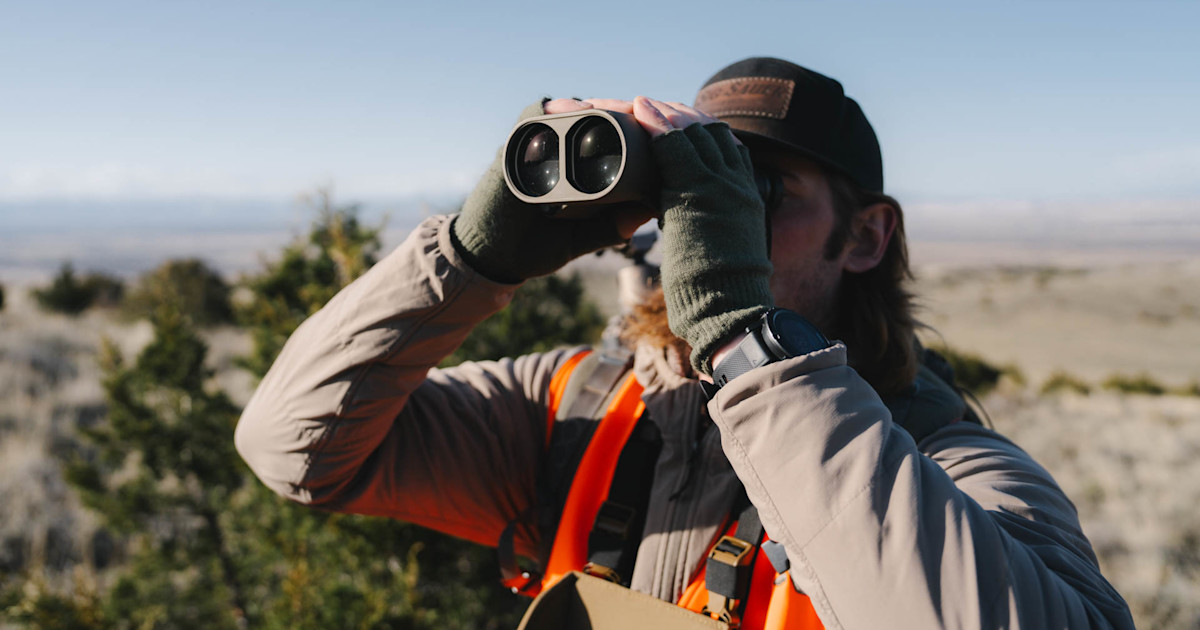
Fundamentally, image stabilizing binoculars move an internal component that shifts the image slightly to account for the external movement of the user. Some use a small lens group that shifts and tilts to adjust the image, while others move an entire prism inside the binos. The latter is used in most binos geared towards hunting because it’s more stable and offers better image quality.
Sig’s ZULU6 affixes a prism to a two-axis gimbal, which is controlled by an accelerometer. The accelerometer adjusts the prism to match your movement according to the on-board software. Others use a similar system, but the devil is in the details. Construction quality and precision, gimbal design, and software functionality all impact how well the system works. The only way of knowing for sure is to test the binos for yourself.
Most image stabilizing binos advertise plus or minus three degrees of stabilization. Some offer more, but those aren’t geared toward hunters, who value both looking at a single object and panning back and forth for game. This is one important feature to consider when you’re looking at various models. Some image stabilizing technology causes the image to float or hover while panning (and sometimes while staying still). It doesn’t exactly make the image more difficult to see, but it’s a little unnerving—and potentially stomach churning. If the binos you’re looking at include a feature designed to mitigate this oddity, that’s a good sign.
Cons
I like to eat my vegetables first, so let’s tackle the reasons you might not want to buy a pair of image-stabilizing binoculars. To help me with this, I called up Anthony Cuomo, a senior product manager for Sig Sauer. Anthony is obviously a fan of Sig’s line of ZULU6 stabilizing optics, but he was honest about what you’re giving up when you use this technology.
“The biggest thing that you’re going to give up in image stabilization today is field of view,” he told me.
Field of view (FOV) describes how much of a given area you can see at one time. Your eyes have a field of view bordered by your peripheral vision. Binos have the same limitations.
Anthony said you can expect non-stabilizing wide-angle 10×42 binos to offer a 6-degree field of view while a standard 10×42 set clocks in around 5.5 degrees. Image stabilized 10×42’s reduce that FOV to just 4 degrees.
To take a more specific example: Sig’s image stabilized ZULU6 HDX 12×42 offers a FOV of 3.8 degrees, which allows you to see a width of 199 feet at 1000 yards. By contrast, the non-image stabilizing ZULU8 HDX 12×50 binos offer a field of view of 5.5 degrees, which expands the FOV to 288 feet at 1000 yards—a 37% increase.
That increased FOV might help catch that buck slipping into the treeline or the ear twitch of a frozen coyote. Seeing more landscape is always better, and Anthony told me they’re working to increase the FOV on future ZULU6 models.
The other drawback of image stabilizing binos is that they struggle to maintain edge-to-edge clarity. All the internal movement makes it extremely difficult to maintain a flat, clear image all the way to the edge of the field of vision. The focal point in the center can be as clear as any other bino, depending on glass quality. But even with primo glass, edge clarity is a tough nut to crack—and that’s true of virtually any image stabilizing binos on the market.
Cost is the final con. Image stabilizers are more expensive than comparable binos without that feature. It’s tough to find a pair for less than $1,000, and many push the $1,500 or $2,000 mark. If that’s more than you can spend—and for many hunters, it is—image stabilizing binos might not be the best financial decision.

Pros
Of course, along with those cons comes a pretty big pro.
If you haven’t used ZULU6’s or another image stabilizer, it’s hard to describe what happens when you turn the unit on. I’ve seen this technology panned as “gimmicky,” but it’s not. It really does smooth out a shaky, hard-to-see image and allow you to pick out details in whatever you’re looking at.
I was at a gun range the first time I used a set of image stabilizers. It was a cloudy, raining day, and I was having trouble seeing bullet holes in a paper target 100 yards away. As soon as I turned on the image stabilizer, I was able to see the hits clearly, despite the fact that I was holding the binos freehand.
And that’s far from the only useful application. I used a set of ZULU6’s on a mule deer hunt last fall, and I appreciated how quickly they allowed me to glass an area. I didn’t have to set up a tripod, find a good seated position, or wait for my breathing to slow (which was a factor, given my East Texas lungs). I could feel confident I’d checked a hillside carefully and move on to the next spot up the mountain.
Anthony argued that in a real-world hunting situation, having a stable image is just as important as glass quality.
“Stabilization gives you that clarity and focus that you lose in traditional binos,” he said. “And that ultimately makes us better in the field, whether it’s judging animals, finding animals, or analyzing terrain.”
You might use the clearest binos in the universe constructed by aliens from Thor’s telescope. But if you’re shaking, you still won’t see that animal bedded under the sagebrush. You can increase the stability of any binos using a tripod, but that adds weight to your pack and time to your setup. What’s more, there are some situations where using a tripod is difficult or impossible.
“As a passenger in a vehicle, I can glass going sixty miles an hour down a road. On a boat, whether you’re out at sea or if you’re on a hunt in Alaska and glassing to shore looking for blacktail or bear. If you’re on horseback, you don’t have to get off of your horse to glass. You can glass directly from your saddle,” Anthony pointed out.
Older hunters with shaky hands or medical conditions will also benefit from this technology.
Last Shot
No one can deny the benefits of a stable image, but the best way to achieve that stability depends on how you hunt. If much of your spot-and-stalk hunting is done from a single position, it might be better to buy the highest quality glass you can afford and stabilize it with a tripod. On the other hand, if you find yourself moving around a lot, scanning hillsides and spending only a few minutes at various glassing spots, image stabilizers are an incredible luxury. They let you pick apart an area without even sitting down, which is impossible with a traditional set of binoculars.
You don’t need image stabilizing binos to be a successful hunter, but like a lot of other gear we use, they make our pursuits a heck of a lot more convenient. The only real way to know whether image stabilizers are right for you is to try them for yourself. I recommend visiting your local sporting goods store and taking a pair for a spin. Or, if you’d like to do some in-field testing, purchase a pair, keep the receipt, and return them in like-new condition within whatever window the dealer stipulates.
You might decide to pass, but if I was a betting man, I’d wager you won’t want to take them back.
Read the full article here
6 Comments
Interesting update on The Pros and Cons of Stabilizing Binos. Looking forward to seeing how this develops.
This is very helpful information. Appreciate the detailed analysis.
Great insights on Hunting. Thanks for sharing!
Solid analysis. Will be watching this space.
Good point. Watching closely.
I’ve been following this closely. Good to see the latest updates.