

Listen to the article
The City of Boston is known historically for the Battle of Bunker Hill, which was fought on June 17, 1775, during the Siege of Boston in the first stage of the American Revolutionary War. Today, Boston is a sprawling coastal city that is fighting a different battle, one of climate change and an increasing threat of disastrous flooding.
To that end, the U.S. Army Corps of Engineers (USACE) is recommending $10 billion in infrastructure investments in its draft ‘Coastal Storm Risk Management Feasibility Study’. Released last week on July 24, the goal is to make recommendations to protect Boston and its 47 miles of coastline from rising floodwaters that city leaders, including Mayor Michelle Wu, say are getting worse year after year.
Since 1991, 24 severe storms qualifying as federal or state disasters have hit Boston, 14 of which caused major flooding. More than 40% of our residents now live in areas at risk of coastal flooding, including some communities that are more than a mile away from the ocean.
Study Recommends Major Flood Mitigation
The study recommendations from the Army Corps of Engineers fall in line with the agency’s mission as the military engineering branch of the U.S. Army. USACE has 37,000 civilian and military personnel, making it one of the world’s largest public engineering, design, and construction management agencies.
Its involvement in Boston’s coastal infrastructure protection plans is a collaboration between the city, the state of Massachusetts and the federal government.

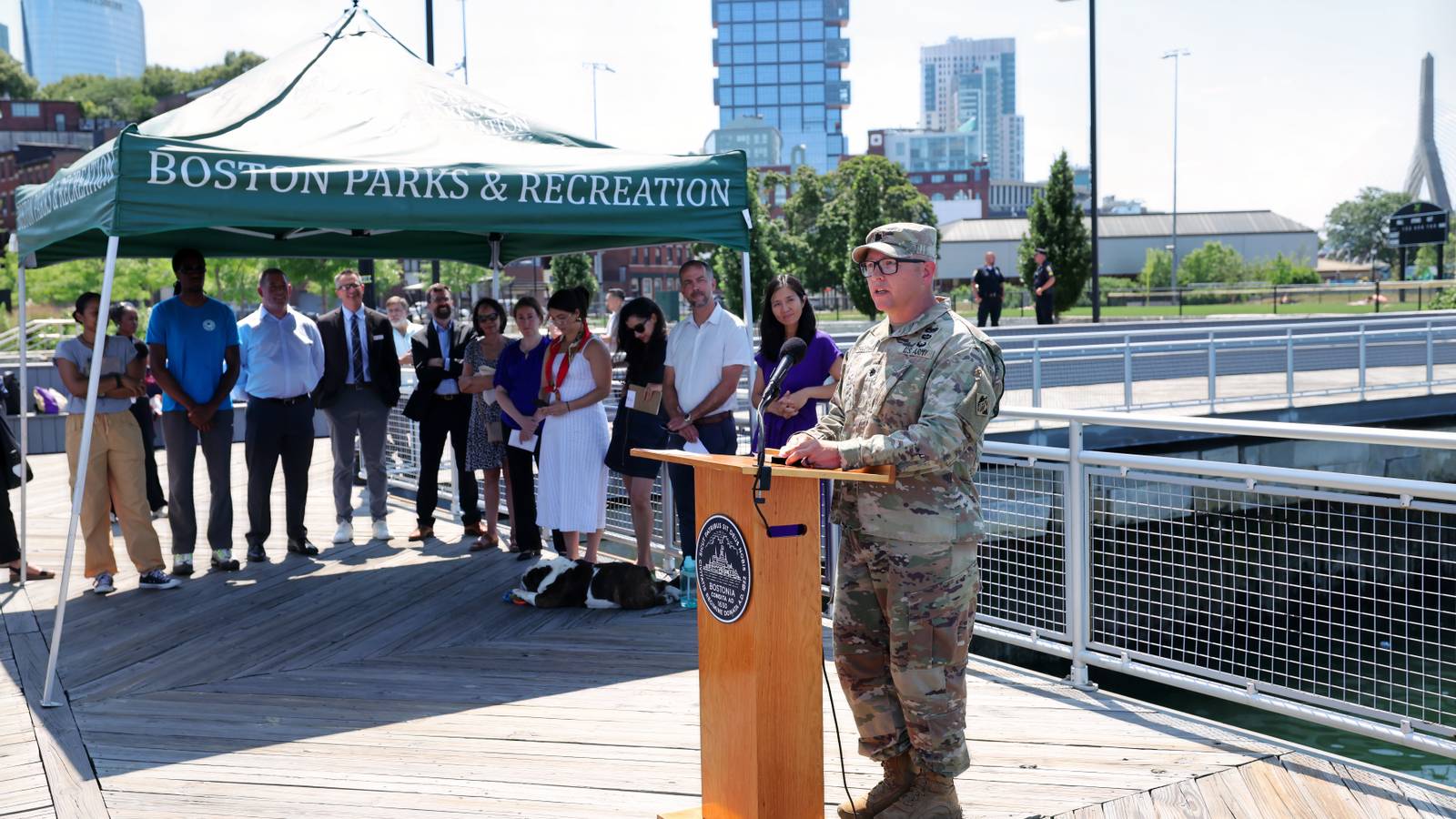
“This study is tied to local planners and took years to assess the Boston shoreline’s vulnerabilities and how we can strengthen the infrastructure,” Army Corps of Engineers Lieutenant Colonel David McPhail said in his remarks at the July 20th news conference. “Whether it’s a nor’easter, which sits here for several days with storm surge, or it’s just a high water event, those all affect the people in Boston, and this entire coastline.”
In the draft study, the USACE recommends 20 infrastructure projects across the neighborhoods of East Boston, Charlestown, downtown Boston, South Boston and Dorchester. Levees and flood walls are among the proposed flood-mitigation measures.
According to USACE, the study will qualify Boston for federal funding to cover 65% of the project costs. The remaining costs will be shouldered by a mix of stakeholders, including the city, state and private partners.

“Without action, we risk more than 54 billion dollars in damages to our homes, hospitals, businesses, roads, and other critical infrastructure by the end of the century,” Mayor Wu said. “That’s why, over the past decade, we’ve been working with our local, state and federal partners to build a climate-ready Boston. And it’s why, once again, we’re returning to the U.S. Army Corps of Engineers to help us defend our city.”
Army Corps of Engineers Rooted in Boston
The USACE traces its roots to the Revolutionary War, where Colonel Richard Gridley, a Boston native, designed a critical man-made barrier on Breed’s Hill in Boston that blocked British cannon fire. The British eventually took the hill, which was later called the Battle of Bunker Hill.
In 1802, Congress established a separate Corps of Engineers within the Army, as well as the U.S. Military Academy at West Point, the country’s first engineering school. Years later, the federal government would go on to authorize the USACE to carry out both military construction projects and other works “of a civil nature.”
“It was Gridley’s fortifications that helped the Americans shock the world at the Battle of Bunker Hill,” Wu said. “Today, Boston faces a different kind of danger. Instead of staring down redcoats, we’re watching sea levels rise and storms intensify.”

A period of public comment on the USACE draft study is underway for Boston residents, with city and state leaders as well as the USACE agreeing that input from the people who live and work along the coastline is vital.
“So this draft report is intentional. It’s not the final solution right now because we’re following through with getting some feedback, questions, comments, and consensus from the public,” Lt Col McPhail said. “It’s very important that we get the feedback from the people that live here in Boston, because every community is unique, it has unique issues, and things that we likely have not considered that make a big difference in how we implement these interventions.”
Mayor Wu said the $10 billion dollars in recommended improvements in the USACE draft study will be historic.
“The study will drive one of the biggest investments in our waterfront,” she said. “That’s more than twice the size of the Boston Harbor cleanup.”
Read the full article here
5 Comments
This is very helpful information. Appreciate the detailed analysis.
Good point. Watching closely.
I’ve been following this closely. Good to see the latest updates.
Great insights on Defense. Thanks for sharing!
Solid analysis. Will be watching this space.