

Listen to the article
An honor more than two centuries later for the only known Indiana man who took part in the Boston Tea Party protest.
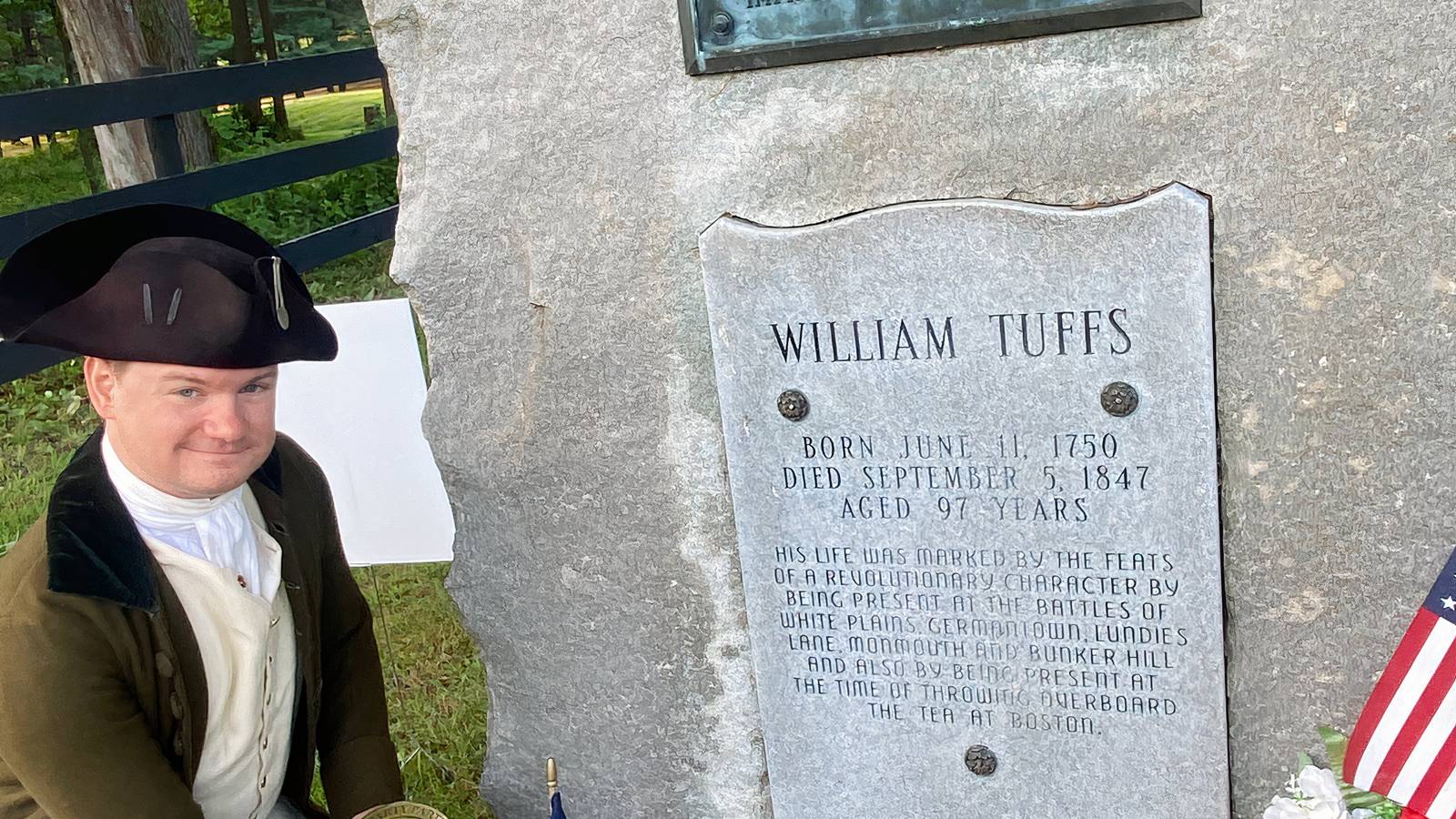
William Tufts is buried at Bonneville Cemetery in Elkhart County, Ind. A graveside ceremony held on July 25, attended by state and local dignitaries, as well as representatives from the Daughters of the American Revolution, saw a commemorative marker placed at Tufts’ grave, courtesy of the Boston Tea Party Ships and Museum.
“William Tufts was a participant in the Boston Tea Party protest. He was an innkeeper’s apprentice at the time,” Evan O’Brien, creative manager of the Boston Tea Party Ships and Museum, said in an interview with Military.com. “As his biographical account goes, he was responsible for hauling some of the heavy tea chests out of the cargo hold of one of the three Boston Tea Party ships.”
Boston Tea Party Sparked American Revolutionary War
The event on December 16, 1773, was an act of protest during the American Revolution. The source of the protestors’ anger was the passage of the Tea Act by the Parliament of Great Britain, which allowed the East India Company to sell Chinese tea in the colonies without paying taxes.
The protest group ‘Sons of Liberty’ strongly opposed the sales, considering it a violation of their right to no taxation without representation. Their bold protest over tea forced a breakdown in relations that led directly to the American Revolutionary War.
The ideals that the participants fought for are still very applicable today. The ideals of representation in your government, the ideal of building a better community and a better future for that community. You also have ideals of making a sacrifice and taking risks for a cause that you believe in.
The commemorative marker at Tufts’ grave is the first such marker placed in Indiana. It bears Tufts’ name, the date of his birth on June 11, 1750, and the date of his death on September 5, 1847. Tufts lived to be 97 years old.

The marker’s inscription reads in part, “His life was marked by the feats of a revolutionary character by being present… at the time of throwing overboard the tea at Boston.”
According to a Facebook post, in an 1840 interview with the Goshen Democrat, Tuffs recounted his participation in what he called the “destruction of the tea.” He said he disguised himself by sticking feathers in his hat and smudging his face with paint while helping to lift chests from the cargo hold to other participants on deck.
O’Brien said after the protest, Tufts appeared to have been inspired to serve the country, as he headed west.
“The Boston Tea Party participants, just like William Tufts, were rather common tradesmen. They were kind of everyday people. They weren’t necessarily the wealthiest of colonial America or colonial Boston. But they were the bravest certainly,” O’Brien said. “Following the Boston Tea Party, he did serve in the American Revolution, and eventually made his way to Ohio and then eventually Indiana, where he lived out the rest of his days.”
Commemorative Grave Markers Part of National Initiative
Tuft’s commemorative grave marker is part of a broader national initiative by the Boston Tea Party Ships and Museum. Organizers have placed more than 120 similar markers at grave sites across the country since 2018.

“We’ve been traveling all over the country and around the world, placing markers at the graves of known Boston Tea Party participants,” O’Brien said. “Indiana is the farthest west we’ve gone so far. But we’ve traveled to Bainbridge, Ohio, to Kilkenny, Ireland, and Paris, France too. So we’ve been going all over the place.”
According to The Boston Tea Party Ships and Museum, there were about 100 to 150 individuals who took part in the tea party protest, with potentially hundreds of thousands of descendants around the world.
“So we’re running into a lot of people that don’t even know that they have an ancestral connection to the Boston Tea Party,” O’Brien said. “Through our program, the Boston Tea Party Descendants program, and this grave marker program, as well as the outreach that our museum has been doing, we’re also helping people make a lot of discoveries about their own genealogy.”
The museum’s mission is to honor the service and sacrifice of ordinary protesters who changed the course of history.
“These ordinary people took an incredible risk, putting their livelihood and their life on the line for a cause that they deemed worthy of sacrifice,” O’Brien explained. “Civic engagement, participating in your community at town meetings, are all associated with the Boston Tea Party. But probably the most important lesson of all is the idea of ordinary citizens doing extraordinary things in changing the world.”
Read the full article here
6 Comments
Great insights on Defense. Thanks for sharing!
Solid analysis. Will be watching this space.
Good point. Watching closely.
This is very helpful information. Appreciate the detailed analysis.
I’ve been following this closely. Good to see the latest updates.
Interesting update on Indiana’s Only Known Boston Tea Party Participant Finally Honored. Looking forward to seeing how this develops.