

Listen to the article
Enlisted Air Force ranks are categorized into three levels: airmen (pay grades E-1 through E-4), noncommissioned officers (E-5 and E-6), and senior noncommissioned officers (E-7 through E-9).
Some personnel can enlist at an advanced rank if they have college credits or have participated in Junior ROTC. The highest advanced rank one can enlist with under these programs is airman first class (E-3).
The Air Force offers accelerated promotion for service members who agree to enlist for six years. Under this program, enlistees who enter service as an airman basic (E-1) are promoted to airman (E-2) after basic training is finished, and then advance to airman first class (E-3) when they graduate technical school, or 20 weeks after graduation from basic training, whichever occurs first.
Air Force Ranks
- Airman Ranks (E-1 through E-4)
- Noncommissioned Officer Ranks (E-5 and E-6)
- Senior Noncommissioned Officer Ranks (E-7 through E-9)
- Chief Master Sergeant of the Air Force (E-9S)
Air Force Airman Ranks (E-1 Through E-4)
Airman Basic (E-1)
Most airmen graduate basic military training with the rank of airman basic (E-1). An airman basic is an apprentice who is acquiring and demonstrating knowledge of military customs, courtesies, traditions and Air Force standards while learning military and technical skills.
Under normal conditions, promotions to E-2 are automatic as long as the Air Force’s standards for performance and behavior are met. The only requirement for advancement is six months’ time in grade (TIG) and time in service (TIS). An airman, while still primarily an apprentice, is expected to understand and conform to military standards.
Airman (E-2)
The rank of airman brings with it the responsibility of adjusting to the Air Force way of military life and becoming proficient in an Air Force occupational specialty. Upon leaving basic training, all airmen enter training at Air Force schools in their specialties (“jobs”), depending on their aptitudes and interests, and the needs of the Air Force.

Airman First Class (E-3)
Airmen first class are considered to be fully adjusted to Air Force and military life, and their duties focus on carrying out their assignments efficiently and effectively while honing their job skills.
Airmen first class are assigned an increasing level of responsibility. An airman first class is expected to comply with Air Force standards and serve as a role model for subordinates. In addition, they are expected to start mastering their job and leadership skills.
Moving up the Air Force ranks: The Air Force requires airmen (E-2) to have at least 10 months’ TIG before they can be promoted to airman first class. There are no time in service (TIS) requirements for airman first class. An airman first class’ role and responsibilities increase as their experience increases and they become journeymen and leaders. The average Air Force-wide, active-duty time for promotion to the rank of airman first class is 16 months.

Senior Airman (E-4)
The rank of senior airman is a transition period from journeyman to noncommissioned officer (NCO). It is essential that airmen develop supervisory and leadership skills through professional military education (PME) and individual study. They are expected to conduct themselves in accordance with established standards, providing a positive influence and example for their subordinates and peers alike.
Senior airmen present the image of competence, integrity and pride.
Moving up the Air Force ranks: The Air Force requires airmen first class to have 28 months’ TIG; or 36 months’ TIS and 20 months’ TIG. The average servicewide, active-duty time for advancement to the rank of senior airman is three years.
Exception to the rule: Senior Airman (E-4) Below-the-Zone: Air Force unit commanders are authorized to promote 15% of their exemplary airmen first class (E-3) to senior airmen (E-4) six months ahead of the normal TIS. The unit commander’s decision is based primarily on a promotion board. Large units conduct the promotion boards “in-house” and select up to 15% for early promotion. Small units combine applicants into a pool and form a Central Base Board (CBB).
Air Force Noncommissioned Officer Ranks (E-5 and E-6)
Air Force enlisted members in pay grades E-5 and E-6 are referred to as noncommissioned officer, or NCOs. Air Force NCOs are expected to exemplify personal integrity, loyalty, leadership, dedication and devotion to duty, including upholding Air Force policies, traditions and standards.
Air Force NCOs and senior NCOs are promoted based on the Weighted Airman Promotion System (WAPS). Airmen with the proper tie in service (TIS), time in grade (TIG), skill level and commander’s recommendation compete for promotion based on their “WAPS points” within their AFSC (Air Force Specialty Code).
The WAPS promotion points are derived from a system that gives points for the Promotion Fitness Examination (PFE), Specialty Knowledge Test (SKT), medals, awards, TIG/TIS, and performance evaluations.

Staff Sergeant (E-5)
The staff sergeant (SSgt) is the first level of the NCO ranks in the Air Force. The staff sergeant is considered a craftsman with specific NCO supervisory responsibilities and may hold either a 5- (journeyman) or 7- (craftsman) skill level. Additionally the SSgt must strive continuously to further their development as technicians and supervisors. The average Air Force-wide, active-duty time for promotion to the rank of staff sergeant is more than four years.
Moving up the Air Force Ranks: Promotion to staff sergeant requires three years of time in serve (TIS) and six months of time in grade (TIG). In addition, airmen must achieve a 5-skill level, compete in WAPS and complete the Airman Leadership School in-residence before assuming the rank of staff sergeant.

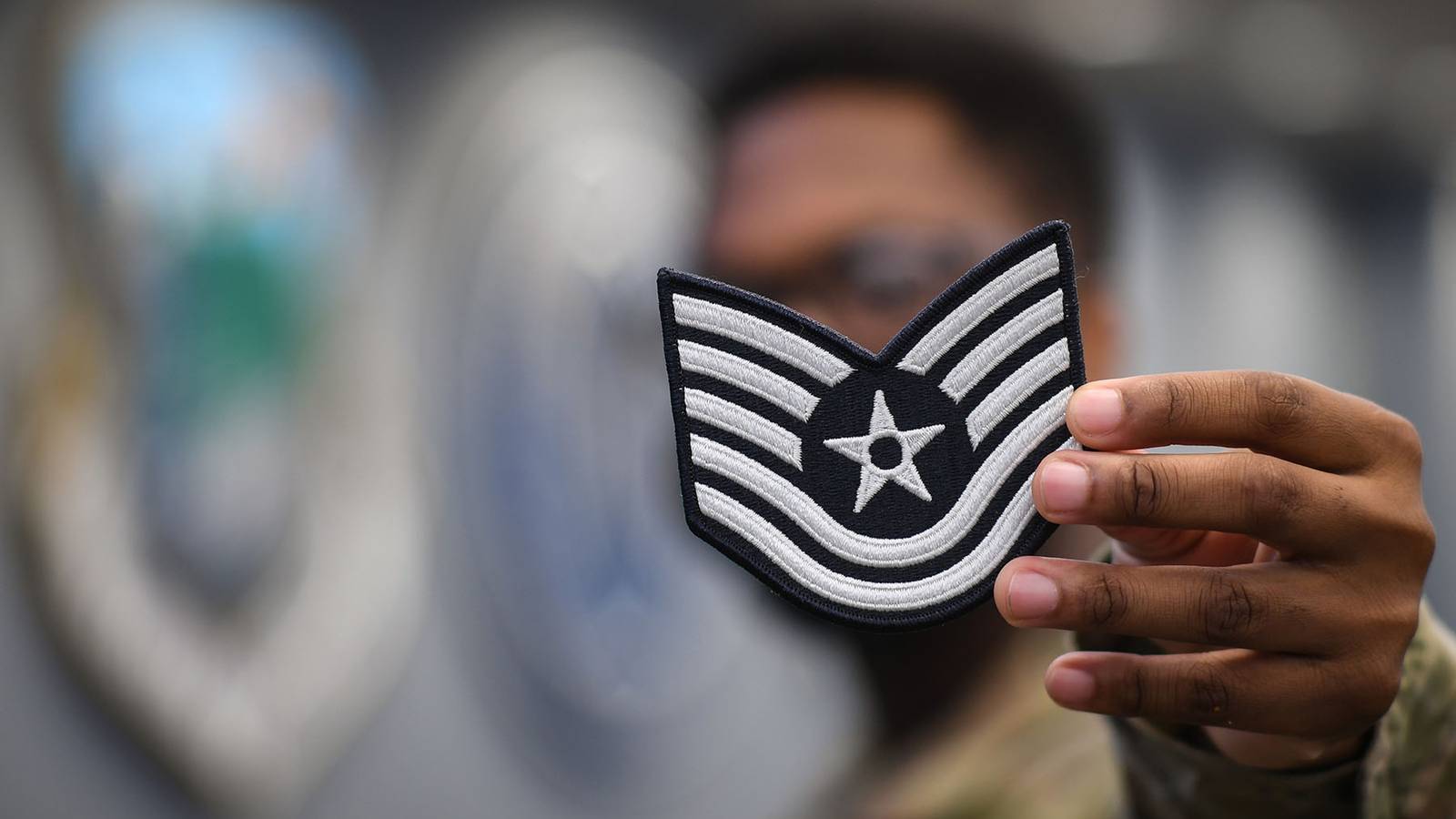
Technical Sergeant (E-6)
The technical sergeant (TSgt) is the second level of the NCO ranks in the Air Force. Technical sergeants are qualified to perform highly complex technical duties in addition to providing supervision. They’re responsible for the career development of each subordinate under their supervision.
It is the TSgt’s responsibility to ensure that all enlisted personnel have the tools, training and support they need to achieve maximum performance and accomplish total mission effectiveness. The average Air Force-wide, active-duty time for promotion to the rank of technical sergeant is 12 years.
Moving up the Air Force Ranks: The promotion process for tech sergeant is identical to the process for promotion to staff sergeant, except for the minimum requirements of five years of time in serve (TIS) and 23 months of time in grade (TIG), in addition to achieving a 7-skill level.
Interested in Joining the Military?
We can put you in touch with recruiters from the different military branches. Learn about the benefits of serving your country, paying for school, military career paths, and more: sign up now and hear from a recruiter near you.
Air Force Senior Noncommissioned Officer Ranks (E-7 through E-9)
Air Force enlisted members E-7 and above are referred to as senior noncommissioned officers (SNCOs). Air Force SNCOs are expected to set the highest standards of personal integrity, loyalty, leadership, dedication and devotion to duty, including upholding Air Force policies, traditions and standards.
Like the NCO ranks, senior NCOs are rated by their “skill levels.” The following is a breakdown of the Air Force’s SNCO required skill levels:
- 7-level: Supervisor. Technical sergeant (E-6) to master sergeant (E-7)
- 9-level: Manager. Skill-level assigned to E-8s and E-9s.

Master Sergeant (E-7)
The master sergeant (MSgt) functions primarily as a craftsman while holding more advanced leadership positions. MSgts hold a 7-skill level. This rank carries significantly increased responsibilities and requires a broad technical and managerial perspective. The average servicewide, active-duty time for advancement to the rank of master sergeant is more than 17 years.
Moving up the Air Force ranks: The promotion process for master sergeant is identical to the process for promotion to staff sergeant and technical sergeant, except for the minimum requirements: eight years’ time-in-serve (TIS) and 24 months’ time-in-grade (TIG) requirements, in addition to achieving a 7-skill level.

Senior Master Sergeant (E-8)
The senior master sergeant (SMSgt) is expected to perform as a superintendent or manager. Broad management skills are essential to exercising the responsibilities of the higher leadership positions in which SMSgts serve. The average servicewide, active-duty time for advancement to the rank of senior master sergeant is more than 20 years.
Moving up the Air Force ranks: Because public law allows only 2% of the enlisted workforce to be in the grades of E-8, the SMSgt promotion system is highly competitive. Senior master sergeant and chief master sergeant promotions in the Air Force are made using both the WAPS points and a Central Evaluation Board that reviews promotion records. To be eligible for promotion, a MSgt must have a minimum of 11 years’ TIS and 20 months’ TIG.

Chief Master Sergeant (E-9)
The rank of chief master sergeant is the highest Air Force enlisted rank, with the exception of the chief master sergeant of the Air Force. Chief master sergeants serve as managers and superintendents, advisers and enlisted force managers, and they provide senior enlisted leadership. Following selection, CMSgts are assigned chief enlisted manager (CEM) codes and may fill any managerial-level position and perform all duties not prohibited by law or directive. The average service-wide, active-duty time for advancement to the rank of chief master sergeant is more than 22 years.

Command Chief Master Sergeant (E-9)
Command chief master sergeants serve as senior advisers to unit and base commanders. CMCs advise the commander on all enlisted matters, including all issues affecting the command’s mission and operations, and the readiness, training, utilization, morale, technical and professional development and quality of life of all enlisted members in the organization. Command chiefs are the functional managers for all SNCOs in their entire command/organization.
Moving up the Air Force Ranks: Only 1% of the Air Force enlisted personnel can hold the grade of E-9 at any one time. This makes the competition for CMSgt promotions extremely tight. Chief master sergeant promotions in the Air Force are made using both the WAPS points and a board that reviews the individual’s promotion record. To be eligible for promotion, a SMSgt must have a minimum of 14 years’ TIS and 21 months’ TIG.

Chief Master Sergeant of the Air Force
The chief master sergeant of the Air Force (CMSAF) is a unique noncommissioned rank in the United States Air Force. The holder of this rank and post represents the highest enlisted level of leadership in the Air Force and provides direction for the enlisted corps and represents their interests, as appropriate, to the American public, and to those in all levels of government.
The CMSAF is appointed by the Air Force Chief of Staff (AF/CC) and serves as the senior enlisted adviser to the Air Force Chief of Staff and the secretary of the Air Force on all issues regarding the welfare, readiness, morale, and proper utilization and progress of the enlisted force.
Interested in Joining the Military?
We can put you in touch with recruiters from the different military branches. Learn about the benefits of serving your country, paying for school, military career paths, and more: sign up now and hear from a recruiter near you.
Read the full article here
6 Comments
Interesting update on From Airman Basic to Chief Master Sergeant of the Air Force. Looking forward to seeing how this develops.
Solid analysis. Will be watching this space.
I’ve been following this closely. Good to see the latest updates.
Good point. Watching closely.
This is very helpful information. Appreciate the detailed analysis.
Great insights on Defense. Thanks for sharing!