

Listen to the article
I’ve used an All American pressure canner for years. Mine is the All American 930, and we’ve put a lot of food through it, including meat and vegetables from the garden.
If you’re trying to decide which All American pressure canner to buy, I think size is the first thing to figure out. There are six models, from the small 910 up through the huge 941. But the liquid capacity number doesn’t tell the whole story.
For most people, I would look hardest at the 921, 925 and 930. The 921 and 925 process the same number of standard quart jars. The 930 is where quart-jar capacity takes a big jump.
→ See All American Pressure Canners at Pleasant Hill Grain (Affiliate)
I own the 930 and like its capacity, but there is a tradeoff. It’s big, and when it’s full of jars, water and food, it’s heavy.
All American Pressure Canner Sizes and Jar Capacity
Here’s the easiest way to compare the six models.
| Model | Liquid Capacity | Pint Jars* | Quart Jars* | Approx. Empty Weight |
|---|---|---|---|---|
| 910 | 10.5 qt. | 7 | 4 | 12 lb. |
| 915 | 15.5 qt. | 10 | 7 | 15 lb. |
| 921 | 21.5 qt. | 18 | 7 | 18 lb. |
| 925 | 25 qt. | 18 | 7 | 19 lb. |
| 930 | 30 qt. | 18 | 14 | 23 lb. |
| 941 | 41.5 qt. | 32 | 19 | 33 lb. |
*Jar capacity can vary somewhat depending on the jar brand and whether you’re using regular-mouth or wide-mouth jars.
The important number here is often jar capacity, not the liquid-quart rating of the canner.
For example, the 921 is a 21.5-quart canner while the 925 is a 25-quart canner. You might assume the 925 will process more quart jars. It doesn’t. Both hold seven standard quart jars for a pressure-canning batch.
That’s one reason the 921 has become such a popular size.
All American 921 vs 925: What’s the Difference?
This is probably the most confusing comparison in the lineup.
Both process 7 quart jars per load and roughly 18 to 19 pint jars, depending on the jars being used.
The 921 and 925 are also essentially the same width. Both have a 12-1/4-inch inside diameter. The 925 gets its extra capacity by being taller, not wider. The 921 holds 21.5 quarts of liquid, while the 925 holds 25 quarts.
That extra height does give the 925 one practical advantage. It can accommodate four half-gallon jars, while the 921 cannot. So if you use half-gallon jars, or want the extra interior height for other cooking uses, the 925 may make more sense.
For normal pint and quart pressure canning, though, the two models have nearly the same capacity. If your main goal is to process more quart jars per batch, you need to move up to the 930.
→ All American 921 Pressure Canner at Pleasant Hill Grain (Affiliate)
For someone specifically interested in the taller model:
→ All American 925 Pressure Canner at Pleasant Hill Grain (Affiliate)
There isn’t anything wrong with choosing the 925. Just understand what you’re getting for the extra size. If your goal is simply to process more quart jars per batch, you need to move up to the 930.
When the All American 930 Makes Sense
This is the model I have.
The 930 is rated at 30 quarts of liquid capacity and can hold 14 standard quart jars, stacked in two layers. That’s double the quart-jar capacity of the 921 and 925.
Here’s mine on the stovetop:
That’s where I think the 930 earns its keep. If we’re going to spend the time preparing food, filling jars, heating the canner and running a complete pressure-canning cycle, I like being able to process a lot at once.
Here’s another batch in our 930:
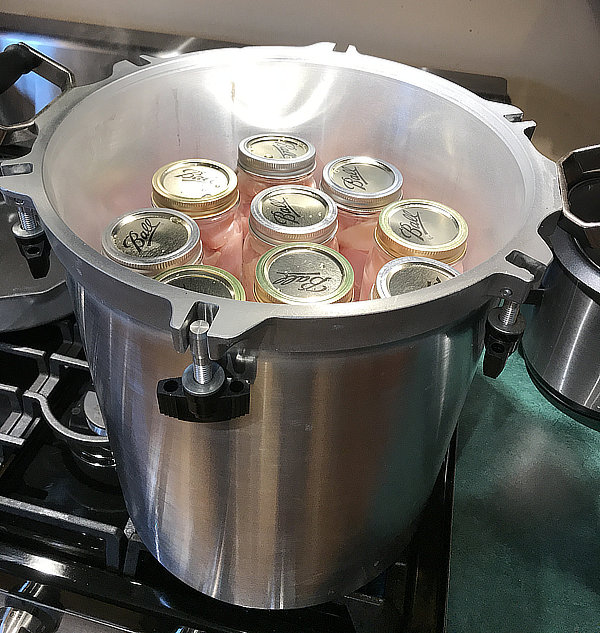
The disadvantage is obvious as soon as you pick it up. It’s large and heavy.
I usually put the canner on the stove before loading it. Once you’ve added water, jars and food, you really don’t want to be carrying it around the kitchen.
→ All American 930 Pressure Canner at Pleasant Hill Grain (Affiliate)
Which All American Pressure Canner Size Should You Get?
For a smaller household or occasional canning, the 915 is an interesting size. It holds seven quart jars but is considerably shorter and lighter than the larger models.
The 921 is probably the best place for most people to start looking. You get seven quart jars per load, and you can stack pint jars. It has enough capacity for serious home canning without becoming enormous.
The 925 is taller than the 921 but doesn’t increase normal quart-jar batch capacity. I would choose it when the extra interior height is useful for what you plan to do with the canner.
The 930 is where I’d look if you regularly process a lot of quart jars. Fourteen quarts in one batch is a big improvement over seven.
Then there’s the 941. It’s huge. That model makes more sense for someone putting up very large amounts of food and who knows they need that much capacity.
One more thing to check is overhead clearance. The 925, 930 and 941 are tall canners, especially once the lid and pressure regulator are installed. If you have a microwave or low range hood above your stove, measure the distance from the burner before ordering.
Our 930 is already plenty large for us.
Can You Use an All American Pressure Canner on a Glass-Top Stove?
This deserves clarification because recommendations have changed and stove designs differ.
The current All American information lists the 910, 915, 921 and 925 for gas, conventional electric and flat-top stoves.
The larger 930 and 941 are not recommended for glass-top stoves because of their size and loaded weight.
I would still check the specifications for your particular stove before putting a heavy pressure canner on a glass cooktop. Burner diameter and weight restrictions can vary by manufacturer.
All American pressure canners are cast aluminum, so they also do not work directly on an induction burner.
What I Like About the All American Pressure Canner
I originally started pressure canning with a Presto. It worked, and we processed plenty of jars with it.
Then I bought the All American.
The difference in construction was obvious as soon as I handled it. The walls and lid are substantial cast aluminum. It’s a very solid piece of equipment.
Metal-to-Metal Seal With No Gasket
This is probably the feature the All American is best known for.
Instead of sealing the lid with a replaceable rubber gasket, the lid and canner body have precision-machined surfaces that form a metal-to-metal seal.
There isn’t a lid gasket to dry out, crack or eventually need replacement.
The cover is secured using the large wingnut-style clamps around the rim. You set the lid on evenly, line it up and tighten opposing clamps gradually.
It feels a little unusual the first few times if you’re accustomed to a conventional pressure canner. After you’ve done it a few times, it’s simple.
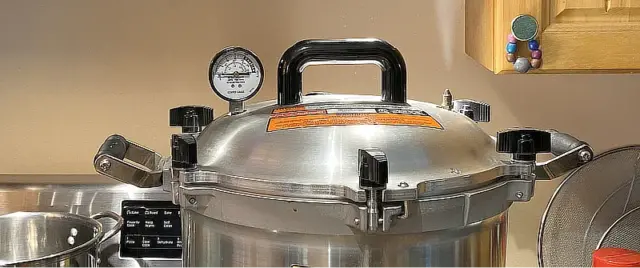
Weighted Pressure Regulator and Dial
Another feature I like is that the All American has both the pressure regulator weight and a dial gauge.
The regulator can be set for 5, 10 or 15 PSI.
The weight controls the processing pressure while the dial gives you a useful visual indication of what’s happening inside the canner.
The lid also has an over-pressure safety plug.
For actual food processing, always follow a current tested canning recipe and the manufacturer’s instructions. Pressure and processing time can change with the food and your elevation.
Made in the USA
All American pressure canners are made in the United States by Wisconsin Aluminum Foundry.
They’ve been making these heavy cast-aluminum canners for generations, and replacement parts are still available for many older units.

That’s one of the reasons I was willing to spend more for mine. This isn’t the kind of kitchen equipment I expect to replace every few years.
All American vs Presto Pressure Canner
I own both.
The obvious difference is price. A Presto pressure canner costs considerably less and can do the same basic job of safely pressure canning food when used correctly.
For someone who cans occasionally, I wouldn’t dismiss the Presto. Ours worked well.
The All American feels like a different class of equipment, though. The cast aluminum is very heavy, there’s no lid gasket to replace, and you have several sizes to choose from.
I also simply enjoy using the All American more.
If you’re only going to can a few batches each year, the additional cost may be difficult to justify. If you can a lot and expect to use the same canner for decades, that’s where the All American begins to make more sense.
For me, the 930 has worked out very well.
→ See all All American pressure canner sizes at Pleasant Hill Grain (Affiliate)
Related MSB Articles
👉 Pressure Canning Carrots
👉 Pressure Canning Chicken | How To Do It Yourself
👉 Canning Outside – The Best Hot Plate or Propane Burner
→ Ball Complete Book of Home Preserving on Amazon
#1 Best Seller in Canning & Preserving

→ The Complete Guide to Pressure Canning on Amazon
1 Best Seller in Pressure Cooker Recipes

Read the full article here
6 Comments
Solid analysis. Will be watching this space.
Interesting update on All American Pressure Canner Sizes: 921 vs 925, 930 and More. Looking forward to seeing how this develops.
Good point. Watching closely.
This is very helpful information. Appreciate the detailed analysis.
Great insights on Hunting. Thanks for sharing!
I’ve been following this closely. Good to see the latest updates.