

Listen to the article
If you’re searching for the highest ORAC value in the world, the top two known sources today are Dragon’s Blood (a tree resin) and Astaxanthin (natural algae-derived antioxidant). Below is a ORAC Top 100 list based on the original USDA ORAC tables (no longer published) along with updated research notes and recommended high-ORAC foods (fruits, spices/herbs).
Quick Summary:
ORAC (Oxygen Radical Absorbance Capacity) measures the antioxidant strength of foods, herbs, and supplements. The highest natural ORAC sources ever recorded are Dragon’s Blood (2.89 million) and Astaxanthin (2.82 million). Among whole foods, the top categories are spices, berries, and certain fruits.
I’ve researched ORAC values and antioxidant supplements for more than a decade, and this page is updated regularly as new data emerges.
Disclaimer: This is simply what my research has uncovered. There may be other data out there showing different results. Please use this information as a starting point and verify as needed.
Contents (Jump to a Section)
As an Amazon Associate I earn from qualifying purchases.
(no extra cost) Thank you
The ORAC value of the following products, spices, herbs, foods, and berries is very high, so they are worth considering for your overall health and well-being.
ORAC stands for Oxygen Radical Absorbance Capacity. The National Institutes of Health in Bethesda, Maryland, developed the ‘USDA Database for the Oxygen Radical Absorbance Capacity (ORAC) of Selected Foods’ from which some of this data is sourced.
ORAC units measure the antioxidant capacity of foods. Higher ORAC value units have the potential for better health.
(Consult your doctor for medical advice.)
It is widely believed that foods high in antioxidants help lower the risk of cancer, degenerative diseases, and other diseases.
The following list includes foods and spices/herbs with high ORAC values. You might consider increasing your intake of them in your regular diet.
About ORAC Score
Quick Summary:
- ORAC values compare antioxidant capacity per 100g
- Normalized for comparison only
- USDA discontinued the database in 2012
- Values can vary by source, growing conditions, etc.
More Detail:
The ORAC values in this list are normalized to 100 grams of weight (~ 3.5 ounces) because that is how the original database of information was presented. The intent is to ‘normalize’ the various items to compare ‘raw value,’ NOT ‘amount per serving.’
This ORAC list does not factor in or attempt to suggest the quantities that a person would typically eat in one serving (for example, who would eat 3.5 ounces of cloves in one serving?). I simply intend to point out which ‘foods’ are literally the highest in ORAC value (that I could find information about).
The ORAC value of a given food may vary due to factors such as growing conditions, processing conditions, specific variety, and others.
Data sourced from the US Department of Agriculture during 2010. The USDA recommends consuming approximately 3,000 to 5,000 ORAC units daily.
ORAC values listed here are in units of µmol TE/100g (micromol Trolox Equivalent per 100 grams). Trolox equivalency is used as a benchmark for antioxidant capacity.
The list I’ve put together here is not all-inclusive
Source: USDA’s Nutrient Data Laboratory (NDL)
Update: Sometime in 2012, the USDA removed its ORAC listings. The original was titled, “USDA Database for the Oxygen Radical Absorbance Capacity (ORAC) of Selected Foods, Release 2 – Prepared by Nutrient Data Laboratory, Beltsville Human Nutrition Research Center (BHNRC), Agricultural Research Service (ARS), U.S. Department of Agriculture (USDA) – May 2010.”
Why did USDA remove ORAC?
My understanding is as follows… The USDA discontinued the database in 2012 because supplement companies were misusing ORAC scores as marketing claims. The underlying science remains valid, but ORAC was never intended as a health claim system.
Highest ORAC Value Product In The World
Before diving into the ORAC value list below, it’s natural to wonder: What has the highest ORAC score ever measured? After revisiting the research, including antioxidant-rich foods, spices, herbs, and now supplements, the answer becomes surprisingly clear.
Two products stand out far above all others known today.
Dragon’s Blood (Highest Known ORAC Value)
Several years ago, my research focused exclusively on foods and spices listed in the USDA ORAC tables. However, expanding that research to include natural supplements revealed an extraordinary outlier: Dragon’s Blood.
Dragon’s Blood isn’t from a mythical creature—it’s a deep red resin harvested from specific trees, traditionally used in various cultural remedies. Its antioxidant capacity is astounding.
- ORAC Value: 2,897,110 μmol TE/100g
- Status: Highest known ORAC value recorded
- Antioxidant comparison: Up to 6,000× the antioxidant power of vitamin C
Looking for high-quality options? Below are trusted products from reputable brands.
While not commonly consumed as a food, Dragon’s Blood resin still holds the highest ORAC value ever recorded. The product linked above exemplifies how this resin is often used in supplemental form, typically as a few drops diluted in water (or as directed on the label). Always follow the product instructions and use responsibly.
Astaxanthin (Natural, AstaReal® Source Recommended)
A close second—and highly practical as a daily supplement is Astaxanthin, a naturally occurring red carotenoid derived from microalgae. When sourced from AstaReal®, it is one of the most thoroughly studied antioxidants in the world.
Why AstaReal® matters:
Most astaxanthin on the market is synthetic. AstaReal® is natural, clinically researched, and produced by Fuji Health Science in the USA and Japan.
Research notes:
- Over 160 total studies
- Including 80+ human clinical trials specifically on AstaReal®
- Affirmed by the FDA as GRAS (Generally Recognized as Safe)
ORAC Value: 2,822,200 μmol TE/100g, just behind Dragon’s Blood.
My personal preference?
A 12 mg daily astaxanthin supplement from a reputable USA company that explicitly uses AstaReal® as the active ingredient. Based on my research, many brands that do not use AstaReal® appear to be of lower quality, so due diligence is important.
One of the highest ORAC-rated antioxidant supplements in the world.
- Natural algae-derived (NOT synthetic)
- Clinically studied: 160+ studies, 80 human trials
- Supports skin, eye, joint, and cellular health
- Only use brands sourcing from AstaReal®
👉 Check price & reviews on Amazon
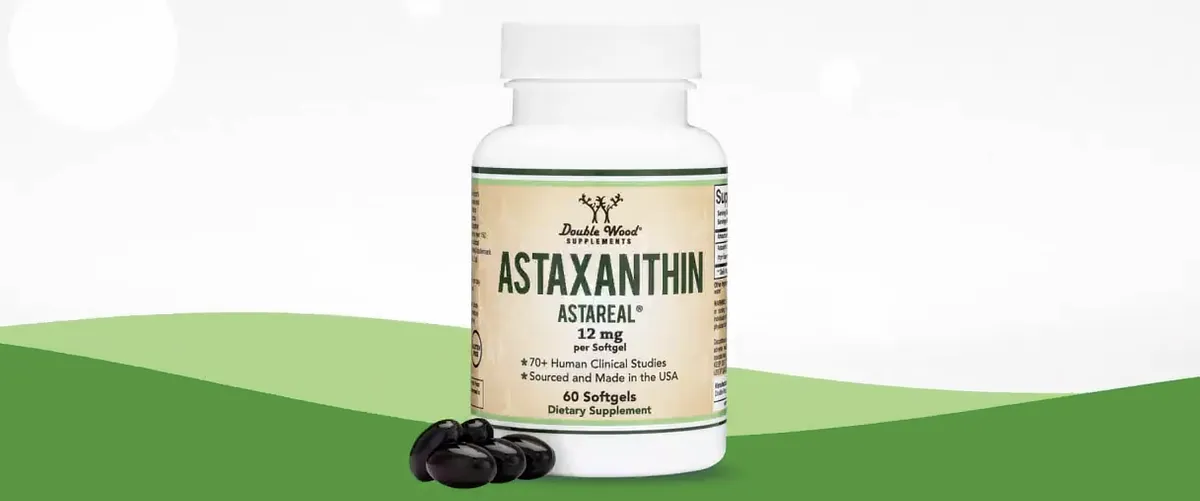
(This is what I take)
Highest ORAC Fruits
While spices and herbs dominate the top of the ORAC charts, several fruits also stand out for their exceptionally high antioxidant capacity. Below are the fruits with the highest ORAC values based on the Top 100 list compiled earlier.
Top High-ORAC Fruits (Overall)
1. Acai Berry (Freeze-Dried) – 102,700 μmol TE/100g
Acai berries are renowned for their antioxidant strength, especially in freeze-dried form, which concentrates their natural phytonutrients. They far surpass nearly all other berries in ORAC value.
2. Maqui Berry (Powder) – 75,000 μmol TE/100g
Maqui berries, native to South America, rank among the most antioxidant-dense fruits on the planet. The powder form retains and concentrates much of their natural potency.
3. Chokeberry (Aronia Berry) – 16,000 μmol TE/100g
Chokeberries (also known as Aronia berries) are among the most antioxidant-rich whole fruits studied. Their deep-purple colour comes from exceptionally high levels of anthocyanins and proanthocyanidins.
Highest ORAC Fruits Commonly Found in Grocery Stores
Most of the world’s highest-ORAC fruits (acai, maqui, elderberry) are specialty items or sold in powdered form. However, many everyday supermarket fruits also provide excellent antioxidant levels. The list below ranks the highest-ORAC grocery-store fruits from strongest to moderate.
1. Cranberries (Raw) – 9,584 μmol TE/100g
Raw cranberries are extraordinarily high in antioxidants—higher even than blueberries. Their tart flavor means most people consume them dried or sweetened, but the raw form offers the biggest nutritional impact.
2. Plums – 7,581 μmol TE/100g
Plums are one of the best antioxidant-rich fruits that people often overlook. They surpass nearly all common berries except cranberries.
3. Blueberries – 6,552 μmol TE/100g
Blueberries are famous for their antioxidant strength and remain one of the top choices for a daily, accessible, high-ORAC fruit.
4. Prunes (Dried Plums) – 6,552 μmol TE/100g
Prunes match blueberries in ORAC value and are widely available. Their polyphenol-rich profile contributes significantly to antioxidant activity.
5. Blackberries – 5,347 μmol TE/100g
Rich in anthocyanins, blackberries are another strong contender and a very accessible high-ORAC fruit.
6. Raspberries – 4,882 μmol TE/100g
Raspberries bring excellent antioxidant benefits while being one of the most commonly purchased berries.
7. Red Delicious Apples – 4,275 μmol TE/100g
Among apple varieties, Red Delicious consistently ranks highest in ORAC value due to its deep-red skin pigments.
8. Dried Peaches – 4,222 μmol TE/100g
Dried peaches have a surprisingly high antioxidant score—much higher than fresh peaches.
9. Granny Smith Apples – 3,898 μmol TE/100g
A crisp, tart apple with a strong antioxidant profile, ranking above many other common fruits.
10. Figs – 3,383 μmol TE/100g
Fresh or dried figs offer solid antioxidant content, along with fiber and natural sweetness.
11. Cherries – 3,365 μmol TE/100g
Sweet cherries, tart cherries, and their juices are all considered strong sources of anthocyanins.
12. Strawberries – 3,577 μmol TE/100g
Strawberries remain one of the most widely consumed antioxidant-rich berries and provide a solid ORAC score.
13. Red Grapes / Concord Grape Juice – ~2,377 μmol TE/100g
Red and purple grapes contain resveratrol and other polyphenols. Concord grape juice is particularly strong among fruit juices.
Highest ORAC Spices & Herbs
Spices and herbs dominate the very top of the ORAC scale. far surpassing fruits, vegetables, and most other plant foods on a gram-for-gram basis. Their extremely concentrated phytonutrients make them some of the most potent natural antioxidants known.
Below are the highest ORAC spices and herbs from the Top 100 list.
Top High-ORAC Spices & Herbs (Overall)
These spices sit at the pinnacle of antioxidant density. Even small amounts can significantly boost the antioxidant content of a meal.
Note: The spice and herb products linked below are sourced from trusted, well-known brands such as Simply Organic and Frontier Co-op. These companies are highly regarded for their clean sourcing, organic options, and consistent quality – important considerations when choosing antioxidant-rich spices.
1. Cloves (Ground) – 314,446 μmol TE/100g
Ground cloves hold the #1 spot on the entire ORAC list. Their extraordinary polyphenol concentration makes them the most potent antioxidant spice known. Commonly used in baking, spiced drinks, sauces, and ham glazes, cloves deliver a remarkable nutritional punch even in tiny amounts.
2. Sumac – 312,400 μmol TE/100g
Sumac is an ancient Middle Eastern spice with a tart, lemony flavor. It ranks almost identical to cloves in ORAC value and is traditionally sprinkled on meats, salads, and rice dishes. Sumac’s deep red pigments signal its high polyphenol content.
3. Cinnamon (Ground) – 267,536 μmol TE/100g
Cinnamon is one of the most commonly used antioxidant spices in the world, and one of the strongest. Its high ORAC value comes from cinnamaldehyde and other potent plant compounds. Popular in baking, oatmeal, beverages, and savory dishes.
Additional High-ORAC Spices & Herbs
These spices and herbs may not take the top three spots, but they remain exceptional antioxidant sources and are widely used in everyday cooking.
4. Oregano (Dried) – 200,129 μmol TE/100g
Dried oregano is extremely rich in polyphenols. Just a teaspoon provides a noticeable antioxidant boost. Excellent for Italian, Mediterranean, and Mexican dishes.
5. Turmeric (Ground) – 159,277 μmol TE/100g
Turmeric owes its high ORAC score to curcumin, the bright yellow compound known for its anti-inflammatory and antioxidant properties. Commonly used in curries, soups, and wellness blends.
6. Parsley (Dried) – 74,349 μmol TE/100g
Dried parsley has a surprisingly high ORAC value—far higher than most people expect. A single sprinkle adds color, flavor, and antioxidants to soups, stews, and sauces.
Everyday Spices & Herbs With Strong ORAC Values
These spices may be more familiar and frequently used, yet still provide impressive antioxidant potential in everyday cooking:
- Cumin Seed – 76,800
- Sage – 32,004
- Ginger (Ground) – 28,811
- Black Pepper – 27,618
- Thyme (Fresh) – 27,426
- Marjoram (Fresh) – 27,297
- Chili Powder – 23,636
- Paprika – 17,919
Even modest use of these spices can increase the ORAC value of a meal significantly.
Why Spices Rank So High
Spices and herbs are dense sources of essential oils, polyphenols, flavonoids, and other protective plant compounds. Because they’re consumed in small quantities, ORAC scores are normalized to 100 grams merely for comparison—not for suggested serving sizes.
Even a ¼ teaspoon of a high-ORAC spice can meaningfully increase the total antioxidants of a dish.
ORAC Value List, Top 100
Again, this ORAC score list does not account for or suggest the typical serving quantities that a person would consume.
Instead, it simply points out the ORAC value for each ‘food’ (at least those on which I could find information).
| 1 | Cloves, ground | 314,446 |
| 2 | Sumac bran | 312,400 |
| 3 | Cinnamon, ground | 267,536 |
| 4 | Sorghum, bran, raw | 240,000 |
| 5 | Oregano, dried | 200,129 |
| 6 | Turmeric, ground | 159,277 |
| 7 | Acai berry, freeze-dried | 102,700 |
| 8 | Sorghum, bran, black | 100,800 |
| 9 | Sumac, grain, raw | 86,800 |
| 10 | Cocoa powder, unsweetened | 80,933 |
| 11 | Cumin seed | 76,800 |
| 12 | Maqui berry, powder | 75,000 |
| 13 | Parsley, dried | 74,349 |
| 14 | Sorghum, bran, red | 71,000 |
| 15 | Basil, dried | 67,553 |
| 16 | Baking chocolate, unsweetened | 49,926 |
| 17 | Curry powder | 48,504 |
| 18 | Sorghum, grain, hi-tannin | 45,400 |
| 19 | Chocolate, dutched powder | 40,200 |
| 20 | Maqui berry, juice | 40,000 |
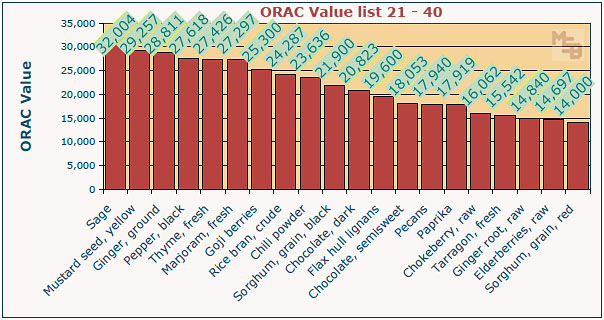
| 21 | Sage | 32,004 |
| 22 | Mustard seed, yellow | 29,257 |
| 23 | Ginger, ground | 28,811 |
| 24 | Pepper, black | 27,618 |
| 25 | Thyme, fresh | 27,426 |
| 26 | Marjoram, fresh | 27,297 |
| 27 | Goji berries | 25,300 |
| 28 | Rice bran, crude | 24,287 |
| 29 | Chili powder | 23,636 |
| 30 | Sorghum, grain, black | 21,900 |
| 31 | Chocolate, dark | 20,823 |
| 32 | Flax hull lignans | 19,600 |
| 33 | Chocolate, semisweet | 18,053 |
| 34 | Pecans | 17,940 |
| 35 | Paprika | 17,919 |
| 36 | Chokeberry, raw | 16,062 |
| 37 | Tarragon, fresh | 15,542 |
| 38 | Ginger root, raw | 14,840 |
| 39 | Elderberries, raw | 14,697 |
| 40 | Sorghum, grain, red | 14,000 |
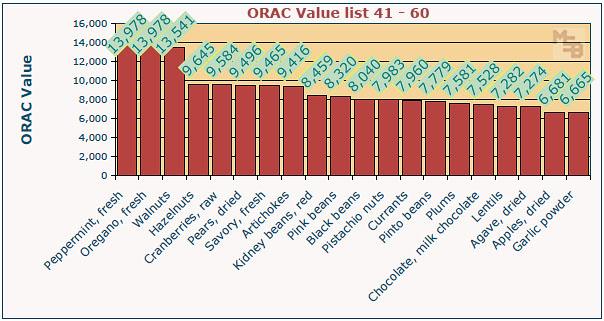
| 41 | Peppermint, fresh | 13,978 |
| 42 | Oregano, fresh | 13,978 |
| 43 | Walnuts | 13,541 |
| 44 | Hazelnuts | 9,645 |
| 45 | Cranberries, raw | 9,584 |
| 46 | Pears, dried | 9,496 |
| 47 | Savory, fresh | 9,465 |
| 48 | Artichokes | 9,416 |
| 49 | Kidney beans, red | 8,459 |
| 50 | Pink beans | 8,320 |
| 51 | Black beans | 8,040 |
| 52 | Pistachio nuts | 7,983 |
| 53 | Currants | 7,960 |
| 54 | Pinto beans | 7,779 |
| 55 | Plums | 7,581 |
| 56 | Chocolate, milk chocolate | 7,528 |
| 57 | Lentils | 7,282 |
| 58 | Agave, dried | 7,274 |
| 59 | Apples, dried | 6,681 |
| 60 | Garlic powder | 6,665 |
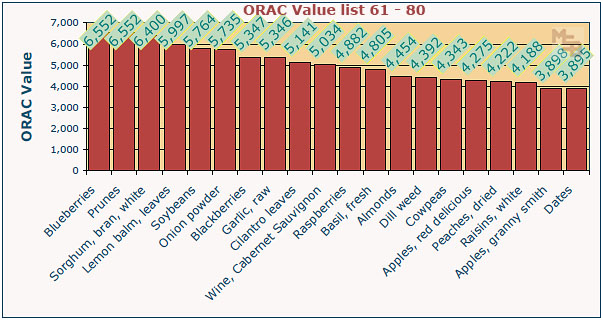
| 61 | Blueberries | 6,552 |
| 62 | Prunes | 6,552 |
| 63 | Sorghum, bran, white | 6,400 |
| 64 | Lemon balm, leaves | 5,997 |
| 65 | Soybeans | 5,764 |
| 66 | Onion powder | 5,735 |
| 67 | Blackberries | 5,347 |
| 68 | Garlic, raw | 5,346 |
| 69 | Cilantro leaves | 5,141 |
| 70 | Wine, Cabernet Sauvignon | 5,034 |
| 71 | Raspberries | 4,882 |
| 72 | Basil, fresh | 4,805 |
| 73 | Almonds | 4,454 |
| 74 | Dill weed | 4,392 |
| 75 | Cowpeas | 4,343 |
| 76 | Apples, red delicious | 4,275 |
| 77 | Peaches, dried | 4,222 |
| 78 | Raisins, white | 4,188 |
| 79 | Apples, granny smith | 3,898 |
| 80 | Dates | 3,895 |
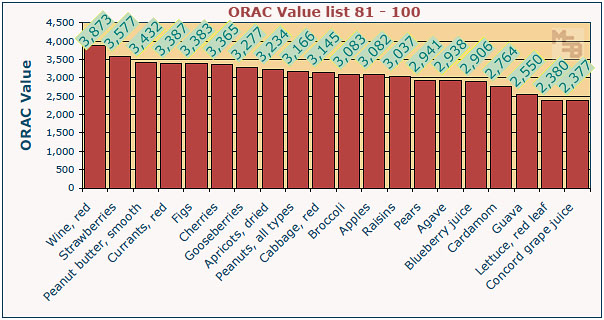
| 81 | Wine, red | 3,873 |
| 82 | Strawberries | 3,577 |
| 83 | Peanut butter, smooth | 3,432 |
| 84 | Currants, red | 3,387 |
| 85 | Figs | 3,383 |
| 86 | Cherries | 3,365 |
| 87 | Gooseberries | 3,277 |
| 88 | Apricots, dried | 3,234 |
| 89 | Peanuts, all types | 3,166 |
| 90 | Cabbage, red | 3,145 |
| 91 | Broccoli | 3,083 |
| 92 | Apples | 3,082 |
| 93 | Raisins | 3,037 |
| 94 | Pears | 2,941 |
| 95 | Agave | 2,938 |
| 96 | Blueberry juice | 2,906 |
| 97 | Cardamom | 2,764 |
| 98 | Guava | 2,550 |
| 99 | Lettuce, red leaf | 2,380 |
| 100 | Concord grape juice | 2,377 |
I compiled this list way back in ~2011, after reading the original report. It is not all-inclusive, and there are likely other food products that could be inserted into my data. However, it does offer some insight for those interested.
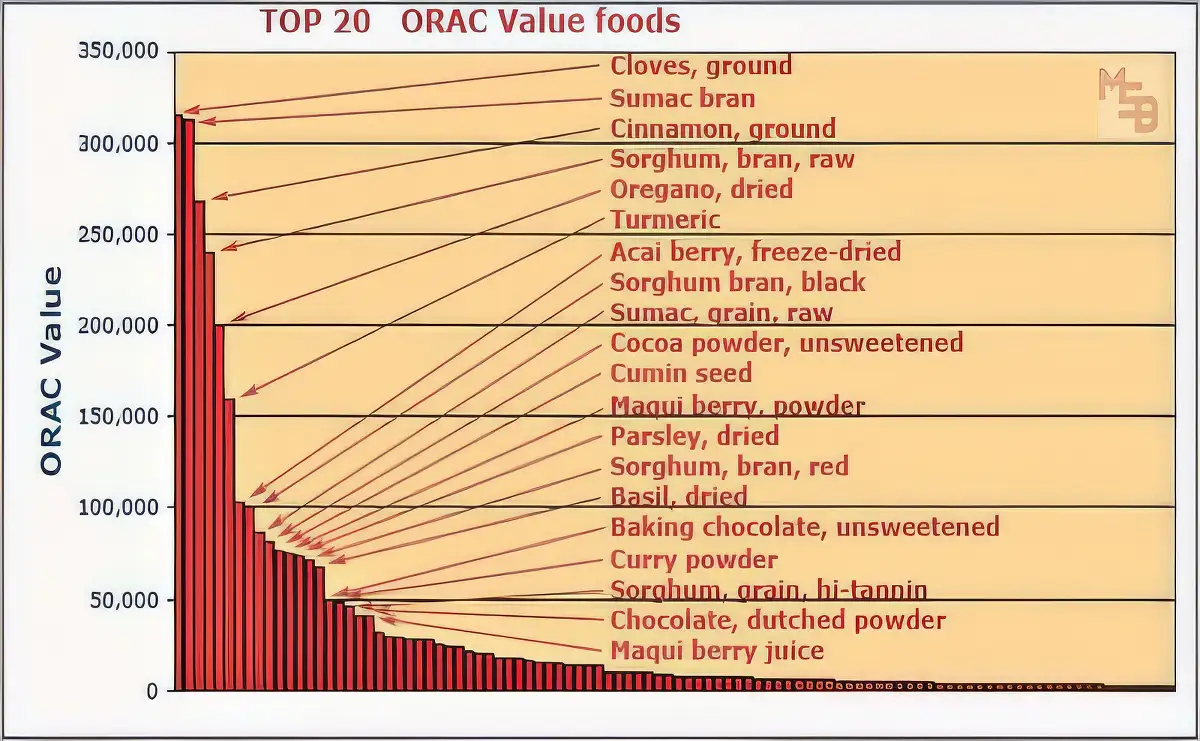
Within the realm of spices and herbs, Ground Cloves are very high in antioxidants, with an ORAC value of 314,000 µmol TE/100g (see explanation below). They are used in baked sweets, meats, ham, sweet potatoes, baked beans, BBQ and tomato sauces, pumpkin pie, and gingerbread…
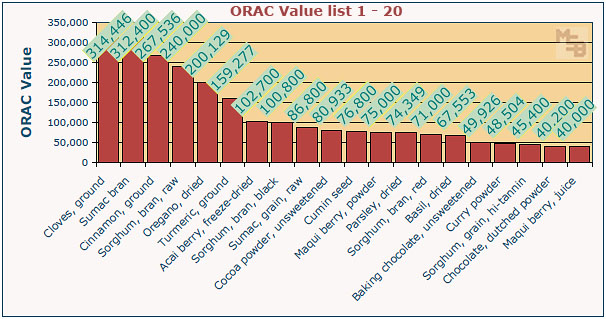
ORAC Value Top 20 list
[ Read: STUDY FINDS 2 Tbsp Cocoa a Day Helps Keep Memory Loss Away ]
[ Read: Mayan Cacao Powder: A Super Food ]
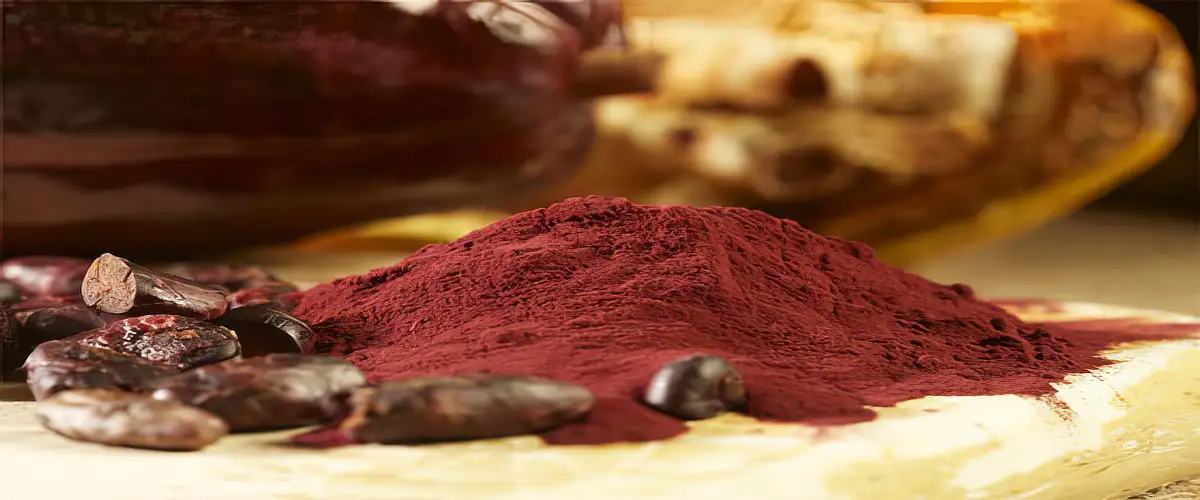
ORAC value of Cacao powder is 95,500 μ mol TE/100g.
ORAC Value list 21 – 40
ORAC Value list 41 – 60
[ Read: 10 Powerful Spices! ]
ORAC Value list 61 – 80
[ Read: Turmeric SUPER SPICE – Home Remedies ]
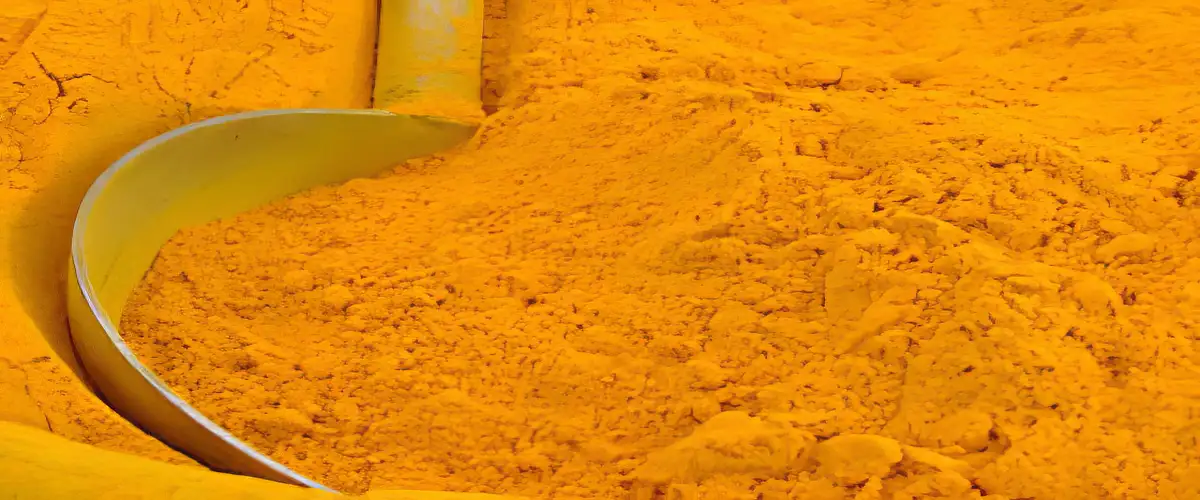
The ORAC value of ground turmeric spice (updated) is 127,068 μ mol TE/100g.
ORAC Value list 81 – 100
Read the full article here
21 Comments
It’s interesting that Astaxanthin, derived from algae, has the second-highest ORAC value at 2.82 million – what are some common sources of this in our diets?
The recommendation to consume 3,000 to 5,000 ORAC units daily seems like a good starting point, but how does one realistically achieve this through diet alone?
Incorporating high-ORAC foods like berries and spices into every meal can help reach this goal, but it might require some meal planning and research.
The discontinuation of the USDA database in 2012 raises questions about the current accuracy of ORAC values – are there any ongoing studies to update this information?
The potential for high-ORAC foods to lower the risk of cancer and degenerative diseases is compelling – what other health benefits have been associated with these foods?
Normalizing ORAC values to 100 grams of weight makes sense for comparison, but it’s also important to consider typical serving sizes for practical application.
Absolutely, understanding both the raw value and the serving size is crucial for making informed dietary decisions.
The fact that Dragon’s Blood has an ORAC value of 2.89 million is astonishing, I had no idea tree resin could have such high antioxidant strength.
Yes, it’s quite remarkable, and the potential health benefits of incorporating it into our diets could be significant.
The distinction between ‘raw value’ and ‘amount per serving’ is important – are there any resources that provide guidance on serving sizes for high-ORAC foods?
Incorporating high-ORAC foods into my diet has been a challenge, but learning about the benefits of berries and certain fruits has been motivating.
Finding recipes that incorporate these foods can make it more enjoyable and help maintain a balanced diet.
I’m curious about the variations in ORAC values due to growing conditions and processing – does this mean the same food can have drastically different antioxidant capacities?
Given that the ORAC values can vary by source and growing conditions, how reliable are the values listed, and should we be considering other antioxidant measures as well?
I’ve been looking into antioxidant supplements, and this list is incredibly helpful – can you recommend any specific products or brands that align with these ORAC values?
The mention of degenerative diseases and the potential role of antioxidants in prevention is intriguing – are there any specific diseases where high-ORAC diets have shown promise?
Considering the ORAC values per 100 grams, how does one balance the desire for high antioxidant intake with calorie and nutritional balance in the diet?
I’m skeptical about the environmental impact of sourcing Dragon’s Blood and Astaxanthin – are there any sustainable sources or alternatives being developed?
The variety of spices and herbs with high ORAC values is impressive, especially cloves, which I had no idea were so potent.
Yes, incorporating a range of spices into your cooking can significantly boost the antioxidant content of your meals.
The role of the National Institutes of Health in developing the ORAC database is notable – what other research initiatives are they involved in related to antioxidants and nutrition?