

Listen to the article
I am a fan of the Ruger Redhawk line of revolvers and have several chambered in .357 Mag., .44 Mag. and .45 Colt/.45 ACP. I also have a Super Redhawk chambered in .454 Casull. As a recent retiree, I now have time to spend time on the range shooting these revolvers. Due to the volume I am shooting, I usually shoot lighter-recoiling ammo in each of the revolvers to preserve my hands as much as anything.
While at the range this past weekend, one of the more knowledgeable members of my club came over to visit and see what I was shooting. When he saw that I was shooting abbreviated cartridges in my revolvers, he became very serious and told me that if I truly valued my guns, I would stop shooting the shorter cartridges in my revolvers immediately. When I asked him why, he said that it would damage the chambers, making it so I could never use the full-length cartridges the guns were chambered for again.
I thanked him for his advice, subsequently packing up and going home to clean my guns and put them back in my vault. I have less than 500 rounds through each revolver, so I hope it is not too late to prevent damaging the guns any further than I already have.
How many rounds does it take in a quality revolver shooting the shorter cartridges to damage the chambers making it so I am not able to shoot the magnum loads if I ever decide to?
Manny Izzi, Secaucus, NJ
The short answer is you have nothing to worry about in shooting the shorter, lower-powered factory cartridges in the magnum chambers of your revolvers, especially if you clean the guns as you indicated after every range session.
Consider the .45 Colt/.45 ACP Redhawk revolver, for instance. Ruger condones and encourages owners of that particular model of revolver to shoot both cartridges without any reservation—as long as reasonable maintenance is performed as anyone would with a gun they cared about. The steel in the cylinders of these guns will withstand the pressures generated by either of these cartridges without damage for generations to come.
Some revolver shooters run into problems trying to chamber magnum cartridges after shorter cartridges have been fired extensively in their guns from a buildup of firing residue just in front of the cartridge case mouth. This is particularly prevalent when firing lead bullets, whether they are factory loads or not. Firing cast bullets—particularly in reloaded ammunition due to the nature of the lubricant and the bullet hardness, as well as sometimes higher velocities—tends to leave more fouling in the chamber just in front of the case mouth than a lower-powered swaged bullet prevalent in factory-loaded, lead-projectile ammunition.
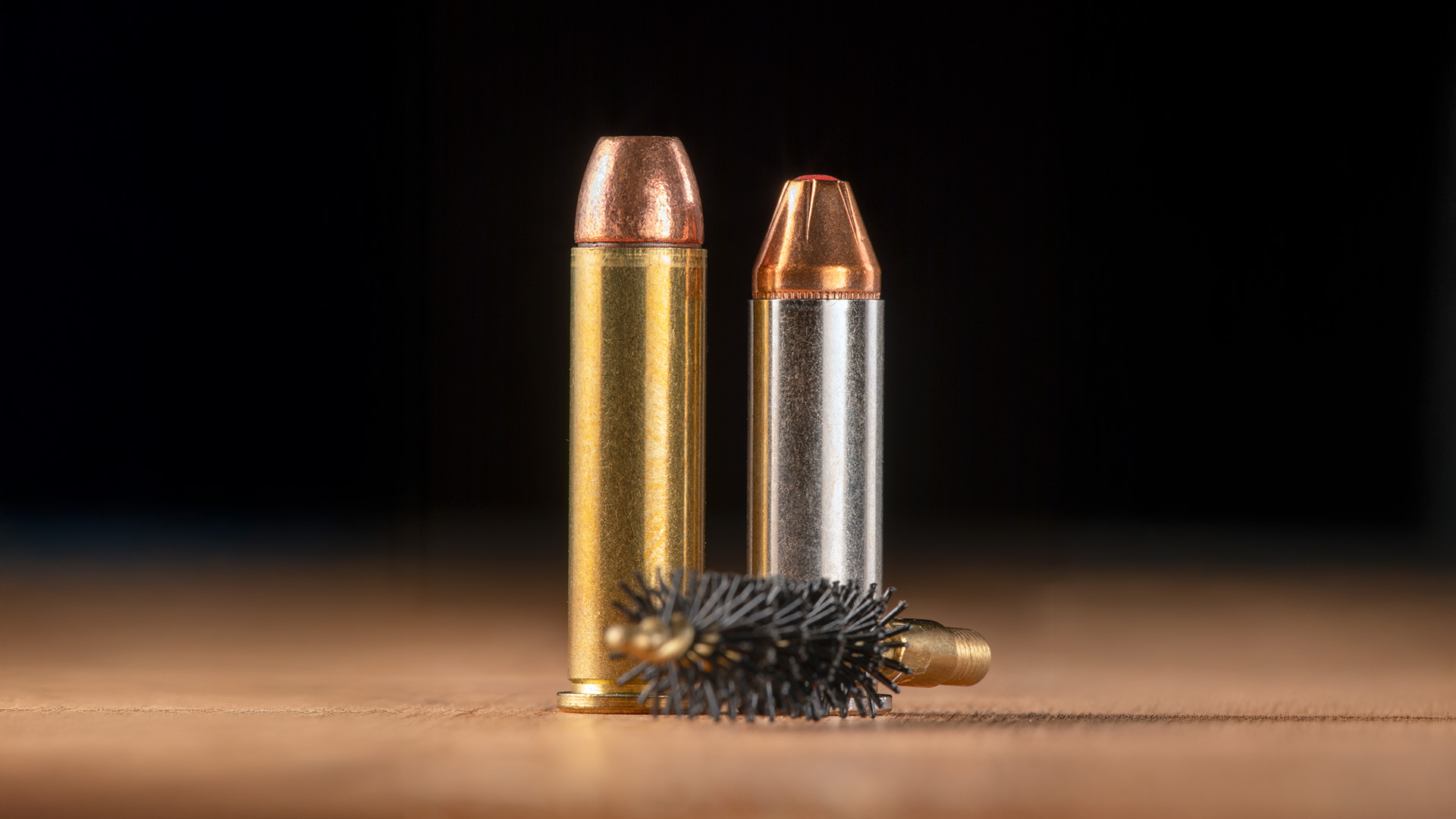
Over time, with high-volume shooting carbon and, to a lesser degree bullet-jacket material, can build up in the chamber, making the insertion of a magnum-length cartridge difficult and also making it difficult to extract after firing as well. The solution to overcoming all these issues is regular cleaning with a tight-fitting bronze- or brass-bristle chamber brush with a quality solvent followed by a few cleaning patches to remove the residue.
You can prove your work by inserting a full-length magnum cartridge into each chamber one at a time to ensure the cartridge seats completely and just as important, falls from the chamber with only gravity as its initiator. Do this in a safe area without any distraction so the cylinder is not inadvertently aligned with the barrel, causing a potentially unsafe condition where firing a gun would be inappropriate. It should be easy-in and easy-out with a full-length cartridge under the force of gravity with each chamber to verify the quality of your chamber cleaning.
Another consideration, even though it doesn’t seem applicable to your individual situation, is firing high-pressure cartridges in shorter-than-chamber-length cartridge cases. As long as you continue your low-pressure loads and regular cleaning afterward you have nothing to worry about.
As for your misinformed friend, the next time he offers a suggestion similar to the one he previously provided, nod approvingly and thank him for taking the time to try and help. Tell him that you will keep his suggestions in mind if and when you have any problems of that nature in the future. All the while with a prominent smile.
Read the full article here
19 Comments
The issue of chamber fouling is a critical one, and I appreciate the article’s emphasis on the importance of regular cleaning to prevent problems with cartridge extraction and chambering.
I’ve noticed that some revolver shooters are hesitant to shoot shorter cartridges in their magnum-chambered revolvers, but the article suggests that this is not a concern if proper maintenance is performed.
I’ve always been careful about cleaning my revolvers after shooting, but I didn’t realize the importance of using a tight-fitting brush to remove residue from the chamber.
The article’s statement that the steel in the cylinders of quality revolvers can withstand the pressures generated by either cartridge without damage for generations to come is reassuring, but I wonder if this applies to all types of steel used in revolver construction.
I’ve experienced difficulties with extracting magnum-length cartridges after shooting shorter cartridges, and I appreciate the explanation that regular cleaning with a tight-fitting brush can help overcome this issue.
The importance of regular cleaning cannot be overstated, and I appreciate the article’s emphasis on this point in preventing problems with chamber fouling and cartridge extraction.
I appreciate the article’s clarification on the differences between shooting lead bullets and jacketed bullets, and I’ll definitely take this into consideration when choosing ammunition for my next shooting session.
Manny Izzi’s concern about damaging his guns after shooting less than 500 rounds is understandable, but the article’s response suggests that he has nothing to worry about if he continues to clean his guns regularly.
The distinction between the effects of shooting lead bullets versus jacketed bullets on chamber fouling is an important one, and I appreciate the article’s clarification on this point.
I’m relieved to hear that shooting shorter cartridges in my revolvers won’t damage the chambers, but I’m still concerned about the potential effects on accuracy and overall gun performance.
I’m curious about the specific maintenance procedures that Ruger recommends for the Redhawk revolver, and whether these procedures differ from those recommended for other revolver models.
The article’s discussion of the differences between firing cast bullets and swaged bullets is informative, but I wonder if there are any other factors that can affect chamber fouling and cartridge extraction.
Ruger’s condoning of shooting both.45 Colt and.45 ACP cartridges in the Redhawk revolver without reservation is reassuring, but I wonder if this applies to all revolver models.
The article mentions that firing cast bullets tends to leave more fouling in the chamber than lower-powered swaged bullets, which is something to consider when choosing ammunition for high-volume shooting.
The article’s response to Manny Izzi’s concern is reassuring, but I wonder if there are any other potential issues to consider when shooting shorter cartridges in magnum-chambered revolvers.
One potential issue to consider is the effect of shooting shorter cartridges on the revolver’s timing and overall performance, which may require adjustment or maintenance to ensure optimal function.
I’m surprised that the article doesn’t discuss the potential effects of shooting shorter cartridges on the revolver’s accuracy, which could be an important consideration for target shooters.
I’m intrigued by Manny Izzi’s concern about damaging his revolvers by shooting shorter cartridges, but the article reassures that with regular maintenance, the steel in the cylinders can withstand the pressures generated by either cartridge without damage for generations to come.
The buildup of firing residue just in front of the cartridge case mouth when firing lead bullets is a critical issue to consider, especially when shooting extensively with cast bullets in reloaded ammunition.