

Listen to the article
Shield Sights, the company best known for pioneering the smallest open-emitter slide-mounted red-dot sights on the market, released a number of new products at SHOT Show 2025, and the OMSsc red-dot sight is one of those items. I recall it wasn’t too long ago that it made a splash when it was launched in conjunction with Springfield Armory’s new Hellcat OSP chambered for .380 ACP.
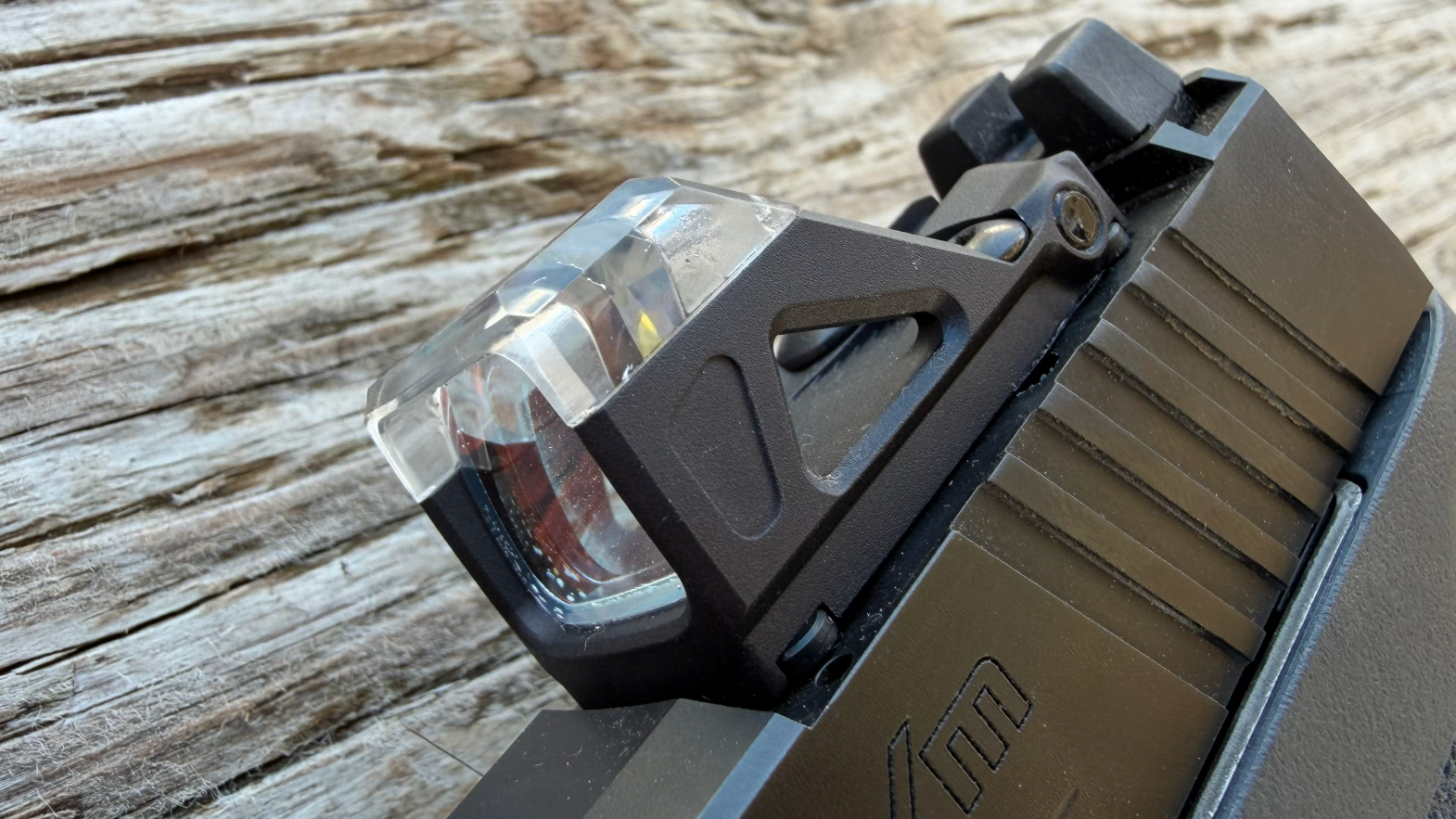
At first glance the OMSsc (Open Mini Sight subcompact) stands out for two reasons: First, it has a translucent clear acrylic top, a feature that Shield Sights is quite proud of. Second, the OMSsc is one of the physically smallest open-emitter red-dot sights currently available. I would be remiss for not mentioning that the OMSsc is also the sibling of the Shield Sights RMSsc (Reflex Mini Sight subcompact). And both sights share the same overall small dimensions.
Shield Sights OMSsc Overview
The OMSsc is an automatic (brightness adjusting), open-emitter red-dot sight built around an unconventional housing consisting of 6082-T6 aluminum and clear acrylic. Even amongst the smallest reflex sights, the OMSsc is tiny with its dimensions of 1.6x.74x.85 inches. Correspondingly, this sight also weighs less than .53 ounce. Naturally, being a Shield Sights product it uses the Shield Sights RMSc footprint, which has evolved into one of the industry standards for “slimline” carry pistols. That means that the OMSsc is guaranteed to fit on the slide of most micro-compact carry pistols.
Power-wise, the OMSsc uses a CR1632 coin battery. Its battery life has a typical runtime of 9,000 hours, or approximately one year of average use. Shield Sights sells the OMSsc with reticle options of either solid 4- or 8-MOA dots. The LEDs are listed as being red only, but my own eyes perceive the reflected dot in a hue closer to amber.
Shield Sights OMSsc reflex sights are low-profile sights in all regards. Besides their diminutive dimensions, the LED array works off a self-regulated sensor, so there are no power or brightness buttons. Similarly, in lieu of dials, the OMSsc uses two Allen screws to adjust either windage or elevation. These are to be used in conjunction with the Shield Sight’s “Mindial” that’s supplied in the box. The OMSsc also lacks a battery tray or housing. Instead, the battery sits underneath the optic’s deck. Accessing the battery does involve removing the sight from the pistol, but the trade-off is that this tiny sight sits very low relative to handgun slides, which makes it very easy for the OMSsc to co-witiness with standard-height iron sights–even on micro-compact pistols.
Clear Acrylic, Clear Glass
The OMSsc’s clear acrylic “roof” is its most eye-catching feature. Shield Sights’ impetus behind this design choice is that it wanted to provide its end-users with the clearest sight picture possible, the idea being the acrylic’s clear qualities will not obstruct the view downrange, especially around the edges of the sight’s housing. I’ll admit that the OMSsc is the first time I’ve gone hands-on with any Shield Sights product despite the company’s longtime industry presence. But, the fact that it sells both the clear-top OMSsc alongside the more conventional RMSsc indicates how strongly the company feels about the split 6082-T6 aluminum and acrylic housing design.
The other feature that caught my eye (pun intended) is the glass used in the OMSsc’s window. I couldn’t help but notice its high degree of clarity and lack of distortion. Whatever optical coatings this glass wears, my eyes cannot perceive any tints either. In short, the glass looks amazing.
RMSc Footprint Versatility Lets The OMSsc Sit On Various Slides
The OMSsc featured in this review was originally directly mounted to my Taurus GX4XL. On that gun, the OMSsc easily co-witnessed to the Taurus’ standard-height sights, which aren’t tall at all. In fact they’re fairly short. Though I shot the Ruger RXM with the OMSsc, I mention the GX4XL because the OMSsc was specifically created to have a symbiotic relationship with those narrow-slide carry guns. Besides the GX4 series, this applies to other makes and models, like Springfield Armory’s Hellcat family, SIG Sauer P365 family, Glock 43X MOS, Glock 48 MOS and the like. The OMSsc’s ultra-low profile form-factor meshes well with them.
I switched the OMSsc over to the Ruger RXM for a couple of reasons. Not only does the RXM’s unique optics factory cut allow the easy direct mounting of Shield RMSc footprint optics, it also provides me with another data point in observing how this low-profile carry sight integrates with another popular style of carry gun: Glock G19-sized handguns. Thanks to the Ruger RXM’s optics cut, the OMSsc’s smaller size and the RXM’s stellar iron sights, the combination co-witnesses amazingly and provides an overall pleasant sight-picture.
Since I also have a Cipher holster on-hand for the RXM, I can safely carry, draw and shoot the RXM + OMSsc combo with live ammunition.
Drawing And Shooting With the Shield Sights OMSsc
I shot approximately 200 rounds through the RXM and OMSsc combo. The shooting consisted both of slow, deliberate fire and several repetitions of more spirited drills like Bill Drills and Failure Drills. Besides taking advantage of getting some reps in, I also wanted to shoot this pistol spiritedly to see if that affected the optic. Far from being an exhaustive round count, I didn’t contend with any immediate issues. At the end of my shooting session, the M4 screws were still snug and the sight stayed zeroed.
I’ve spent 2025 working from concealment, and the efforts for this review were no different. All my draws were from the Henry Holsters Cipher at 7 yards on a standard IPSC target. My draw-to-first-shot times weren’t really different from my norm of around 1.4-1.5 seconds with a Glock G19-size pistol. In any case, the smaller window did not interfere with my own skill (or lack thereof). Throughout the various repetitions in drawing and firing from the holster, not once did the OMSsc’s smaller size become an issue in my own shooting.
The OMSsc’s overall compact sight makes it carry well, especially on a pistol like the RXM which includes its own generous optics-cut. Stowed in the Cipher holster, the roof of the OMSsc is nearly flush with the front edge of the holster which serves as the “tunnel” for tall iron sights that are typically paired with conventional red-dot sights.
Reactivity To Ambient Light
The OMSsc LED’s automatic adjustment sensor works reasonably well, as I experienced no disruptions. In terms of daylight bright, the reticle seems to be “bright enough.” The target backers at my gun club are white, and they tend to get quite bright and reflective when the afternoon sun shines on them. The reflection didn’t wash out the reticle, as I could still see it. I doubt it will glow nuclear-bright like a manually adjusted Aimpoint on the maximum setting, but it still worked. Mind you, the stall at my shooting club is directly under a roof which could have affected the sensor. Overall, the dot’s minute-to-minute brightness was satisfactory. Transitioning from concealment garment to the “outside” didn’t really affect the sensor much.
When dry-firing indoors or when being outside in trickier light conditions, I can sense the dot’s refresh rate (flicker) a little more, but it will acclimate. It appears as if it is programmed with a reasonable brightness level in darker conditions. Shield Sights does claim that its acrylic roof helps its light-gathering abilities.
The OMSsc is my first exposure to auto-adjusting red-dot sights, so I can’t provide a reasonable comparison to other models at this time. But, as someone used to high-end, manually-adjusted reflex sights, I was not put off while evaluating the OMSsc in this regard. As far as acrylic top’s ease of “easily seeing the surrounding environment,” it neither helped nor took anything away. I still saw an outline as with any other sight. To give it some credit, I do like the consistency of the sight housing’s outline. It isn’t distracting by having the top or the sides being overly thick unlike other makes and models.
Acrylic Durability And Takeaway
With the understanding that the Shield Sights OMSsc’s primary role is to sit on top of a defensive carry gun’s slide, my only concern would be how it would fare when dropped from chest height over asphalt or concrete. No doubt an enclosed-emitter sight like the Aimpoint ACRO P-2 or Trijicon RCR would better resist that type of abuse–and the elements.
I won’t pound it into the pavement to prove a point. But considering it made through about 200 rounds or so without issues on the RXM, it just might be sturdy enough for a casual around-town carry gun. While the battery tray being hard to reach makes it a con compared to many of today’s carry reflex sights, the trade off is an amazing efficiency of size and an amazing ability to play with a given set of co-witnessing iron sights.
I was skeptical of such a tiny dot coming into this review, but I find myself rooting for it. Time will tell how it holds up over (reasonable) use.
Read the full article here
17 Comments
The fact that the OMSsc uses the Shield Sights RMSc footprint means it will fit on most micro-compact carry pistols, which is a big advantage for users who want a slimline carry option.
The OMSsc’s LED array works off a self-regulated sensor, which means there are no power or brightness buttons, do you think this will be a problem for users who prefer more control over their sight’s settings?
The use of 6082-T6 aluminum and clear acrylic in the OMSsc’s housing is an interesting combination, do you think this will provide adequate durability and resistance to wear and tear?
The use of two Allen screws to adjust windage or elevation on the OMSsc is an interesting design choice, do you think this will provide adequate precision and control for users?
I’m excited to try out the OMSsc on my micro-compact carry pistol, has anyone else had a chance to use this sight in real-world scenarios, and what were their experiences?
I’m curious about the battery life of the OMSsc, with a typical runtime of 9,000 hours or approximately one year of average use, how often do users need to replace the CR1632 coin battery?
The OMSsc’s weight of less than 0.53 ounces is impressive, how does this affect the overall balance and handling of the pistol when the sight is installed?
The OMSsc’s reticle options of either solid 4- or 8-MOA dots are a good starting point, but I wish there were more options available, such as a combination of dots and circles.
The OMSsc’s dimensions of 1.6x.74x.85 inches make it one of the smallest open-emitter red-dot sights available, which is impressive considering its automatic brightness adjusting feature.
I’ve heard that the OMSsc is the sibling of the Shield Sights RMSsc, what are the main differences between these two sights, and which one would be more suitable for my needs?
I’m impressed by the OMSsc’s low-profile design, which allows it to co-witness with standard-height iron sights, even on micro-compact pistols, this is a big advantage for users who want a slimline carry option.
The fact that the OMSsc is guaranteed to fit on the slide of most micro-compact carry pistols is a big selling point, but I’m concerned about the potential for compatibility issues with certain pistol models.
Shield Sights has a reputation for producing high-quality sights that are compatible with a wide range of pistols, so I’m confident that the OMSsc will fit my pistol.
I’m skeptical about the lack of a battery tray or housing on the OMSsc, won’t this make it more difficult to access and replace the battery when needed?
Actually, the design allows for easy access to the battery, and the trade-off is that the sight sits very low relative to handgun slides.
Shield Sights’ decision to use a clear acrylic top on the OMSsc is interesting, do you think this design choice will provide a clearer sight picture for end-users, especially around the edges of the sight’s housing?
Yes, the clear acrylic should provide an unobstructed view, but I’m concerned about its durability and potential for scratches or cracks.