

Listen to the article
When Everything Goes Dark: Why Communication and Navigation Matter
Picture this: you’re heading out on a weekend adventure or, worse, you’re in the middle of an emergency and suddenly your phone shows no bars. Your GPS stops responding. The familiar digital lifelines you rely on daily have vanished. It’s a sobering thought, isn’t it? But here’s the good news—this scenario doesn’t have to catch you off guard. When disaster strikes or you find yourself in a remote area, traditional communication systems and navigation tools often fail. Roads wash away, cell towers go down, and GPS signals can’t penetrate certain terrain. That’s not meant to scare you; it’s meant to empower you. By planning ahead for these communication and navigation limitations, you’re not being paranoid—you’re being smart. This is genuinely the difference between staying safe and mobile when things go sideways, and being stranded wondering what to do next.
Let’s be honest: our phones are extensions of ourselves. We use them for everything. But in a real emergency or when you’re off the grid, that smartphone becomes a brick without a signal. That’s why having a genuine backup communication plan isn’t optional—it’s essential.
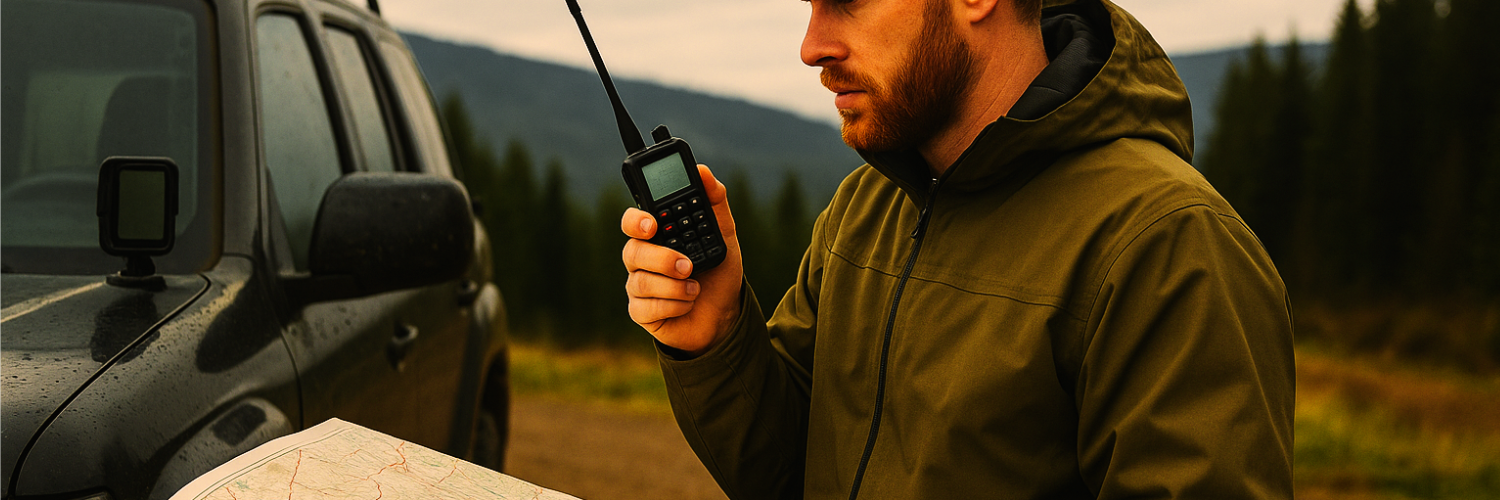
Radio systems are your best friend here. They work independently of cell towers, don’t require internet, and can reach people over impressive distances even in challenging terrain. If you’re new to this concept, don’t worry. Radio communication is easier than you might think, and there are several options depending on your needs and budget.
CB radios have been around for decades and remain incredibly popular within the off-road and adventure community (especially among Jeep enthusiasts). They’re affordable, widely used, and create an instant community of other travelers on the same frequency. If you’re joining the off-road scene, a CB radio connects you to a network that’s already out there.
GMRS radios (General Mobile Radio Service) are a personal favorite for many preparedness folks because they offer fantastic range, require no special knowledge to operate, and here’s the kicker—you only need a license, which now costs just $35 for a 10-year family license. Yes, one license covers your entire household. For that minimal investment, you get reliable communication across miles, even in remote areas. That’s genuinely hard to beat.
UHF/VHF radios are another solid option, particularly if you’re planning to be with a team or group. They’re great for coordinating between vehicles or within your party when you’re spread out across an area.
Why does this matter? In a genuine emergency—whether you’re navigating a natural disaster, dealing with a road closure, or coordinating with family members—these backup communication systems can literally be lifesaving. They work when nothing else does. We’re not talking about a luxury here; we’re talking about actual redundancy that keeps you connected when it matters most.
Navigation: Go Beyond Factory GPS
Here’s another uncomfortable truth: built-in vehicle navigation systems are convenient, but they’re not foolproof. They fail when signals drop (which happens more often than you’d think), they don’t always have accurate information about current conditions, and they sometimes lead drivers down roads that are no longer passable.
If you’re new to planning for navigation, the goal is simple: have multiple ways to figure out where you are and where you’re going.
Modern navigation apps loaded onto tablets or smartphones give you incredible flexibility. Apps like OnX allow you to download detailed topographic and off-road maps before you leave civilization, meaning you can navigate even without cell signal. This is genuinely a game-changer. You’re carrying sophisticated mapping technology that gives you options your factory GPS never will.
But here’s the catch: phones and tablets die, get damaged, or lose signal. This is where sturdy, reliable mounts come in. Securing your device so it doesn’t shift around during rough terrain keeps your navigation tool functioning when you need it most. A good mount isn’t sexy, but it’s absolutely practical.
And then there’s the old-school option that sounds outdated but actually saves lives: paper and offline maps. When your battery is dead, your signal is gone, and your tech has failed, a physical map still works. It doesn’t need charging, it doesn’t need a signal, and it never crashes. Learning to read a paper map might seem like a lost skill, but it’s one of the most reliable navigation tools you can carry. In a genuine emergency, you’ll be grateful you have it.
Why multiple navigation options? Because redundancy isn’t wasteful—it’s wisdom. If your primary system fails, you don’t get stranded; you switch to your backup.
Fuel and Water: Extend Your Range and Stay Alive
Running out of fuel during an emergency isn’t just inconvenient—it can be catastrophic. The same goes for water. These aren’t philosophical concerns; they’re survival basics. If you can’t move under your own power, you’re stuck. If you don’t have water, your body and mind start failing within hours.
The solution is straightforward: carry extra supplies strategically so you can extend your range beyond what the factory tank provides.
Rotopax fuel and water carriers have become popular in the preparedness community because they’re genuinely good at what they do. They’re compact enough not to eat up all your cargo space, durable enough to handle rough terrain, and they mount securely so they’re not banging around in the back of your vehicle. For someone new to this, they’re an excellent entry point into extended-range thinking.
If you’re planning for truly extended operations—think multi-day adventures or serious distance in emergency scenarios—an auxiliary fuel tank might be worth the investment. It’s a larger commitment in terms of installation and cost, but the peace of mind that comes from knowing you can go hundreds of extra miles? That’s valuable.
Why does this matter beyond just convenience? Because in a real emergency, being able to travel when others can’t moves you from vulnerable to capable. You become a resource rather than a liability. You can help others, navigate to safety, or reach a destination when everyone else is stranded.
First Aid and Emergency Kits: Prepare for Trauma
Here’s something many new folks to preparedness don’t want to think about but absolutely should: in a genuine emergency, professional medical help might not be available quickly. A vehicle accident in a remote area, an injury during off-road travel, or getting caught in a disaster zone means you might be the first responder for yourself or your companions.
This reality is why carrying medical equipment isn’t paranoia—it’s responsibility.
At minimum, you need a basic medical kit. This should handle cuts, burns, and minor wounds. It’s the foundation. But if you’re genuinely committed to being prepared, upgrading to something more comprehensive makes sense.
Specialized trauma kits go beyond Band-Aids. Trauma kits contain tourniquets, wound packing materials, and supplies designed for actual serious injuries. If someone is seriously bleeding in the back of your vehicle and professional help is 45 minutes away, these supplies might literally save their life. That’s not fear-mongering; that’s logistics.
The Fieldcraft Mobility Go Bag is particularly clever for beginners because it serves double duty. It mounts directly to your seatback, maximizing your limited vehicle space, but it also detaches to work as a standalone backpack if you need to go on foot. It comes with modular pouches, so you can organize medical gear, survival tools, and other essentials exactly how you want them. This kind of thoughtful design makes it actually likely that you’ll grab it when you need it, rather than having it shoved somewhere you forget about.
Additional options like modular visor panels and bleeding control kits might seem like overkill if you’re new to this, but they represent a philosophy: tiered preparedness. Start with the basics, then add capability as you get more comfortable and understand your specific needs.
Why invest in trauma supplies? Because the gap between a minor injury and a serious one is sometimes just luck—or lack thereof. Having these supplies on hand transforms that luck. You move from hoping everything will be okay to actually being equipped to handle serious situations.
The Bigger Picture
If this section seems like a lot to absorb, that’s fair. You’re essentially learning to think like someone who plans for uncertainty. But here’s the beautiful thing: you don’t have to do everything at once. Start with one or two improvements. Maybe it’s adding a GMRS radio this month and some offline maps next month. Build your capability gradually.
The reason we focus on communication, navigation, fuel, water, and medical preparedness isn’t because we expect disaster. It’s because when these systems fail—whether from a natural event, a mechanical breakdown, or being genuinely lost—these tools are what keep you safe, mobile, and capable. They transform vulnerability into resilience. And in preparedness, resilience is everything.
Read the full article here
13 Comments
The idea that our phones can become useless in an emergency or when off the grid is a wake-up call, and it’s essential to plan ahead and invest in alternative communication methods like radio systems.
CB radios have been around for decades and are popular among off-road and adventure communities, but I’m curious to know more about the range and effectiveness of GMRS radios in remote areas.
The fact that GMRS radios require no special knowledge to operate and can connect an entire household for just $35 makes them an attractive option for emergency communication.
That’s a great point, and I think it’s also important to consider the importance of having a license, as it ensures that users are aware of the proper procedures and protocols for using these radios.
The article mentions that radio communication is easier than you might think, but I’d like to know more about the potential challenges or limitations of using radio systems in emergency situations.
One potential challenge is the need for a clear line of sight between radios, which can be difficult in mountainous or urban areas with tall buildings.
The importance of staying connected and navigating the unknown cannot be overstated, and I think it’s essential to prioritize emergency preparedness and invest in reliable communication systems like radio radios.
I’m interested in learning more about the different types of radio systems available, such as GMRS and UHF/VHF, and how they compare in terms of range and effectiveness in various terrains.
The scenario where your phone shows no bars and your GPS stops responding is a sobering thought, and it’s crucial to have a backup communication plan in place, such as using radio systems that work independently of cell towers.
I completely agree, and I think it’s essential to consider the cost of a GMRS radio license, which is only $35 for a 10-year family license, making it a worthwhile investment for emergency preparedness.
The fact that roads can wash away and cell towers can go down in an emergency makes it clear that traditional communication systems can fail, and it’s crucial to have a reliable backup plan in place.
The article highlights the importance of having a backup communication plan, but I’m skeptical about the ease of use of radio systems for those who are new to them, and I think more guidance or training may be necessary.
I’ve had personal experience with UHF/VHF radios while hiking with a group, and they were invaluable for coordinating between team members and ensuring everyone’s safety.