

Listen to the article
If you’ve been to a natural-history museum (or watched anything from the “Jurassic Park” franchise on the big screen), you know that the period from the time dinosaurs became the dominant life form on the planet until a cosmic fender bender somewhere off the Yucatán Peninsula killed all of them except chickens, cockroaches, parrots and whatever those little brown birds are that sit in the tree over your car and poop on it was called The Age of the Dinosaurs.
Few stretches of dominance have run longer; not the Roman Empire nor even the Brady/Belichick-era New England Patriots.
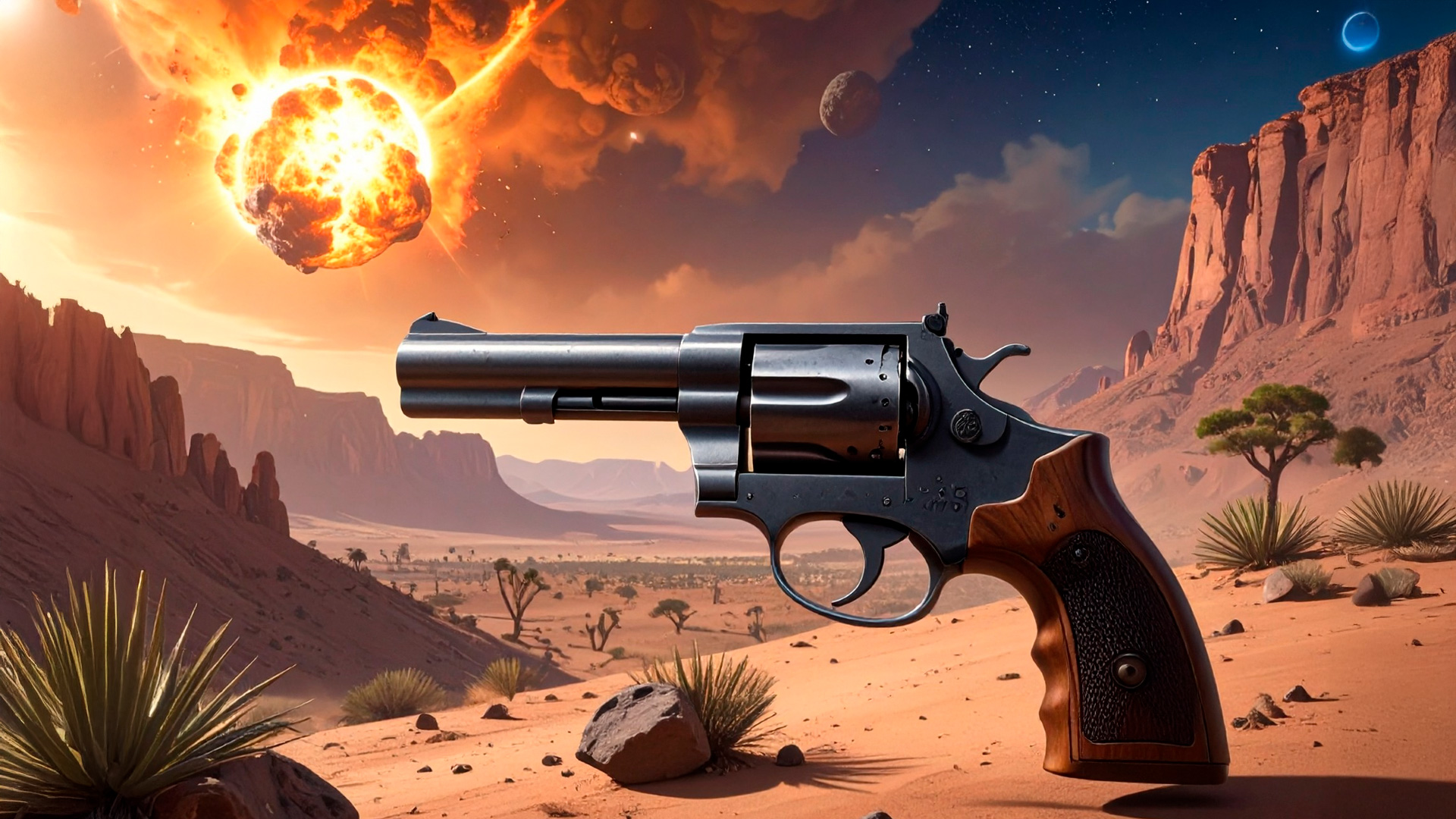
One stretch of dominance that was nearly as total, if somewhere in between New England’s in the AFC East and Rome’s in Europe and the Mediterranean littoral, was that of the medium-frame, double-action revolver, which reigned supreme in the United States for something like a century.
If we define the Age of the Medium-Frame Revolver as running from the first adoption of Colt’s Model 1889 by the U.S. Military to the abandonment of the Smith & Wesson Model 65 and Ruger Service-Six by the NYPD in favor of semi-automatic pistols, that’s a solid 105 years of duty.
During that era, medium-frame revolvers, usually in some variety of .38 caliber, could be found everywhere in our glorious United States.
The aforementioned Colt M1889 was followed by several other models from Colt and Smith & Wesson as the standard sidearms of the U.S. Military. Even after the military adopted a semi-automatic pistol in the shape of the Browning-designed M1911 in the early years of the 20th century, the medium-frame double-action (DA) .38-caliber revolver remained either the substitute standard or the standard issue for specific services and branches. The Smith & Wesson .38 Military & Police and the .38 Combat Masterpiece saw service as issue sidearms well into the Atomic Age and, in various logistical backwaters, outlasted the Cold War.
It wasn’t just with the United States military, either. Smith & Wesson alone produced mil- lions of M&P revolvers in the 20th century, and nearly countless numbers went to the armies of the United Kingdom and its empire (some as part of a business deal to salvage the Springfield, MA, arms maker that had originally contracted to develop a compact submachine gun for the Brits).
Many militaries embraced this classic design. From Spain to Brazil to the Philippines and beyond, clones of the Smith & Wesson medium-frame .38-caliber revolver became one of the most common handguns on the planet, in the millions.
On the domestic side of things, the medium-frame revolver was so common that its appearance on the screen, big or small, practically became shorthand for “the good guys.” Whoever was running around with that swing-out cylinder, double action in their hand, whether they were Barney Fife or the guys from “Adam-12,” was simply and obviously the Good Guy. The characters they were opposing had Lugers or M1908s or whatever and therefore were obviously the bad guys.
On the private-citizen side of things, the medium-frame revolver stood sentry every bit as diligently. In our grandparent’s era and back to our great-great-grandparent’s, the handgun on the top shelf in the closet or in the nightstand drawer (it was a more innocent time; we’ve learned more about good storage procedures and have access to better ready-storage fixtures since those days) kept American private citizens safe from burglars and home-invading bandits.
If I’ve got someone busting into my home downstairs, I’d certainly prefer to have a swing-out cylinder double-action revolver in a medium caliber with a handy reload if stuff goes pear-shaped, as opposed to a single-action .45 Long Colt thumb-buster with only five beans in the wheel in case I dropped it.
On top of that, it didn’t take long before these medium-frame revolvers began to be offered in barrel lengths other than the typical 3 to 6 inches.
Once 2- and 3-inch-barrel, medium-frame revolvers became popular among detectives and other plainclothes police officers, they saw a surge of popularity among private citizens who lived in states where there was a minimum of restrictions on concealed carry by private citizens.
In the earliest days of the Shall-Issue concealed-carry movement (propelled by the NRA) the once-considerable popularity of the medium-frame re- volver began to falter. The reasons for this are manifold.
Probably the least serious one is the “outgunned” one. On the one hand, nobody wants to be on the side of a gunfight where you have fewer BBs in your blaster than the other guy, but at the same time, it’s not deniable that the victory tends to go to the participant who can keep their gun in the fight longer.
During the 1980s and ’90s, though, pop culture had everyone convinced that law-enforcement officers were outgunned. A more pertinent and applicable worry was the difficulty of training rank-and-file officers to fire medium-frame, double-action revolvers decisively and accurately.
One problem was that mastering the long and heavy double-action revolver trigger pull was difficult. The temptation was always there to cock the revolver to the shorter, lighter single-action pull, but high-profile court cases caused that option to be eliminated. By the late 1980s, many large departments had gone over to double-action-only (DAO) triggers on their revolvers. Once this trigger-pull barrier was eliminated, it freed up the possibility of DA semi-automatics with similarly heavy triggers.
The other ding against the classic medium-frame revolver was the size of the handgun itself. Using the Smith & Wesson K-frame (Model 10 and its offshoots) as the test case, this is a frame size that is hard to get a proper trigger reach on unless you wear a men’s size “M” glove. If your hand is smaller than that, well …
An illustration of this is that back in the Age of Disco, when the NYPD authorized the Colt Official Police .38 and Smith & Wesson Model 10 as its official handguns, female officers whose small hands couldn’t handle the reach to the double-action trigger on the medium-frame guns could use a 3-inch, heavy-barrel version of the J-frame Model 36, a smaller five-shot revolver, as a substitute standard-issue duty gun.
Medium-frame revolvers still exist to this day, largely as rimfire, small-game-hunting wheelguns or niche gamer pieces, but it’s kinda sad to see that their frontline service in defense of our nation and cities has largely passed. The passing of the dinosaurs is lamented, too, but I doubt “Wheelgun Park” becomes a franchise.
Read the full article here
19 Comments
The adoption of the Browning-designed M1911 semi-automatic pistol by the US military in the early 20th century marked a significant shift away from revolvers, but it’s notable that medium-frame revolvers remained in use as substitute standards or issue sidearms for specific services.
It’s curious that the article mentions the medium-frame revolver’s dominance in the United States, but doesn’t explore its use in other countries, such as Spain or Brazil, in more depth.
Perhaps a follow-up article could delve into the international history of the medium-frame revolver and its various applications.
The medium-frame revolver’s influence on popular culture, from film to television, is a testament to its iconic status and enduring appeal, with characters like Barney Fife and the protagonists of ‘Adam-12’ becoming synonymous with the ‘good guy’ archetype.
The revolver’s appearance in these contexts has become a visual shorthand for authority and heroism.
The medium-frame revolver’s appearance in popular culture, particularly in film and television, has become synonymous with the ‘good guy’ archetype, as seen in characters like Barney Fife and the protagonists of ‘Adam-12’.
The Smith & Wesson medium-frame.38-caliber revolver’s widespread adoption by militaries around the world, from the UK to Brazil to the Philippines, demonstrates its versatility and effectiveness in various contexts.
It’s worth noting that many of these countries developed their own clones of the Smith & Wesson design, further highlighting its influence on handgun design.
The article’s mention of the Colt M1889 and its adoption by the US military is a great example of how the medium-frame revolver played a significant role in shaping the course of handgun development.
The medium-frame double-action revolver’s 105-year reign as the standard sidearm in the United States is a testament to its reliability and effectiveness, with models like the Colt M1889 and Smith & Wesson Model 65 seeing widespread use.
The fact that millions of M&P revolvers were produced in the 20th century highlights the revolver’s enduring popularity.
It’s interesting to note that the Smith & Wesson.38 Military & Police and the.38 Combat Masterpiece were still in service well into the Atomic Age.
I’m concerned that the article’s focus on the medium-frame revolver’s past glory might overlook its potential continued relevance in modern contexts, such as self-defense or sport shooting.
It’s true that the revolver’s design has been largely eclipsed by more modern semi-automatic pistols, but it still has its adherents and enthusiasts.
I’m skeptical about the statement that the medium-frame revolver is extinct, given its continued use in various logistical backwaters and its iconic status in popular culture.
The fact that the medium-frame revolver remained in use long after the introduction of semi-automatic pistols suggests that it had a certain enduring appeal or practical advantage.
It’s notable that the article highlights the medium-frame revolver’s use by the NYPD, which abandoned it in favor of semi-automatic pistols, marking a significant shift in the world of law enforcement.
The fact that the medium-frame revolver was produced in millions, with Smith & Wesson alone producing millions of M&P revolvers in the 20th century, underscores its significance in the history of handguns.
The comparison between the Age of the Dinosaurs and the Age of the Medium-Frame Revolver is an interesting one, highlighting the revolver’s lasting impact on the world of handguns.