

Listen to the article
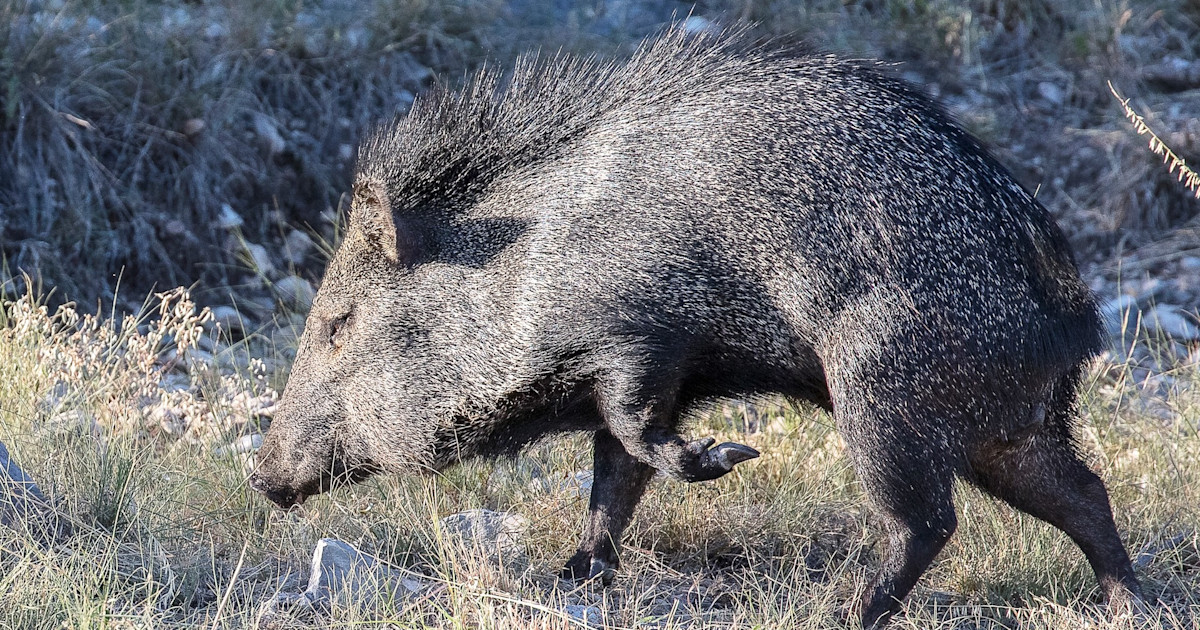
Javelina are one of the most underappreciated of all our big game species. Their unique history and physical features spark curiosity from hunters and other wildlife enthusiasts. What is not to like about a native pig-like critter that ekes out a living in dry, cactus-dominated Southwestern landscapes?
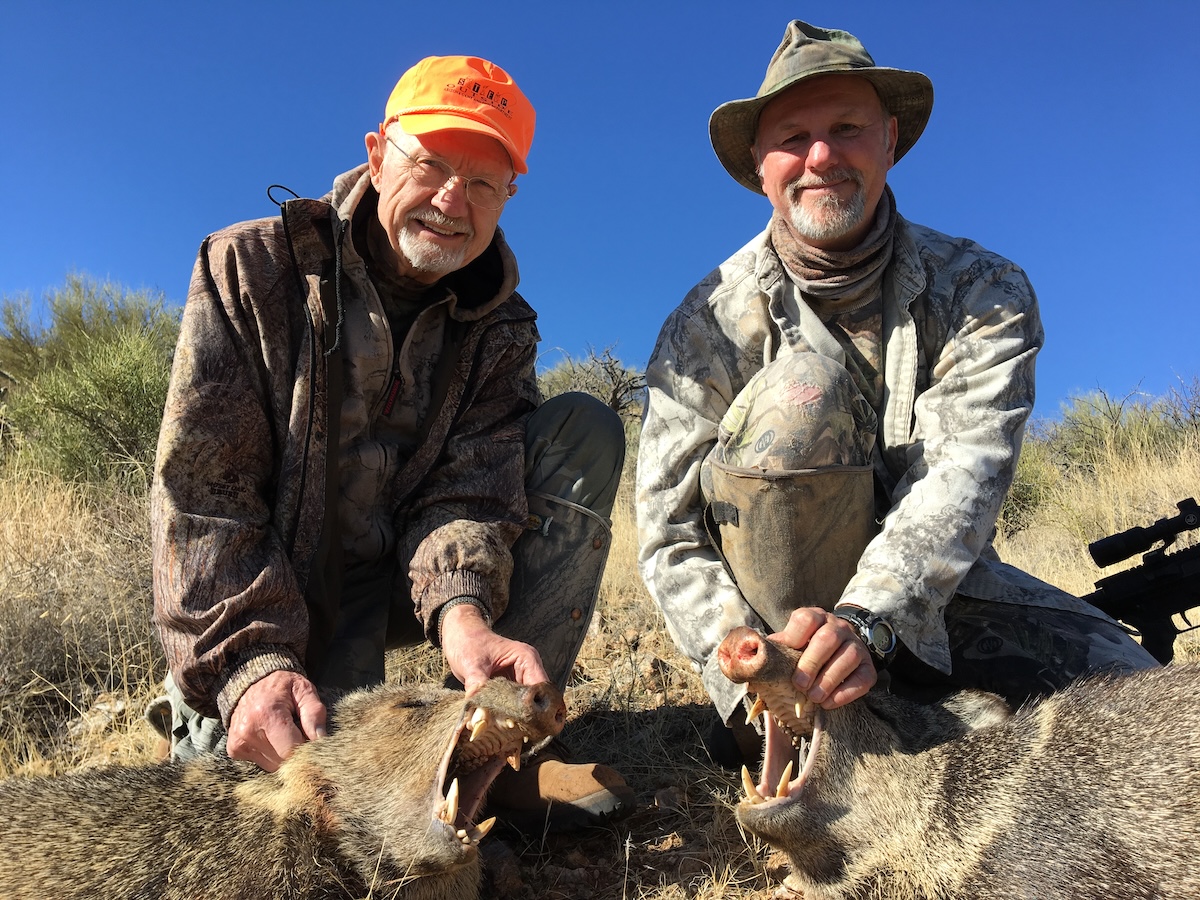
They are incredibly interesting native animals that can be hunted at times when other big game seasons have closed for the year. What other hooved big game animal does the taxidermist mount with its mouth open to show its huge, sharp canines in a menacing way?
Don’t Call Me a Pig!
Although we often affectionately call them pigs, javelina are not truly members of the pig family (Suidae); they have characteristics that are unique enough to be placed in a separate, but closely related, peccary family (Tayassuidae). The javelina is also known as the collared peccary, named for the white band, or collar, that runs across their shoulders. It shares the peccary family with two other species that live in southern Mexico and southward: the white-lipped and the Chacoan peccary. Javelina is not its official name, but is derived from the Spanish word “Jabali,” thought to refer to the sharp tusks like the javelin thrown in the Olympic Games.
Their eyesight is notoriously poor. They have small eyes that are not very adept at seeing objects at a distance. Since javelina evolved in the thick thorn scrub of Central America, they never needed to see much farther than 75 yards. Their sense of smell is their main defense, supplemented by average hearing. When they sense danger, they do not delay in getting away and are surprisingly fast for the short-legged, 30 to 50-pound porkers they are. The javelina “attacks” we sometimes hear about in the wild are probably javelina trying to get away, but with their poor eyesight, they just don’t know which direction “away” actually is.
Their famous self-sharpening canines look like something that might be used to deliver a killing bite to a horse, but are actually used to process vegetation. When habituated to humans (which they do, readily), they are unpredictable and will literally bite the hand that feeds them. When a javelina bites with its overlapping canine teeth, it creates a single wound channel through whatever extremity it feels like biting at the time. They seem to have no shortage of bacteria in their mouth, so infection is a real concern.
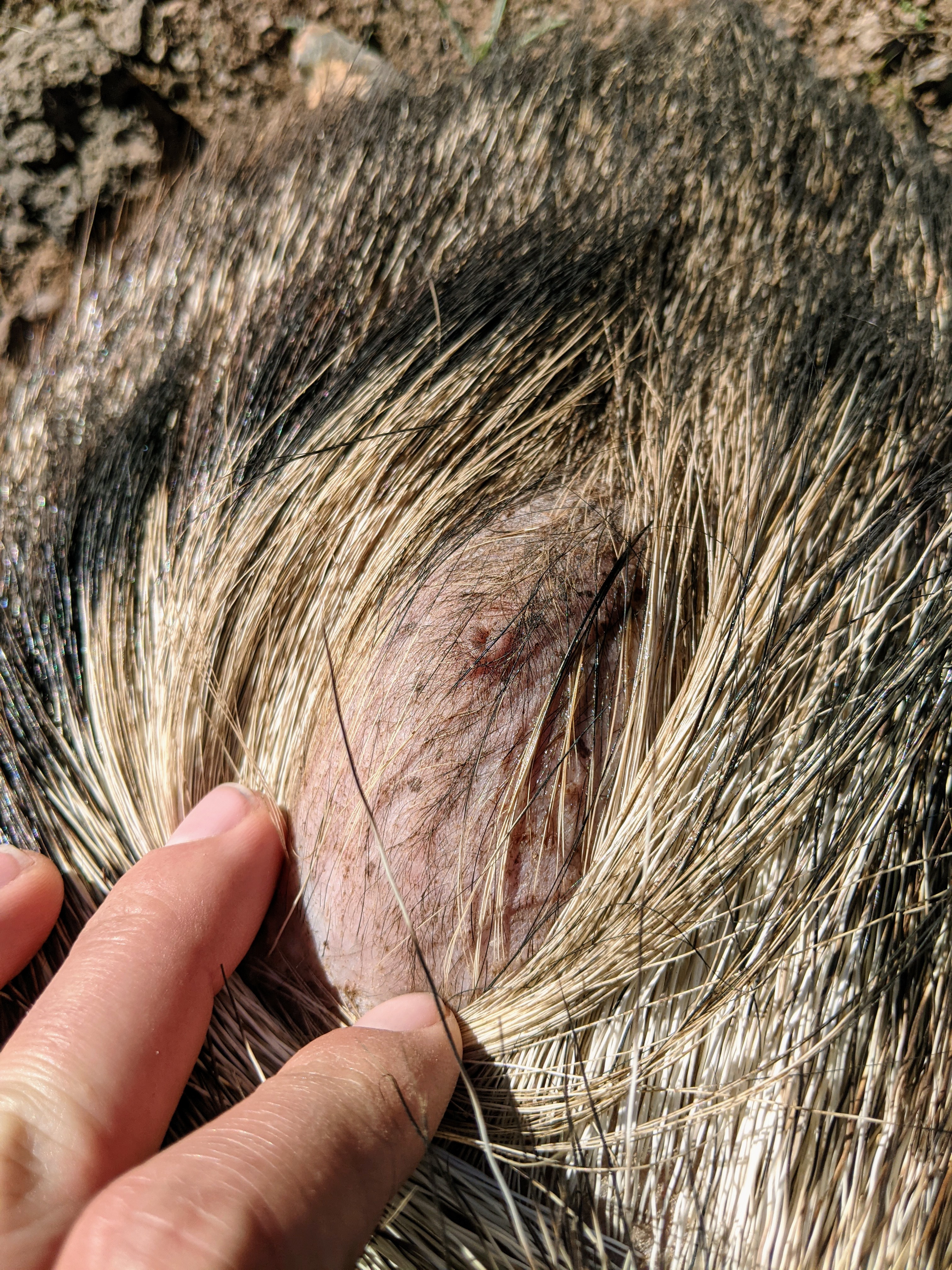
Besides the tusks, javelina differ from the real pigs in several important ways. The most obvious is the scent gland that both sexes have about six inches above the tail on the lower back. This tramp-stamp of a gland is filled with smelly (some might say nasty) clear liquid secretions that are used to mark their territory by rubbing the scent on rocks and trees. This scent gland also serves to identify individuals as members of the herd when they stand face-to-butt and rub the oily secretions on one another. This scent is easily detected when one gets close to a herd; some describe it as a skunky—or even marijuana—smell.
Javelina differ from pigs because they do not have a tail that is easily visible, they have three toes on the hind feet rather than four in feral hogs, only 38 teeth, a more complex stomach, no gallbladder, and a few other minor differences. Most of these differences are not very important to people who look at a javelina and think: “It looks like a pig, smells like a pig, and sounds like a pig.”
America’s Pig
Javelina (and all peccaries) are 100% American. In contrast, the real pig family evolved in Europe and was first imported to the Americas on a ship commanded by none other than Christopher Columbus in 1493. Peccaries, however, evolved in Central and South America and spread northward into North America. This northward spread occurred along the Pacific coast of Mexico, into Arizona and New Mexico, and also up the east side into Texas.
Although the journals of early explorers in the 1800s are sparsely sprinkled with reports of “Mexican hogs” along the rivers and lowland valleys of the Southwest, these critters were relative newcomers to the United States. Archeological remains around indigenous habitations prior to 1700 show no evidence of javelina. The first Europeans in the Southwest were probably documenting a relative newcomer that just barely beat them there. They have since continued a northward invasion even into the Ponderosa pine country in higher elevations of the American Southwest.
Their tough hides were shipped to the East Coast and on to Europe, not only for leather articles, but also for bristles used for brushes. There are historical reports of thousands and thousands of javelina hides being shipped out of the Southwest and Mexico. The hides were even used locally as barter in many trading posts along the Mexican border.
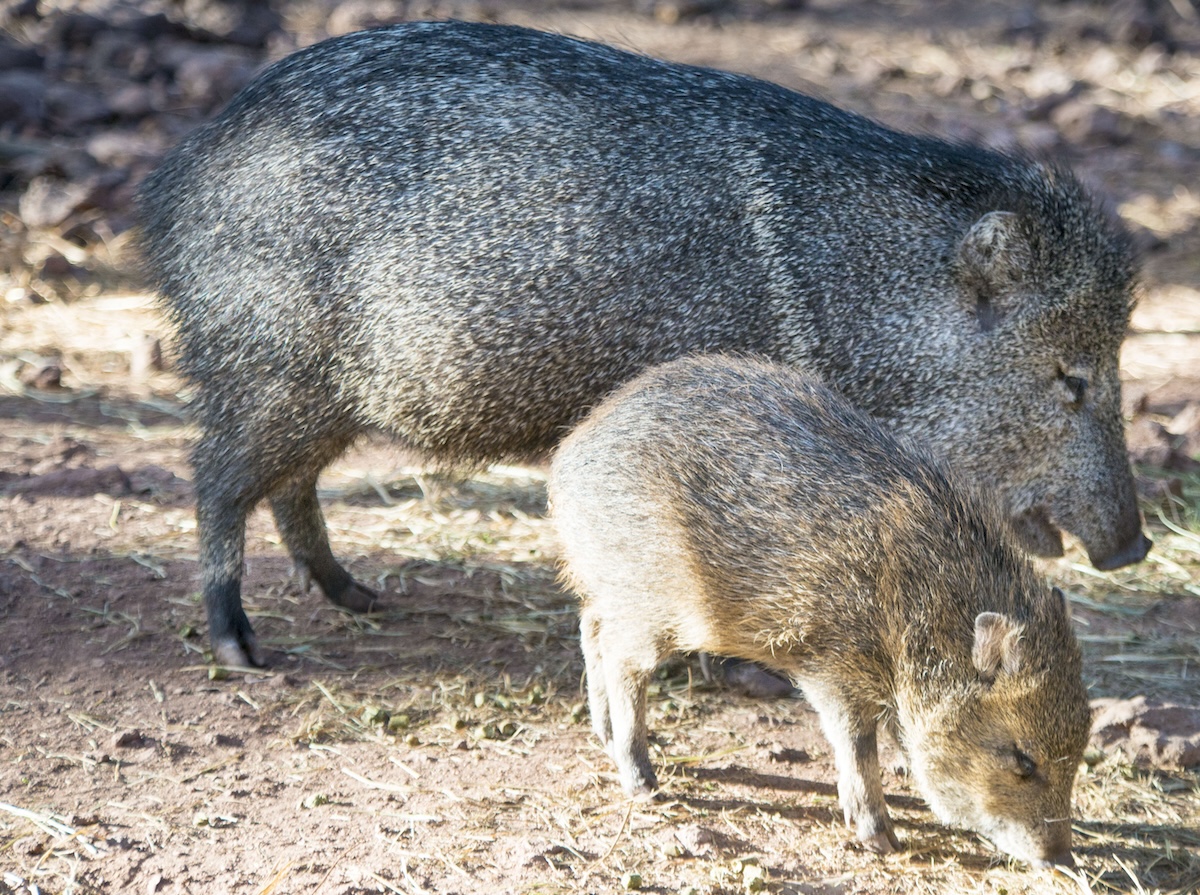
Being of a tropical origin, javelina breed year-round, with a peak in the Southwest’s mild winters and a pulse of young born during the summer. Most sows give birth to two piglets, which are called “reds” because they have reddish fur for the first few months. Reds suffer a fairly high mortality since they feed coyotes, eagles, bobcats, and anything else brave enough to attempt to outsmart or outrun a herd full of sharp tusks.
It is important to understand that these native mammals are not the exotic invasive hogs that now run feral in many states, rooting up the soil and snarfing down acorns to compete with other wildlife. Although they are physically similar to feral swine, their ecology and biology are as far apart as the continents they came from.
Javelina do use their snout to grub out roots of cacti and plants, but only enough to get at shallow roots and small plants held loosely by the hard desert soil. Feral pigs can start breeding at six months of age and have two litters of 10 piglets each year, which is more than 10 times the reproductive output of javelina. This difference means collared peccaries have to be carefully managed sustainably, not controlled as their feral cousins do.
Javelina Habitat
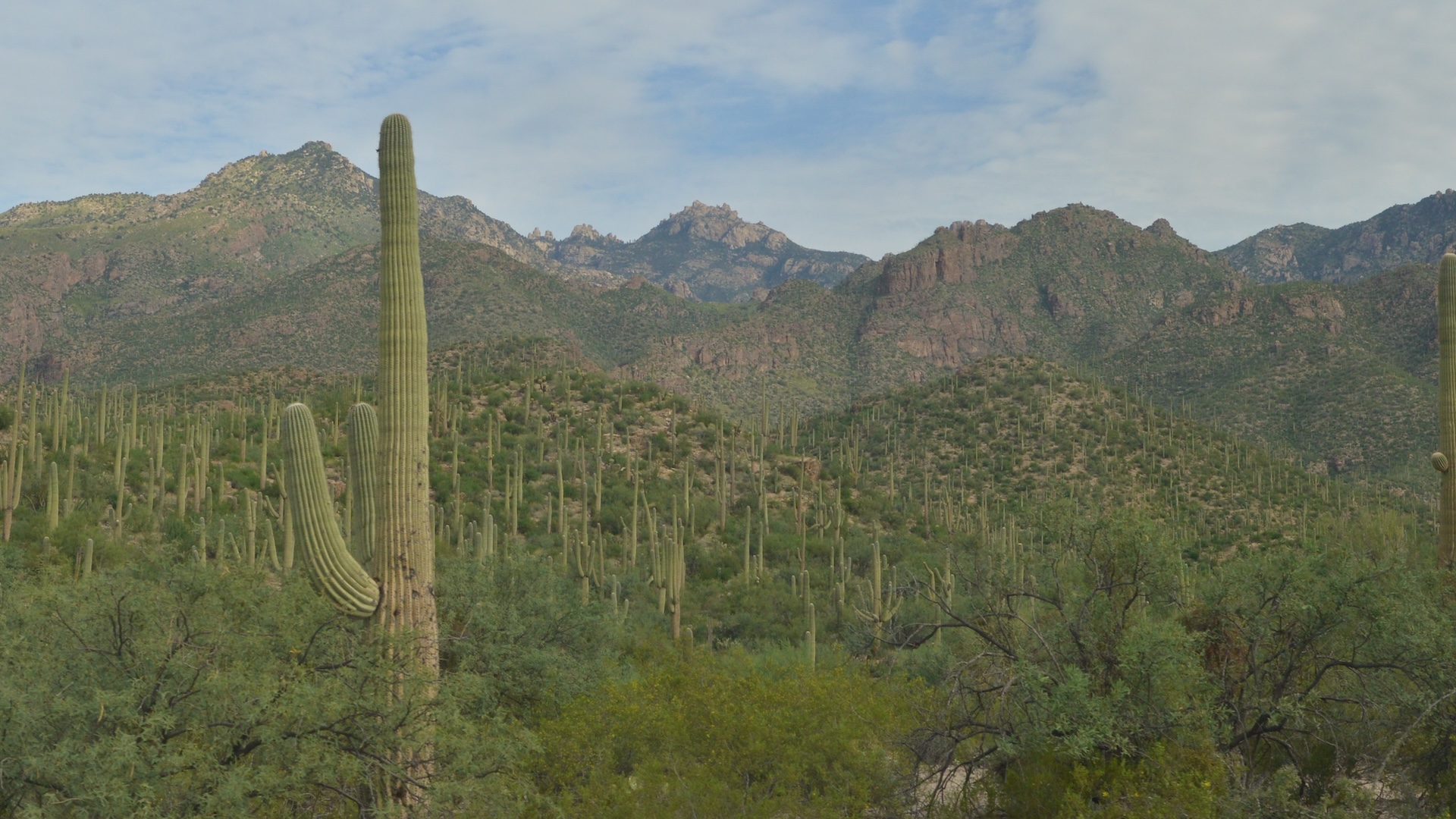
One would think such a stinky scent gland would relegate javelina to living a life in solitude, but they find safety in numbers and live in herds of seven to fifteen. Herds occupy territories ranging in size from 200 to 1,300 acres, depending on the productivity of the habitat to provide the space, food, water, and shelter needed to sustain themselves. These territories are defended against intrusion by other javelina herds, and dangerous little gang fights reinforce these boundaries.
In good javelina habitat, each territorial boundary abuts the boundary of adjacent herds, but they sometimes call a truce and agree to share a common watering source. They reach their highest densities in areas where the prickly pear cactus is dense and there is more than 50% brush canopy cover. As herds increase in size, they may get so large that they fragment into two smaller herds or simply disperse individuals to other nearby herds.
When feeding, javelina concentrate heavily on succulents such as prickly pear, hedgehog cactus, pincushion cactus, and agaves. The fruits and fleshy parts provide not only nutritious feed, but water as well.
When javelina feed on prickly pear pads, they grasp the pad and pull, which shreds the pad and leaves the stringy interior fibers visible. When they chomp down on a pad, they seem to give zero thought to being careful of the sharp spines. Small cacti, such as hedgehogs, are knocked over with a front hoof, and the insides are eaten out so that only the tough outer skin and spines remain. Lechuguilla, shin daggers, and other agaves are pulled apart and left scattered as the javelina eats the fleshy heart out of the plant. Roots and tubers are also dug or “rooted” up by javelina in search of a meal.
Southwestern Bacon
Javelina meat is criticized by some as not great table fare. Some have even gone as far as to suggest this is the reason we find no evidence of javelina in pre-1700 archaeological sites. Perhaps paleontologists should call this the “Precrockpot Period.” However, if properly cared for from field to table, javelina provide for good eating.
The key is to skin it and quarter it at your first opportunity. They are small big game animals, so it’s tempting to just carry it back to the truck. But, you have to butcher it somewhere, so just find the nearest mesquite or juniper and get that meat cooling off in clean game bags.
Don’t worry about that scent gland; it is embedded in the skin (not the meat). When you skin it, it will come off with the skin without you even noticing it. What you don’t want to do is carve it out and smear that oily scent all over your knife and hands. In fact, all the hairs of the javelina are covered with this scent from animals rubbing against each other, so it is important that you don’t touch the meat with the hand that has been holding the hide during the skinning process.
In their native range, javelina and other peccaries are heavily consumed by inhabitants of Central and South America, and in some areas make up a large percentage of the protein brought into these villages. Indigenous peoples in the Southwest and Mexico do not seem to have such a deep cultural tradition. There are several stories of native tribes not eating them, even when they had the opportunity.
It’s possible that since javelina expanded northward in the last few hundred years, they were never a strong part of their culture, or possibly even treated as taboo. Apache scouts traveling with General Crook in the late 1800s along the Mexican border pursued a group of “Jabali” with gusto that crossed their path and killed five of six, but did not eat them.
Being tropical animals, javelina do not have a fat layer, so the meat has to be cooked differently. Wet methods, like crockpots and pressure cookers, are best to keep it moist. Once you have clean, fresh cubes of javelina meat, you have almost limitless options, including any kind of sausage when mixed with pork fat. Javelina chorizo is our family favorite, especially wrapped up in a warm tortilla with scrambled eggs, cheese, and potatoes. Unfortunately, the lack of fat rules out bacon.
Javelina are a remarkable and iconic resident of the southwestern deserts and scrublands. With their recent inclusion in record books, they should enjoy a continued surge in popularity and the respect they have long deserved. With this increased attention, we will likely see more research and more conservation actions specifically designed to benefit our very own nontypical pig.
Read the full article here
23 Comments
The fact that javelina are able to habituate to humans readily is a concern, as it can lead to negative interactions and conflicts between humans and these animals.
The fact that javelina have a unique way of marking their territory by rubbing their scent gland on rocks and trees is interesting, and I wonder if this behavior is unique to the peccary family.
Actually, several animal species use scent marking to communicate, but the location and composition of the scent gland in javelina are distinct.
I’m curious about the social structure of javelina and whether they live in large groups or have a more solitary existence, as this could impact their behavior and interactions with humans.
I was surprised to learn that javelina are not truly members of the pig family, but rather belong to the peccary family, and that they have a unique scent gland on their lower back that they use to mark their territory.
I’m curious about the conservation status of javelina and whether their populations are threatened by habitat loss or hunting, as they seem to be an important part of their ecosystems.
I’ve had personal experiences with javelina in the wild, and I can attest to their unpredictable nature and the importance of exercising caution when interacting with them.
Javelina are able to run surprisingly fast despite their short legs and 30 to 50-pound weight, which is likely an adaptation to their environment and the need to escape predators.
The description of the javelina’s ‘tramp-stamp’ of a scent gland is amusing, but it’s clear that this feature plays an important role in their behavior and social interactions.
The name ‘javelina’ is derived from the Spanish word ‘Jabali’, which refers to the sharp tusks of these animals, and I find it fascinating that they use these tusks to process vegetation rather than for defense.
The unique appearance of javelina, with their collared markings and sharp tusks, makes them a popular subject for taxidermy, and I’ve seen some impressive mounts in my time.
The fact that javelina can be hunted at times when other big game seasons are closed makes them an attractive option for hunters, but it’s essential to ensure that hunting is sustainable and regulated.
Regulations and conservation efforts are crucial to maintaining healthy javelina populations and ensuring that hunting is a viable and sustainable practice.
I’ve heard of javelina being unpredictable when habituated to humans, and the fact that they can bite with their overlapping canine teeth and cause infection is a concern, especially for hunters and wildlife enthusiasts who interact with them.
Yes, it’s crucial to exercise caution when interacting with javelina, as their bites can be serious and even lead to infection.
I’m skeptical about the claim that javelina are ‘underappreciated’ as a big game species, given their unique characteristics and the interest they generate among hunters and wildlife enthusiasts.
The description of javelina as ‘nontypical pigs’ is apt, given their unique characteristics and behaviors, and I appreciate the opportunity to learn more about these fascinating creatures.
The article mentions that javelina are able to live in dry, cactus-dominated landscapes, which is a testament to their adaptability and hardiness as a species.
The fact that javelina have poor eyesight, but a strong sense of smell, makes me wonder how they adapt to their environment and find food in the thick thorn scrub of Central America.
I’ve always been interested in the taxonomy of peccaries and how they differ from true pigs, and this article has provided some valuable insights into the characteristics that set them apart.
The description of the javelina’s sense of smell as their ‘main defense’ is intriguing, and I wonder how they use this sense to navigate their environment and detect predators.
The self-sharpening canines of javelina are an impressive feature, and it’s interesting to learn that they use them to process vegetation rather than for defense or predation.
The idea that javelina ‘attacks’ are often just the animals trying to get away due to their poor eyesight is a good reminder to exercise caution and respect their space when interacting with them.