

Listen to the article
SCHOFIELD BARRACKS, Hawaii—The 25th Infantry Division is all about drones: Drones that sense. Drones that shoot. Drones that get blown to smithereens for HIMARS target-practice. And more and more, drones built by soldiers themselves.
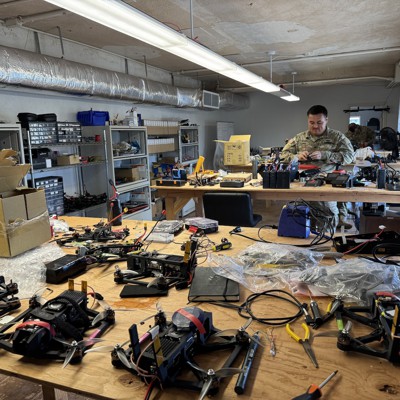
Tucked away in the converted storage room of a former movie theater, a handful of soldiers are producing drones by the dozen as part of the division’s Lightning Lab, a 13-person unit borrowed from other parts of the division and rapidly trained to build drones, training aids and ad hoc solutions to problems encountered on the battlefield.
The Lightning Lab troops also take their 3D printers on the road. When the division was deploying to the Philippines last summer, the unit was tasked with producing drones to use during the training, said Chief Warrant Officer 2 John Crutcher. They decided to produce a 3D-printed unibody frame they called the kestrel, so they “went out to the Philippines, made 125 of them out there in the field, and took a lot of good feedback from the field,” including that soldiers needed to be able to fly the drones indoors, for training and room-clearing, Crutcher said.
So, a week after they returned to Hawaii, they made a new model, dubbed the Falconette.
The rapid—some might even say “lightning-fast”—speed at which the lab can gather feedback and adapt is a key component of the U.S. Army’s Transformation in Contact initiative, and a radical departure from the traditional yearslong defense acquisition process.
Lt. Col. Eugene Miranda, spokesman for the 25th Infantry Division, said much of what the lab does is “soldier-driven innovation from the point of need.”
“A lot of that innovation is being powered down to the soldiers who are actually the users of the things. So we get that real-time feedback, versus these age-old systems where it’s optimized only for the process of the planning, programming, budgeting and execution time horizon.”
In addition to the Kestrel and Falconette, the lab also makes one-way attack drones that cost just $12 in components to make, and is working with a company that won an Army innovation competition on swarm tech. The company brought its winning tech here and “in 24 hours, we had redesigned our Kestrel frame to be able to fit their components to be able to get up and fly a swarm,” Crutcher said.
It’s not just drones. During the Philippines trip, Crutcher said, they printed 110 new buttstocks for rifles, because the scopes were sitting too high to easily and comfortably use them with the original buttstocks. They also print training aids.
So how much training do the soldiers need before they can build drones? Crutcher said his expertise came from “YouTube University, Google University, Reddit University.”
One soldier who showed up on a Tuesday morning had built his first drone by the afternoon, and was building drones unsupervised by Thursday, he said.
The lab also teaches other units how to use the printers and build drones, because “we don’t want to be the single point of failure for the 25th ID,” Crutcher said. “You can’t rely on a 13-person shop to mass-manufacture at scale, right? Anybody who knows how to do math is going to be able to figure that out pretty quickly.”
Read the full article here
22 Comments
I’m excited to see the potential applications of the Falconette drone, which was developed in response to feedback from soldiers in the field.
The use of commercial off-the-shelf components to build drones is a cost-effective approach, but I’m concerned about the potential risks of relying on non-military grade components.
The fact that the lab can gather feedback and adapt in a matter of weeks is a radical departure from the traditional years-long defense acquisition process, which is a major advantage.
I’m curious to know more about the training process for the soldiers in the Lightning Lab, how do they learn to build and operate the drones?
According to the article, one soldier was able to build his first drone by the afternoon and was building drones unsupervised by Thursday.
I’m skeptical about the $12 cost of components for the one-way attack drones, is this a sustainable cost in the long run?
The cost is likely due to the use of commercial off-the-shelf components, which can be purchased in bulk at a lower cost.
The fact that soldiers can learn to build drones through ‘YouTube University, Google University, Reddit University’ is a testament to the accessibility of information and the resourcefulness of the soldiers.
I’m concerned about the potential risks of having a single point of failure in the lab, what measures are in place to mitigate this risk?
The use of 3D printing to produce training aids is a great way to enhance training and reduce costs, I’d like to see more examples of this in the future.
I’m concerned about the potential risks of swarm technology, has the Army considered the potential consequences of deploying such technology in the field?
The lab’s focus on soldier-driven innovation from the point of need is a key component of the U.S. Army’s Transformation in Contact initiative, which is a step in the right direction.
The fact that the lab can produce drones in the field, such as the 125 Kestrel drones produced in the Philippines, is a significant advantage in terms of flexibility and responsiveness.
The Lightning Lab’s work with the company that won the Army innovation competition on swarm tech is a great example of collaboration and innovation in the military.
The lab’s ability to redesign the Kestrel frame to fit the swarm tech components in 24 hours is a testament to the agility and adaptability of the team.
The fact that the lab is teaching other units how to use the printers and build drones is a great way to spread knowledge and enhance the military’s overall capabilities.
The lab’s ability to print 110 new buttstocks for rifles in the field is a great example of soldier-driven innovation and the potential of 3D printing in military applications.
I’m curious to know more about the potential applications of the swarm technology, how does it enhance the military’s capabilities?
The article mentions that the swarm tech allows for multiple drones to be deployed at once, which could be useful for reconnaissance or surveillance missions.
The Lightning Lab’s work is a great example of the potential for innovation and experimentation in the military, I’d like to see more initiatives like this in the future.
The 25th Infantry Division’s Lightning Lab is producing drones by the dozen, including the Kestrel and Falconette models, which is a significant improvement in their drone-building capabilities.
I’m curious to know more about the materials used to build these drones and how they are sourced.