

Listen to the article
Back when I first got into the gun business in the mid-1990s, my gun-handling and shooting skills were, to put it charitably, extremely—well, let’s go with “mediocre.” I was enthusiastic, read everything I could on the topic and knew all manner of facts and statistics, but I just didn’t have a lot of trigger time or formal instruction. I was the sort of shooter who would have been referred to on the internet then as a “Counter-Strike Kiddie.”
My carry habits were similar: Enthusiastic yet casual. In the gun store I managed I carried a Glock G23, mostly. Sometimes I’d carry a different pistol, just because. I was still a 20-something club kid who liked to dress cool, and carry options like PHLster’s Enigma didn’t exist back then. When I wasn’t at work, I toted a SIG Sauer P228 in a dedicated carry purse.
In plinking sessions and the occasional casual competitions in which I’d participate, I didn’t notice any real difference in performance between the Glock or the SIG because, frankly, any mechanical pistol differences were swamped in the sea of my own mediocrity. When you’re having to use all your skill to keep them in the 8-ring of a B27 at 7 yards and your reloads can be measured with a sundial, pistol differences don’t matter much.
Fast-forward about a decade and I’d gotten a lot more serious. I was carrying the same pistol in the same holster—a full-size custom 1911 in a Galco Royal Guard inside-the-waistband holster at the 4-o’clock position—every day, whether at work or at home or wherever.
I’d also sought out some one-on-one instruction and was spending as much time reading up on software—technique and principles—as hardware. Finally, I was doing a lot more shooting, since I was living somewhere I could shoot in the backyard and working at a shop with an indoor range.
I picked up another classic SIG Sauer, a P226 in .40 S&W, to use as a range toy. While it shot fantastically, I suddenly noticed I had a problem with it that I hadn’t had with the P228 back in the ’90s. To wit, the slide frequently wouldn’t lock back on an empty magazine.
You see, in the intervening years I’d fixed my grip on the pistol, choking up on the grip and eliminating the gap between the web of my thumb and the tang on the pistol’s frame, as well as getting my fingers jammed up snug on the bottom of the trigger guard.
More significantly, I’d learned to use a “thumbs-forward” firing grip, so as to position my strong-side thumb on top of the 1911’s thumb safety. It turned out that my grip also put my thumb in the perfect position to interfere with the operation of the slide stop on the classic SIG Sauer semi-autos. (For those not familiar with them, the classic SIGs have the positions of the decocker and slide stop reversed relative to the vast majority of other semi-autos. The decocker is high on the frame, slightly above and behind the magazine release, while the slide stop is far more rearward on the frame, in almost the same place as the thumb safety on a 1911.)
All those repetitions building in good habits for driving my 1911s were actually hindering my ability to run the SIG with anything like “unconscious competence.” I had to expend mental energy trying to keep from influencing the slide stop—energy that could have been better spent on the sights or the overall scenario on the range.
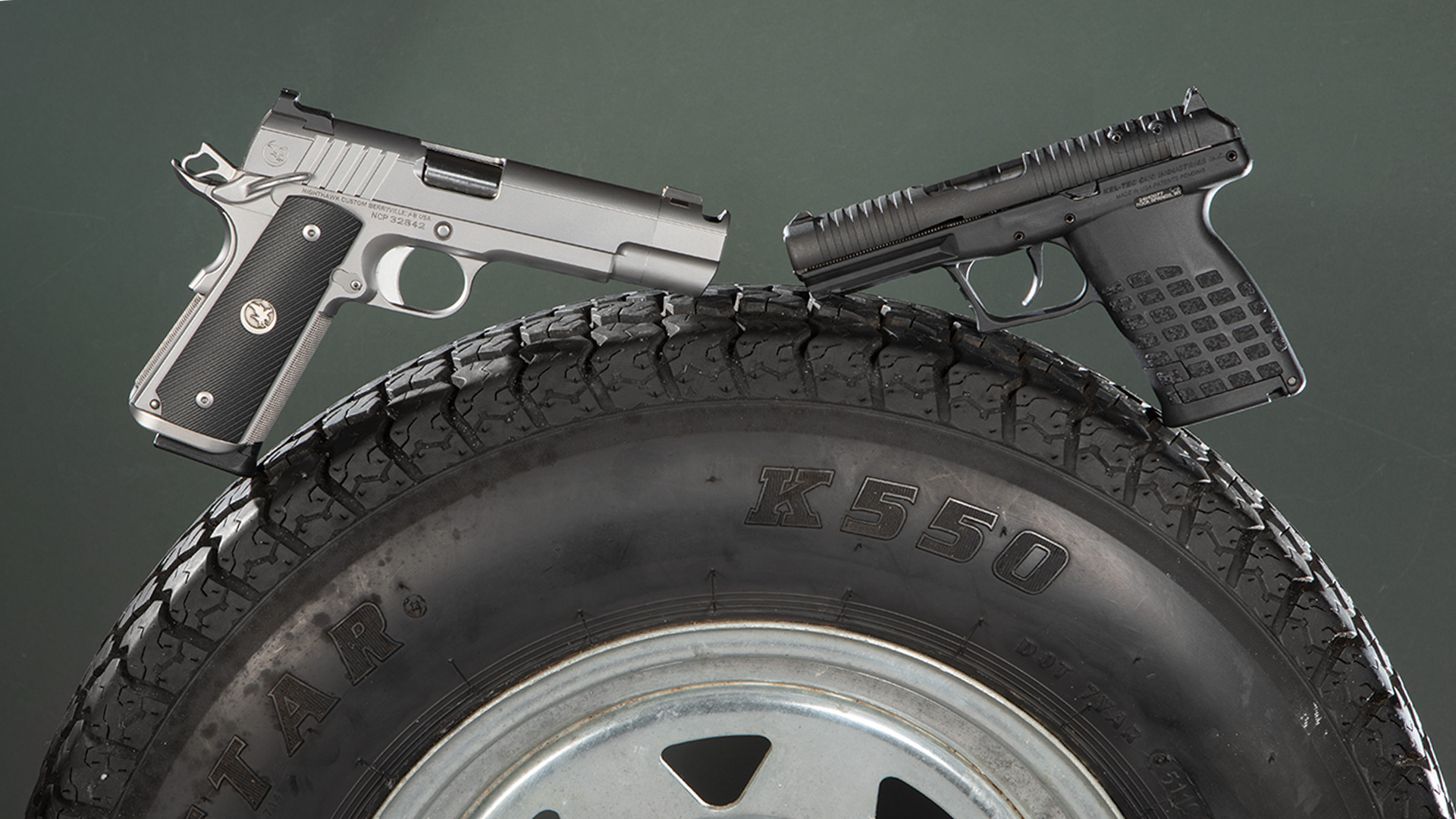
Two pistols chambered in 5.7×28 mm I’ve tested recently resulted in similar problems with unfamiliarity during handling.
I tried to use the KelTec PR57 to run some standardized drills, some of which involved starting with a specified number of rounds in the gun and performing a mandatory reload. With the PR57 having a blind magazine, when the slide locks back on an empty gun, you fetch your stripper clip and jam more rounds in through the ejection port, drop the slide and get back to work.
However, every time the gun ran dry on the timer, I reflexively pulled the pistol back into my workspace and stabbed my thumb at the place where the magazine release would be on a typical semi-auto. After a second or two (which feels like an eternity while the timer’s running) of poking at a nonexistent button would come the “D’oh!” and the initiation of a proper reload. Even when not under time pressure, just standing on the range doing some casual shooting, half the time I’d find myself trying to hit a button that isn’t there.
The other incident happened in a class with conducted by John Hearne of Two Pillars Training. His Cognitive Pistol class is a 600-round, two-day course that is specifically marketed as a class that is not for beginners. After the first couple drills on the line so Hearne can ensure all attendees are capable of safely running a pistol from a concealed holster and can keep up with basic accuracy standards, the rest of the class is given in such a way that every drill increases the cognitive load on the student, requiring solving problems and knowing when and when not to shoot. A certain amount of automaticity in running one’s pistol is assumed, because otherwise you won’t have the mental-processing cycles available to determine whether or not you’re supposed to shoot this particular target.
Due to the vagaries of various other current projects and reviews, the only handgun chambering for which I had 600-plus rounds of good factory ammunition that weren’t allocated to something else was 5.7 mm. “Hey, no biggie! I’ve put a lot of rounds through the FN Five-seveN, so I’ll just bring it. It’ll be interesting to run a 5.7 mm pistol with a Trijicon RMR through a class-type setting.”
What I didn’t stop to consider is that almost none of the rounds I’d fired from the Five-seveN previously were from concealment and under any sort of time pressure. If you’re not familiar with it, the ambidextrous safety on this FN handgun is located forward of and above the trigger guard and best operated with the trigger finger.
While I’m sure that various agencies and units that issue these pistols have developed a set of efficient TTPs (Tactics, Techniques and Procedures) for how and when the safety should be disengaged and reapplied, I had no idea what exactly those might be. I found myself in a very demanding course having to concoct TTPs on the fly from first principles. If I hadn’t had hundreds of hours of training and fired all kinds of handguns for a living, I’d have been completely at sea. As it was, it was all I could do to keep up.
Gun games and training classes, however, are safe places to figure this stuff out. Firearms can be the stuff of fun and games when used for competition, however, your EDC is an entirely different animal and should be treated as such. For a pistol that’s intended as a lifesaving tool, there’s no reason to switch heaters because you’re in a “different gun mood.” You don’t move the brake pedal around in your car on a whim, so why would you want to randomly cycle through carry handguns to essentially the same effect?
Read the full article here
21 Comments
The author’s realization that their grip and firing technique could interfere with the operation of certain pistols, such as the SIG Sauer P226, is an important consideration for shooters to keep in mind when choosing a firearm.
It’s crucial to find a pistol that fits your hand and shooting style to ensure reliable operation and accuracy.
The mention of the Galco Royal Guard holster as the author’s preferred carry method for their 1911 is a specific example of how different holsters can affect the carry experience.
The fact that the author carried a SIG Sauer P228 in a dedicated carry purse when not at work shows the importance of having a convenient and accessible means of carrying a firearm for personal protection.
The use of a ‘thumbs-forward’ firing grip and its impact on the operation of the SIG Sauer semi-autos is a specific technique that not all shooters may be aware of, and it’s useful to consider its effects on different pistols.
It’s interesting to note that the author’s improvement in shooting skills allowed them to notice differences in pistol performance that were previously masked by their own ‘mediocrity’ as a shooter.
As I improved my skills, I also started to appreciate the nuances of different firearms and their performance characteristics.
The author’s experience with the P228 in the 1990s versus the P226 a decade later highlights the importance of consistent practice and training in developing gun-handling skills.
The difference in the author’s performance with the Glock G23 versus the SIG Sauer P226, particularly in terms of the slide locking back on an empty magazine, highlights the importance of understanding the specific characteristics of each firearm.
The author’s decision to seek one-on-one instruction and focus on ‘software’ – technique and principles – in addition to ‘hardware’ – the firearms themselves – is a key aspect of their improvement as a shooter.
The issue with the slide not locking back on an empty magazine with the SIG Sauer P226 is intriguing, and it’s interesting to see how the author’s changed grip and firing technique affected the pistol’s operation.
The comparison between the author’s early days as a ‘Counter-Strike Kiddie’ and their later, more serious approach to firearms training and carry is a compelling narrative of growth and development as a shooter.
The fact that the author could shoot in their backyard and had access to an indoor range at their workplace was likely a significant factor in their ability to improve their shooting skills.
Having regular access to a range can make a huge difference in developing and maintaining shooting proficiency.
The comparison between the classic SIG Sauer semi-autos and other semi-autos, in terms of the positions of the decocker and slide stop, is a valuable point for those considering different types of pistols.
Yes, understanding the unique features of each firearm is crucial for effective use and maintenance.
The author’s personal experience with various pistols and their evolution as a shooter serves as a reminder that gun handling and shooting skills are developed over time with practice, training, and patience.
The mention of PHLster’s Enigma as a carry option that didn’t exist during the author’s early days of carrying a pistol highlights the evolution of concealed carry technology and accessories.
The author’s transition from carrying a Glock G23 to a full-size custom 1911 in a Galco Royal Guard holster is notable, as it shows their growth in gun-handling skills and preference for a specific type of pistol.
I’ve also noticed that as my skills improved, I preferred more customized firearms that fit my shooting style.
The author’s experience with the classic SIG Sauer semi-autos, including the P226 and P228, provides valuable insights into the characteristics and potential issues of these pistols.