

Listen to the article
For most of us, the Lincoln assassination lives only in history books or in television or movie adaptations of the event. But for Samuel J. Seymour (1860–1956), it was a core memory. It was a confusing, scary night at the theater, seen through a child’s eyes, long before he understood what the moment meant.
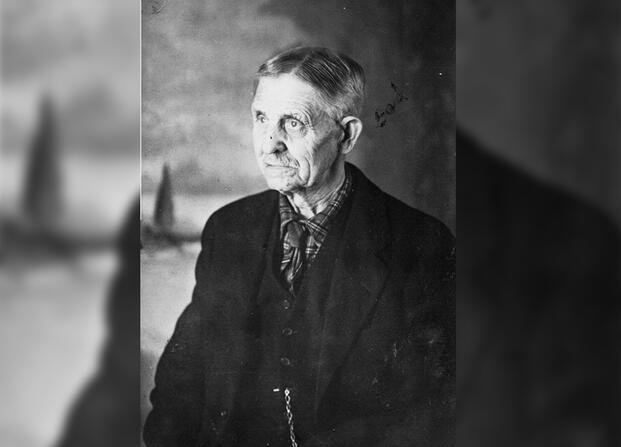
Seymour is best remembered today, if remembered at all, as the last surviving eyewitness to President Abraham Lincoln’s assassination. He was five years old on April 14, 1865, and was in attendance, sitting in the balcony of Ford’s Theatre when John Wilkes Booth fired the shot. And he lived long enough to bring that memory to mid-century America in the most unexpected setting: a bright, chatty American television game show.
Source / Credit: Newspaper archive photo / public domain
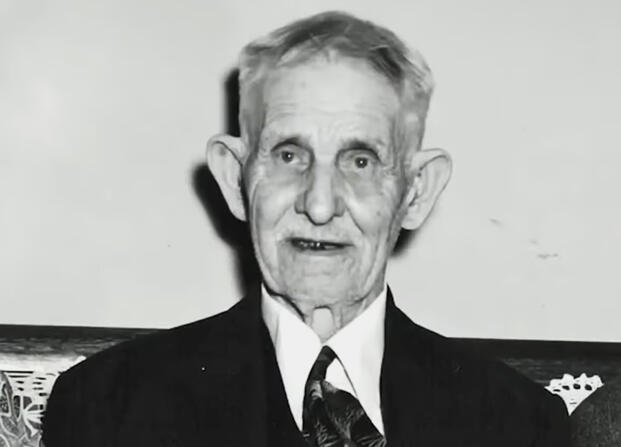
Samuel J. Seymour, the Last Living Witness
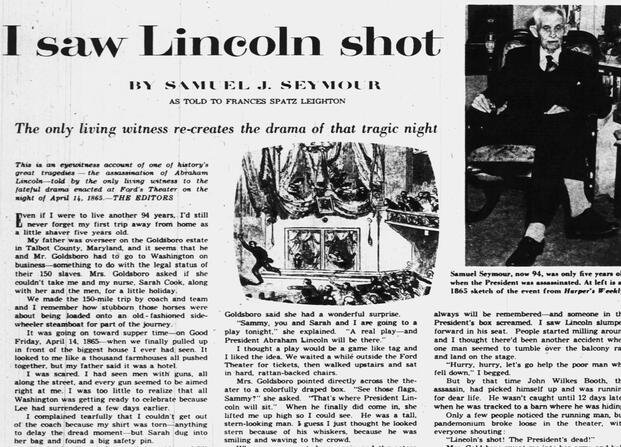
In a feature for The American Weekly Magazine titled “I saw Lincoln shot” (published with Seymour’s name on it and “as told to” writer Frances Spatz Leighton) begins not in a theater, but with a little boy leaving home for the first time. Seymour describes traveling from Talbot County, Maryland, to Washington with his nurse, Sarah Cook, and members of the Goldsboro household. He even remembers the stubborn horses and part of the journey involving an old-fashioned side-wheeler steamboat.
When they arrived in Washington on Good Friday, April 14, 1865, Seymour didn’t see a celebratory capital. He saw something much more frightening: men with guns. In his memory, the rifles and pistols lining the streets felt like they were aimed at him. Only later did he realize the city was on edge, preparing to celebrate, because Robert E. Lee had surrendered days earlier.
There’s also an almost darkly comic moment in his account. Seymour recalls his shirt being torn as he exited his horse carriage, and when Sarah Cook tried to fix it with a safety pin, he jerked in fright and got stuck. He shouted:
“I’ve been shot!” long before anyone fired a weapon inside Ford’s Theatre.
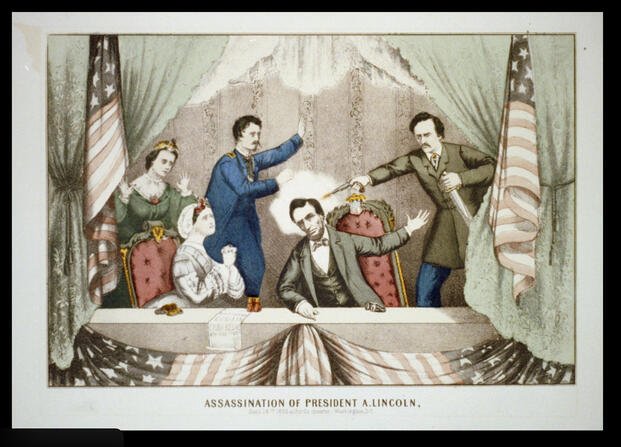
Source / Credit:
Library of Congress, Prints and Photographs Division
April 14, 1865: A Child’s View From Ford’s Theatre
In the newspaper account, Mrs. Goldsboro tells him they’re going to a play that night and adds a line that would make any child’s eyes widen: the President will be there. Seymour thought a “play” might be something like a game. Instead, he and the adults waited outside the theater for tickets, then went upstairs and sat in hard, rattan-backed chairs in the balcony.
From there, he had a clear view across the room to the presidential box, decorated with drapery and flags. Mrs. Goldsboro pointed it out to him directly: that was where Lincoln would sit.
When Lincoln arrived, Seymour says his nurse lifted him so he could see the president. As he recalled, Lincoln struck him as a tall and “stern man,” even though he was smiling and waving to the crowd—the sternness he chalked up to his whiskers and his five-year-old memory.
It’s an oddly tender snapshot of Lincoln from someone too young to have politics in his bones.
The Shot, the Leap, and the Part Seymour Couldn’t Stop Watching
Seymour heard the shot. In his memory, someone screamed from the President’s box, and he saw Lincoln slump forward in his seat. But what seized Seymour’s attention wasn’t the slumped figure in the box. It was what happened next.
A man tumbled from above, over the balcony rail, and landed on the stage. Seymour didn’t see it as an assassin escaping. He saw it as an accident.
In the newspaper feature, Seymour recounts begging the adults: “Hurry, hurry, let’s go help the poor man who fell down.” That line says everything about his child’s perspective. In the instant after the gunshot, his concern was for the man who “fell,” not for the President who had been shot.
That “fallen man,” of course, was John Wilkes Booth, who broke his leg during the jump. Seymour’s account notes that Booth was running for his life and wasn’t captured until 12 days later, when he was tracked down to a barn.
Inside the theater, panic spread fast. Seymour remembered the crowd milling, shouting, and the words no one forgets once they hear them:
“Lincoln’s shot! The President’s dead!”
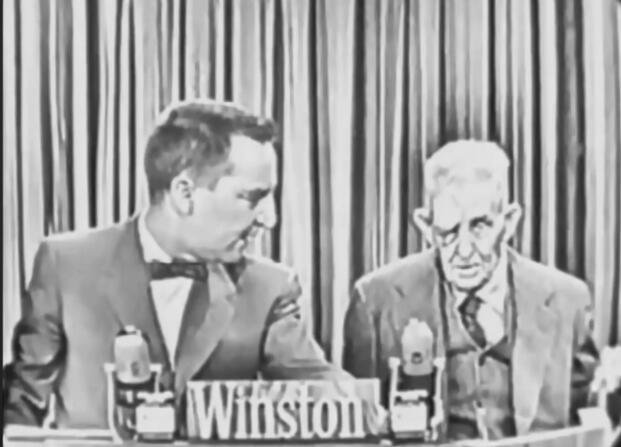
Samuel J. Seymour appears on ‘I’ve Got A Secret’
Features original commercials for Winston Cigarettes, With the host and Desi Arnaz both plugging the product.
Goodson-Todman
Samuel J Seymour
Abraham Lincoln
Lincolns assassination
fords theater
1865
Getting Out Alive, and Living With the Night for Decades
As the chaos grew, Mrs. Goldsboro pulled Seymour into her arms and held him close while they got outside.
Seymour later admitted the event didn’t simply fade into a childhood blur. It followed him. In the same newspaper account, he says he was “shot” again and again in nightmares, and that even as an old man dozing in his rocker, he could still relive the horror of the historical moment.
The TV Moment That Made Seymour Famous All Over Again
Seymour’s name might have stayed mostly in archives if not for one perfectly timed media moment.
In February 1956, at 95 years old, he appeared as a contestant on the CBS game show I’ve Got a Secret. The show’s whole gimmick was light entertainment: a panel tries to guess a guest’s secret by asking yes-or-no questions.
Seymour’s secret wasn’t cute or silly. It was unbelievable.
He was introduced as a man who had witnessed Lincoln’s assassination. It’s hard to imagine the feeling in that studio: a living bridge between the Civil War and television’s golden age, sitting under bright lights while people smiled, joked, and then slowly realized the weight of what they were hearing.
Two months later, Seymour died on April 12, 1956. With him went the last known living witness to one of America’s defining tragedies.
Why Seymour’s Story Still Resonates in 2026
Samuel J. Seymour’s story endures because it resists polish. It feels almost impossible on a human scale. As YouTuber VSauce once noted, the man who witnessed Abraham Lincoln’s assassination was alive at the same time as Breaking Bad actor Bryan Cranston. That overlap is jarring, but it’s also a reminder that history doesn’t unfold in neat, distant chapters. It stretches forward in ways that can be hard to grasp until someone like Seymour makes it tangible.
What also gives the story its staying power is how it moved through American media. A child’s confused memory became a firsthand newspaper account. That account turned into a television appearance on a 1950s game show. From there, it entered the long afterlife of American pop culture, where it continues to resurface whenever the distance between past and present suddenly collapses.
Read the full article here
19 Comments
The fact that Seymour was only five years old when he witnessed the assassination and yet retained such specific details, including the presidential box being decorated with drapery and flags, is a testament to the impact of the event on his young mind.
The mix of fear and confusion in Seymour’s account, from seeing men with guns to the moment of the assassination, provides a gripping narrative that draws the reader into the events of that night.
The detail about Seymour shouting ‘I’ve been shot’ after getting his shirt caught on a safety pin is a hauntingly comedic moment, especially given the events that would later unfold at Ford’s Theatre.
It’s remarkable how Seymour’s story has been preserved, from his initial account in ‘The American Weekly Magazine’ to being remembered today as the last living witness to the Lincoln assassination.
The description of the presidential box, decorated with drapery and flags, as seen by Seymour from the balcony, adds a layer of detail to the historical accounts of the assassination, making it more vivid for readers.
Seymour’s story, as told to Frances Spatz Leighton for ‘The American Weekly Magazine’, provides a unique blend of historical significance and personal anecdote, making the Lincoln assassination more relatable to readers.
Seymour’s memory of traveling to Washington with his nurse, Sarah Cook, and the Goldsboro household, including the journey by old-fashioned side-wheeler steamboat, paints a vivid picture of the time period.
The image of Seymour sitting in the balcony of Ford’s Theatre, in hard, rattan-backed chairs, with a clear view of the presidential box, is a powerful one, especially considering what he was about to witness.
It’s astonishing that Seymour lived long enough to share his experience on a 1950s game show, bringing a firsthand account of the Lincoln assassination to a mid-century audience in such an unexpected setting.
Seymour’s age at the time of the assassination, just five years old, and his later sharing of the event on a game show, highlights the enduring impact of historical events on individuals and their lives.
Seymour’s story is not just about the Lincoln assassination but also about the journey of a young boy to witness one of the most significant events in American history, and how it stayed with him throughout his life.
The way Seymour’s account weaves together the personal and the historical, from his childhood fears to the national tragedy, makes his story both a valuable historical resource and a compelling personal narrative.
It’s interesting to note the contrast between Seymour’s initial excitement at possibly seeing a ‘play’ and the reality of what he experienced, highlighting the innocence and misunderstanding of a child’s perspective.
I’m skeptical about the accuracy of Seymour’s memory, considering the event occurred when he was very young and he shared his story many years later; however, his account does offer a personal and emotive perspective on history.
Seymour’s experience, from the journey to Washington to the events at Ford’s Theatre, serves as a reminder of the human side of historical events, often overshadowed by political analyses.
The fact that Seymour’s account was shared on a game show underscores how different the approach to historical events and their presentation to the public was in the 1950s compared to today.
I was fascinated by Samuel J. Seymour’s account of the Lincoln assassination, particularly his description of the city being on edge with men carrying guns, which he initially found frightening, not realizing it was a celebration of Robert E. Lee’s surrender.
It’s remarkable how his childhood perspective offers a unique view of such a pivotal moment in history.
The detail about Seymour’s nurse, Sarah Cook, and her attempt to fix his torn shirt with a safety pin, only for him to shout ‘I’ve been shot’, is a poignant moment that humanizes the historical figure of Seymour.