

Listen to the article
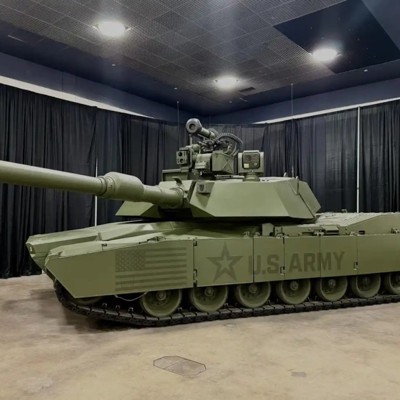
DETROIT—Car enthusiasts milling around the floor at the Detroit auto show this week will get the first public glimpse of the Army’s new main battle tank, as the service prepares to roll out its M1A1 Abrams replacement five years ahead of its original timeline.
Rather than wait to field the vehicles until every last sensor and radio is determined, the Army cut the tank’s development time way down by getting the physical vehicle built and allowing the bells and whistles to be installed and upgraded as the technology evolves.
“The way we used to look at all these boxes…we used to take that box and install the computer,” Col. Ryan Howell, the Abrams’ project manager, told reporters Wednesday. “Today, it’s computer first, and it happens to be hardware second. So the box doesn’t matter.”
With that in mind, the Army is putting “the box” into soldiers’ hands to make sure it maneuvers the way a tank platoon needs it to, and to gather feedback on what it needs for communications, weapons, and sensors.
“Rather than focusing on the tank, we focused on all the digital backbone and the software and what it’s supposed to do, and then we wrapped a tank around it,” said Alex Miller, the Army’s chief technology officer. “So the fact that the hull looks similar is because we figured out a long time ago, that’s what armor should look like to be effective.”
All of the cameras, the counter-drone systems, the gunnery and so on will evolve based on the best commercially available tech.
“So now Col. Howell and the acquisition team can update our tank in days and weeks on the software side, rather than us taking a year,” Miller said.
The vehicle itself is made of commercial parts: a Caterpillar engine, SAPA transmission, and a Roush race car cockpit with embroidered Recaro seats.
It sounds pretty fancy for the Army, but it turns out that using all of these commercial products to build the new tank cut down significantly on the price tag.
“I won’t give you the exact dollar figure, but they can produce them at 10-percent the cost—with the embroidery,” Howell said of the luxe seating.
The M1E3 is the biggest program yet developed under the Army’s new Continuous Transformation acquisitions model, which eschews exquisite, bespoke systems that take decades to develop and lock the Army into the hardware, software and the company that builds them.
Instead, the Army has ordered four of the prototypes from Roush, who in their partnership with General Dynamics used the existing Abrams specs to build the vehicle’s skeleton. General Dynamics will take the lead on the next round of test vehicles.
“So I think it would be, you know, a vendor comes and says, ‘Hey, I’ve got something that’s better for active protection. There’s a better engine, there’s a lighter transmission to meet those specs.’ They could, you know, plug in and play in that,” Gen. Randy George, the Army’s chief of staff, told reporters.
Those specs include a total weight one-quarter less than today’s 70-plus-ton Abrams. It also has a hybrid-electric engine that sips half the fuel while delivering a top speed of about 40 mph.
“So it doesn’t have a fast quarter-mile time, but it can knock out a target at a quarter-mile in about a tenth of a second. You know, shoot an apple off a fence at 3-plus kilometers,” George said. “You can kill drones, do the kinds of things that we would expect of a system like that out there, and you could put it anywhere in the world to do that.”
The Army has also spent a lot less money than usual before getting it into soldiers’ hands. About $75 million bought the research and deent, the software architecture inside the tank, and the first production models.
The service has asked for more than $700 million in this year’s budget to start expanding the work. It will take a couple years to get enough built to start sending them out to every tank unit, but the Army was originally planning that it wouldn’t even have soldiers testing them until 2031.
With that initial feedback expected to start coming in this summer, officials are comfortable taking the resources they would have spent on finding the perfect sensors and sights and radios before testing and spending it on the back end, to continuously upgrade the M1E3 as soldiers test it in the field.
And George hopes to be able to repeat this success with its forthcoming M2 Bradley replacement.
“It’s one of our goals that we’re back here next year, and sitting in the same room having the same discussion with an XM-30 that’s down there,” he said.
Read the full article here
21 Comments
The fact that the new tank can be updated with new software in days and weeks rather than years is a significant advantage, as it will allow the Army to respond quickly to changing circumstances on the battlefield.
I’m concerned that the focus on commercial technology and ‘plug and play’ integration may compromise the security and reliability of the new tank, and I hope the Army has taken steps to mitigate these risks.
The use of embroidered Recaro seats in the new tank seems like a luxury item, but it may be intended to improve the comfort and performance of the soldiers operating the vehicle.
The fact that the new tank is made with a Roush race car cockpit and embroidered Recaro seats seems like an unusual choice for a military vehicle, but it’s interesting to see how commercial products are being utilized in its construction.
The use of a ‘plug and play’ approach to integrating new technologies into the tank could potentially create security risks, as it may be vulnerable to hacking or other forms of cyber attack.
Col. Howell’s statement that ‘the box doesn’t matter’ raises questions about the role of hardware in modern military technology, and whether the focus on software and digital systems is the right approach.
It’s impressive that the Army was able to unveil the new tank five years ahead of schedule, and I’m excited to see how this will impact their military capabilities.
I’m interested in learning more about the counter-drone systems that will be integrated into the new tank, and how they will be used in combat situations.
The partnership between Roush and General Dynamics to build the new tank’s skeleton using existing Abrams specs is a clever way to leverage existing knowledge and expertise.
I’m curious to know more about the testing process for the new tank, and how the Army will evaluate its performance in different scenarios.
The use of commercial parts, such as a Caterpillar engine and SAPA transmission, in the construction of the new tank has significantly reduced the price tag, with Col. Howell stating that it can be produced at 10-percent the cost.
The idea of using a ‘digital backbone’ to integrate different systems and technologies into the tank is an interesting one, and I’d like to learn more about how it will be implemented.
The Army’s emphasis on using commercially available technology to build the new tank suggests that they are prioritizing cost-effectiveness and efficiency over traditional military specifications.
I’m curious to know more about the Army’s Continuous Transformation acquisitions model and how it will be applied to other projects, as the M1E3 program is the biggest yet developed under this model.
The Army’s decision to unveil the new tank five years ahead of schedule is a testament to their ability to adapt and innovate in response to changing circumstances.
The reduction in weight of the new tank could potentially make it more fuel-efficient and easier to transport, which would be a significant advantage in logistics and deployment.
The Army’s decision to focus on the digital backbone and software of the new tank, rather than the physical vehicle itself, is a significant shift in their approach to development, as noted by Col. Ryan Howell’s statement that ‘the box doesn’t matter’.
This approach could potentially lead to more efficient and cost-effective upgrades in the future, as Alex Miller mentioned that the software can be updated in days and weeks rather than years.
Gen. Randy George’s comment about vendors being able to ‘plug in and play’ with new technologies, such as active protection systems, suggests that the Army is prioritizing flexibility and adaptability in their new tank design.
I’m skeptical about the idea of using commercial products in a military tank, as it may compromise the vehicle’s durability and reliability in combat situations.
The goal of reducing the total weight of the new tank to one-quarter less than the current 70-plus-ton Abrams is ambitious, and I wonder what specific design choices were made to achieve this reduction.