

Listen to the article
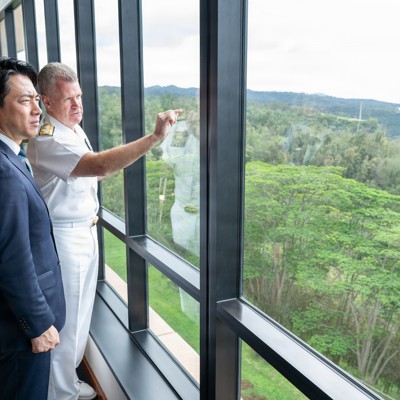
HONOLULU—The military balance is “shifting dramatically and rapidly” in the Indo-Pacific, and “provocative military activities are intensifying” in the western and southern Pacific, Japan’s minister of defense said this week.
“The boundary lines between peacetime and contingency, between military and non military, between truth and fake news, these are no longer clearly visible,” Shinjiro Koizumi said during a Monday keynote speech at the Honolulu Defense Forum. “Right now, we can see tensions that are on the brink of war across the globe.”
Alluding to China without mentioning it by name, Koizumi noted “the routinization of military coercion,” “opaque military buildups,” and “attempts to change the status quo by force” in the East China Sea and South China Sea.
To maintain peace, Japan “will become stronger” by reinforcing its defense capabilities and increasing its defense spending, Koizumi said. Additionally, “we will expand Japan-U.S. bilateral joint presence in Japan’s southwestern region,” work with the United States to co-produce and co-sustain equipment and strengthen the defense industrial base, and “spread a multi-layer network of interconnectivity across the entire region.”
In a keynote speech to begin the forum, U.S. Indo-Pacific Command leader Adm. Sam Paparo called alliances and partnerships “our strategic center of gravity.”
“When we operate with allies and partners, we multiply capability and we raise the threshold for aggression,” he said.
The range of allies and partners was evident throughout the event, with military representatives from several countries in Europe, Asia, and Oceana in the audience and on stage.
Brig. Gen. Roy Anthonthy Derilo, the Philippines’ defense and military attaché to the United States, told reporters his country has a key role to play in maintaining security in the region.
“We are witnessing a significant shift in the global security landscape,” Derilo said. “This situation calls for a strong and coordinated response … The Philippines had to take a hard look at its situation in reflection of the bigger regional situation and their global effects.”
Instead of acting alone, Derilo said, “We have deliberately became a major contributor and co-architect of the kind of coordination and allyship that could cut through this new and emergent security challenges.”
And while reports of Chinese aggression toward the island nation have made headlines across the world in recent years, Derilo said the country has been more careful lately to not go too far, so as to not jeopardize their bigger political objectives.
France, which has several territories and 7,000 troops permanently based in the region, is also committed to security in the Indo-Pacific, and working with the United States and other allies and partners to preserve it, Rear Adm. Guillaume Pinget, commander of French joint forces in French Polynesia, told Defense One. And while Germany has no territory in the Indo-Pacific, the region is very important for economic reasons, said Maj. Gen. Wolfgang Ohl, deputy director general for the German Armed Forces.
About 40 percent of the country’s goods travel through the Indo-Pacific, Ohl said in an interview, and if “something from a security point of view” were to happen—such as a Chinese move to seize Taiwan—“this would have an impact on the European economy.
But, he said, Germany also believes that “it is necessary that those of us who believe in the rules-based international order, and those who share some values, those who are like-minded, stick together.”
Ohl was speaking as Danish officials were en route to the White House to speak to President Trump about Greenland; after the meeting ended with “fundamental disagreements,” Germany, France and other European nations sent troops to Greenland.
On Tuesday, he said the Indo-Pacific has “become more volatile” in the past 10 years. “At the end of the day, it’s not a region we can turn our back to.”
Read the full article here
25 Comments
The Philippines’ defense and military attaché to the US, Brig. Gen. Roy Anthonthy Derilo, noted that his country has a key role to play in maintaining security in the region, which is reassuring given the recent reports of Chinese aggression.
The presence of military representatives from several countries in Europe, Asia, and Oceana at the Honolulu Defense Forum demonstrates the breadth of international cooperation on regional security issues.
Japan’s minister of defense, Shinjiro Koizumi, mentioned that the military balance is shifting dramatically and rapidly in the Indo-Pacific, which raises concerns about the region’s stability.
It’s interesting to note that Koizumi didn’t mention China by name, but the allusions to ‘opaque military buildups’ and ‘attempts to change the status quo by force’ in the East China Sea and South China Sea are telling.
I’m interested in learning more about how the defense industrial base in the region would be strengthened through the cooperation between Japan and the US, as mentioned by Koizumi.
Adm. Paparo’s comment that operating with allies and partners ‘raises the threshold for aggression’ suggests that a strong alliance can be an effective deterrent against potential aggressors.
This approach could potentially reduce the risk of conflict in the region by making it clear that any aggressive action would face a united response.
Rear Adm. Guillaume Pinget’s statement about France’s commitment to security in the Indo-Pacific, despite having no direct involvement in the recent conflicts, underscores the global community’s interest in the region’s stability.
The fact that the Philippines has ‘deliberately became a major contributor and co-architect of the kind of coordination and allyship’ to address security challenges, as stated by Brig. Gen. Derilo, shows the country’s proactive approach to regional security.
The mention of a ‘multi-layer network of interconnectivity’ across the region by Koizumi is intriguing, and I’d like to know more about how this would be implemented and what benefits it would bring.
The US Indo-Pacific Command leader, Adm. Sam Paparo, emphasized the importance of alliances and partnerships, stating that they are ‘our strategic center of gravity’, which highlights the value of cooperation in the region.
Koizumi’s statement that Japan ‘will become stronger’ by reinforcing its defense capabilities and increasing its defense spending is a clear indication of the country’s commitment to regional security.
The shift in the global security landscape, as noted by Brig. Gen. Derilo, necessitates a strong and coordinated response from regional actors and their international partners.
The expansion of Japan-US bilateral joint presence in Japan’s southwestern region, as announced by Koizumi, could significantly enhance the military capabilities of both countries in the area.
This move might also serve as a signal to other regional actors about the commitment of Japan and the US to maintaining peace and stability.
It’s worth considering how the ‘routinization of military coercion’ and ‘attempts to change the status quo by force’ in the East China Sea and South China Sea, as mentioned by Koizumi, impact the sovereignty of countries in the region.
The mention of ‘provocative military activities’ intensifying in the western and southern Pacific by Koizumi is concerning and warrants closer monitoring of the situation.
It’s crucial for regional actors and their international partners to address these provocations through diplomacy and cooperation to prevent escalation.
The fact that Germany considers the Indo-Pacific region important for economic reasons, despite having no territory there, underscores the region’s global significance.
This highlights the need for a coordinated response to security challenges in the region, as the economic implications of instability would be far-reaching.
It’s notable that France has 7,000 troops permanently based in the region and is committed to working with the US and other allies to preserve security in the Indo-Pacific, as stated by Rear Adm. Guillaume Pinget.
The presence of ‘tensions that are on the brink of war across the globe’, as noted by Koizumi, highlights the urgency of addressing regional security challenges through international cooperation and diplomacy.
I’m curious about the co-production and co-sustainment of equipment between Japan and the US, as mentioned by Koizumi, and how this will impact the defense industrial base in the region.
This joint effort could lead to significant advancements in military technology and strengthen the alliance between the two countries.
The US and its partners are in for the long haul in the Indo-Pacific, as indicated by the discussions at the Honolulu Defense Forum, which suggests a prolonged commitment to regional security.