

Listen to the article
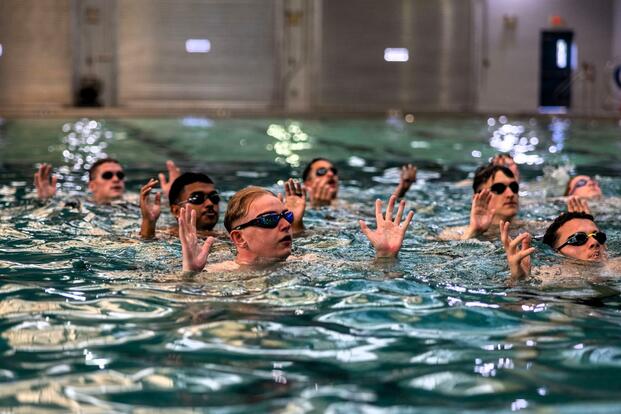
Many military diving and rescue swimming training programs include a wide variety of pool skills. One of the most overlooked and frankly ignored by students is treading. Because treading is easy, right? Wrong! Here is a question from a recruit preparing for a military diving program in the future, who is curious about how to add in treading workouts:
Stew, do you have any recommendations on how much I should be treading before Navy Dive School? I can swim well, but I struggle to tread water without my hands. It is much easier for me to sink than float. Thanks, Joseph.
Joseph, it is smart that you recognize treading is something you need to work on regularly. When you are negatively buoyant (sinker), treading water is extra effort and requires both technique and conditioning to keep you afloat for longer without using your hands. Most tread tests in Navy Special Warfare/Special Operations will require treading without hands. Here is what we do:
Add Treading to Warmup/Cooldowns
Warm up with a 10-minute tread without using your hands (as much as possible). No grabbing the edge of the pool, but when you start to sink, use your arms to keep you on the surface. But once you have recovered, take away the arms again. You can either start or end your workout with this 10-minute treadmill warmup or cooldown.
Add Treading to Your Swim Workout as Rest
Resting with treading is easier said than done, but when you can build up to it as an active rest exercise, you are getting into the type of swimming conditioning needed to excel in these pool skills. We will typically do 100- to 200-meter swim sets, and for the rest, tread for 1 minute with (or without) hands. A good swimming workout is roughly 1,500 meters 2,000 meters of distance per workout (with or without fins), so depending on your sets, you can get 5-10 minutes of treading time accumulated in the workout alone.
A classic workout is the 50/50. For 10-15 sets:
- Swim 50 meters of freestyle
- Swim 50 meters of critical swim speed (CSS)
Rest between sets with a 1-minute tread, float or bottom bounce to mix in more pool skills you will need to improve during your preparation phase. Not only will you need to master treading, but you will also need to learn the drownproofing skills. Mix those into the workout “rest” sets as well.
How Much to Tread
So, to answer your question, we swim five times per week for roughly 50-60 minutes, for a total of 10 minutes per workout of treading. In five days, you will have accumulated 50 minutes of treading.
Learning treading technique is just as important as getting into treading shape. Make sure it is part of your cardio training. If you are negatively buoyant, treading will be difficult. If you are positively buoyant, you are not treading, but floating. Bobbing up/down from the bottom will be more challenging for the positively buoyant candidate. So, challenges exist for all body types.
Treading Technique
Here are a few videos and articles from the Military.com Fitness Section to help you learn how to tread and how to add in flexibility and mobility to enhance the treading range of motion with every kick:
Want to Learn More About Military Life?
Whether you’re thinking of joining the military, looking for fitness and basic training tips, or keeping up with military life and benefits, Military.com has you covered. Subscribe to Military.com to have military news, updates and resources delivered directly to your inbox.
Read the full article here
14 Comments
I’m curious to know more about the specific challenges that positively buoyant candidates face when it comes to treading water, and how they can work to overcome these difficulties.
The 10-minute tread without using hands as a warmup or cooldown is a great tip, and I appreciate the suggestion to start or end the workout with this exercise to build up technique and conditioning.
The 50/50 workout routine sounds like a challenging but effective way to build up swimming endurance and treading skills, with the 50 meters of freestyle and critical swim speed followed by a 1-minute tread or float.
I’m interested in learning more about the differences in treading technique for individuals who are positively or negatively buoyant, and how this affects their ability to master the skill.
The use of videos and articles from the Military.com Fitness Section as a resource for learning treading technique is a great idea, and I appreciate the emphasis on seeking out additional guidance and support.
The idea of mixing in bottom bounce and other pool skills into the workout rest sets is a great way to add variety and challenge to the training routine, and to prepare for the different skills required in Navy Special Warfare/Special Operations.
I’m supportive of the approach outlined in the article, which emphasizes the importance of consistent practice and patience in building up treading skills and technique.
The suggestion to accumulate 50 minutes of treading per week, spread out over five workouts, seems like a reasonable and achievable goal for someone preparing for Navy Dive School.
The article mentions that treading will be difficult for those who are negatively buoyant, but what about those who are neutrally buoyant – do they have an advantage when it comes to treading water?
Neutrally buoyant individuals may have an easier time treading water, but it’s still important for them to practice and build up their technique and conditioning.
I appreciate the emphasis on incorporating treading into cardio training, as it’s clear that this skill requires both technique and physical fitness to master.
I’m skeptical about the effectiveness of resting with treading as an active rest exercise, especially for those who are negatively buoyant and struggle to stay afloat without using their hands.
I’m surprised that treading water without hands is a required skill for Navy Special Warfare/Special Operations, and I’m curious to know more about the drownproofing skills that are also necessary for the preparation phase.
Drownproofing skills are indeed crucial, and it’s great that the article mentions the importance of mixing them into workout rest sets.