

Listen to the article
Baiting is one of the biggest hot-button issues in hunting. Regardless of species, everyone has an opinion. This is especially true for deer hunting, where antler inches can make toddlers out of grown men. Opponents of baiting often raise ethical or moral questions about the tactic itself and the risk of potential disease exposure involved with congregated deer herds. Those in favor of baiting compare it to food plots or similar strategies for attracting and holding deer at specific locations.
I live in Mississippi, where baiting is legal. Its restrictions are mainly limited to public lands. For whitetail hunting on private lands, it’s fair game. Talk to nearly any hunter from my state, and you can assume that they’re running corn. It’s just part of the hunting culture. Even though I’m a lifelong resident of this state, I don’t have a ton of experience with baiting. So, to get the lowdown on all things baiting, I spoke with the Element’s K.C. Smith.
K.C. is from Texas, the baiting capital of the whitetail world. He baits on his property there, and grew up in a place where baiting is the norm. K.C. offers a unique and authoritative perspective on baiting specifically because of his experience with it, but also because he’s known for killing big bucks on public ground with his bow (usually at ground level) all over the country.
What is Baiting?
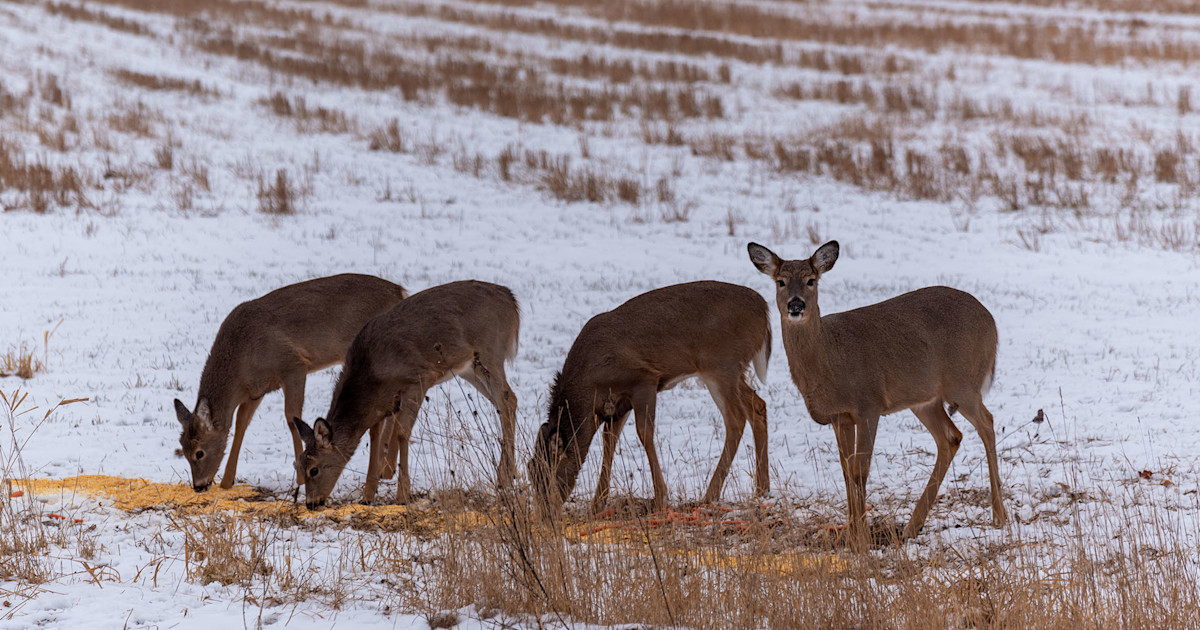
If you’re unfamiliar with the tactic of baiting, K.C. defined it as “the strategic placement of corn, pellets, or anything to attract or hold deer on a certain property,” he said. Essentially, anything that’s used for the purpose of attracting and holding deer can be considered bait. This could include corn, mineral blocks, and, yes, even food plots.
While most people associate baiting with killing deer, it can also be used for camera intel. There are a lot of hunters, especially in states where you can’t hunt over bait, that use it before deer season starts to gather intel on their local deer herd. Yet, a lot of hunters don’t consider this actual baiting, even though they use this tactic to ultimately locate deer in hopes of killing one. It’s one of the many contradictions that hunters ignore. Bait can attract and hold deer in certain areas, but that doesn’t mean you’ll get a shot at that big buck.
Baiting Misconceptions
Regardless of what a lot of hunters think, baiting doesn’t eliminate all the guesswork in deer hunting. It also doesn’t mean that hunters who bait lack the skills of hunters who don’t. Still, that won’t squash any of the misconceptions out there.
Baiting Makes It Easy to Kill Big Bucks
It’s easy to look at your neighbors or other hunters and blame baiting for all the big bucks they kill. Sure, someone might get lucky and have a monster stroll into a corn pile, but the same could happen in your food plot. I’ve been guilty of this thinking in the past, especially in seasons when I just couldn’t catch a break. But, bait piles just don’t guarantee big bucks as most people assume.
“It’s tough to kill a big buck over a bait pile,” K.C. said. “If anything, it can make it harder, especially if you have good cover on your property. When deer find cover near corn or feed, they’ll bed nearby, making your access even more critical.”
He pointed out that big bucks still approach a feeder like they do other food sources by circling downwind. This is why a lot of hunters who run feeders get plenty of nighttime pictures of big bucks but never see them during shooting hours. It’s not as simple as sitting directly over a bait pile.
Only Lazy Hunters Bait
People who feed deer are lazy. That’s what a lot of people assume about hunters that run bait, but that’s hardly the case. “I know guys who spend 12-hour days throwing around 50-pound bags of corn,” K.C. said. “That’s a lot more work than people are used to.”
Obviously, those are large hunting operations, either for outfitters or landowners, but that’s more work hours than most people spend in a day at their nine-to-five. That time doesn’t account for everything else, like stand prep, camera work, and the hours spent hunting. Theoretically, you could dump a pile of corn on the ground and set up within rifle range of it, but that’s not the way most hunters use bait.
Not to say there aren’t plenty of people who use bait this way or even illegally, which K.C. pointed out. However, the person who illegally dumps a pile of corn where it’s prohibited isn’t the same person who baits within the legal boundaries of the law.
Baiting Intel
“If you want to keep tabs on deer during the year, there’s probably no better way to do it than with bait,” K.C. said. “I use it on properties where I want camera data and to understand what deer use the property.”
Where legal, putting cameras over bait can help you take inventory of the local deer herd. This is especially true for areas where food might be a limited resource, especially in places outside of ag country. Small parcels are another place where baiting can be super effective.
“In my area of Texas, there’s a ton of small parcels where people bait,” K.C. said. “It’s about the only way to attract deer to your property.”
In Texas and other states where baiting is legal, feeders can play a big role in deer sightings and movement. Though not always the case, you might not see as many deer if the surrounding properties bait but you don’t. In these instances, baiting can provide a focal point on the landscape, where you might otherwise not have something that naturally draws deer to or through your property.
Aside from trail camera data, K.C. pointed out that bait can also provide feed where food plots aren’t possible or on distant properties where you might only visit when it’s time to hunt.
How to Hunt Over Bait
Like any hunting tactic, you need a good strategy to be effective. If you’re unfamiliar with K.C. Smith and Tyler Jones, you should check them out on YouTube. They make a living bowhunting (and killing) big bucks on public ground all across the states. They’re some of the best DIY hunters out there. They know how to run-and-gun for big bucks, but they’re not above using bait where it’s legal.
Turns out that effectively hunting over bait isn’t really different from hunting over food plots, feed trees, or other food sources. The approach remains the same. Though there are a few things specific to baiting that you have to consider.
“You can certainly just put a pile of bait out, but timed feeders that fling out protein or corn help make sure that the feed doesn’t ruin from moisture,” K.C. said. “This allows people to feed during daylight hours and control how much they put out.”
Regarding feeder placement, K.C. said that finding spots just off natural travel corridors is a great starting place. The idea isn’t to hunt directly over the feeder but to set up somewhere downwind of it, preferably along a travel corridor. This could be 50 yards downwind or 500.
K.C. cited a hunt, which you can watch here on YouTube, where he killed a buck that had been visiting a feeder at night. Instead of sitting over the feeder and blindly hoping that deer would show, he picked the closest optimal bedding cover, which happened to be about 500 yards away, and decided to rattle in that area. He ended up rattling in that same buck they had on camera and shooting it.
It’s not the way most people imagine using bait to kill a big buck, but it’s a similar approach that you would take to hunting over other food sources or how you might interpret trail camera data.
“It’s just like another tool in your belt,” K.C. said about baiting, “you just have to know how to use it.”
Risks Involved with Baiting
No matter where you land on baiting, there’s no getting around the fact that this strategy congregates large concentrations of deer within a small area. It’s not the congregating itself that is problematic, but when deer infected with EHD, CWD, or other diseases risk contaminating the rest of the herd.
Because feeders or other bait sites continually replace food in the same place, deer tend to feed in the same spots. Unlike food plots or even hot feed trees that have a shelf life each year, bait sites can increase disease transmission.
Read the full article here
6 Comments
Great insights on Hunting. Thanks for sharing!
Good point. Watching closely.
I’ve been following this closely. Good to see the latest updates.
Solid analysis. Will be watching this space.
This is very helpful information. Appreciate the detailed analysis.
Interesting update on Baiting Whitetails: Misconceptions, How-to, and Risks. Looking forward to seeing how this develops.