

Listen to the article
The U.S. Navy is in its overhaul era: new warfighting strategy, new ways of doing business, new ships, and more ships ready to deploy. The chief of naval operations previewed his soon-to-be-unveiled “Fighting Instructions” on Wednesday, another initiative to follow 2025’s Golden Fleet announcement and Naval Sea Systems Command’s plan to get 80 percent of the fleet deployable by 2027.
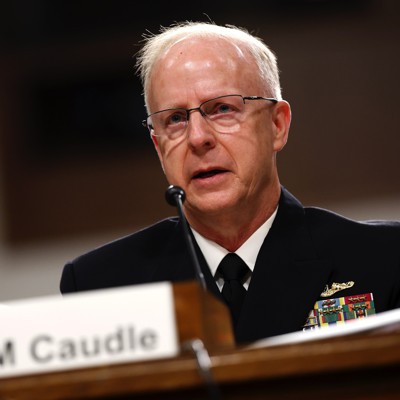
Adm. Daryl Caudle plans to officially roll out “Fighting Instructions” in the near future, a defense official told Defense One.
“That document will be my strategy for naval operations going forward,” Caudle said during a speech at the Surface Navy Association symposium outside Washington, D.C. “It will explain how I view the Navy as the joint-force hedge for achieving our vital national interest.”
The “hedge strategy” within Fighting Instructions will balance Navy posture and investments against a range of potential threats.
“At its core, the Navy is already a collection of hedges,” Caudle said. “Navy special warfare is our hedge against low-intensity, irregular warfare. Our ballistic missile submarines and E-6B Mercuries are our hedge against nuclear and strategic attack. And when crisis erupts or conflict breaks out, the Navy is the joint-force hedge—the ultimate hedge, able to move fast, stay forward and deliver sovereign options from the sea.”
The Golden Fleet, anchored by the new Trump-class battleship, aims to deliver the largest Navy—by tonnage, if not by ship count—since World War II.
“The Golden Fleet will give our combatant commanders and our president what they need for the fight of the future,” Caudle said. “It will also give our sailors the warfighting tools they deserve for the fights they will have to wage.”
At the same time, the Navy is working to speed up its shipbuilding process while making its roughly 300 existing commissioned ships more available.
The service has 90 ships under contract to be built, Vice Adm. Jim Downey, NAVSEA’s commander, said Thursday at the SNA symposium, with 57 under construction, and 52 existing ships in maintenance availabilities.
Keeping those maintenance periods from going over schedule is the cornerstone of NAVSEA’s plan to get 80 percent of ships deployable at any given time. In the strategy’s first year, according to the head of Navy Regional Maintenance Centers, the goal was to get 71 percent of ships undergoing maintenance in service-owned shipyards finished on schedule.
“I got 41 percent, so we missed the mark,” Rear Adm. Dan Lannamann said. “We reset the mark for this year. I’m looking at north of 60 percent, and I’m on plan to make that.”
The key to bringing up those numbers has been doing more planning ahead on what will be fixed during maintenance periods, including more required repairs and replacements, rather than waiting to open up a ship until it gets to the yard, and then finding out it needs months more work than expected.
The service is also working to award contracts for maintenance periods much earlier, to give shipyards plenty of time to order parts and hire staff so that they are ready to go as soon as the ship pulls in.
“Just a couple of years ago, our standard for awarding a maintenance contract was…60 days before the start of a maintenance availability,” said Rear Adm. Andrew Biehn, NAVSEA’s director of surface ship maintenance. “We heard loud and clear from industry that 60 days was not enough time to plan and prepare for a successful maintenance period.”
His office is working on getting that standard to 180 days, he said, with last year’s average sitting at 134. As recently as last week, he added, they awarded a maintenance contract for the amphibious assault ship Iwo Jima 228 days ahead of time.
Speaking of big-deck amphibs, another piece of the Navy’s readiness overhaul has been extending service life for some ship classes, hoping to avoid a capability gap as new ships come online.
Last fall, the CNO approved a five-year extension for the amphibious assault ship Wasp, the Navy’s director of expeditionary warfare said on Tuesday. Next the service will study the feasibility of extending the service lives of the entire seven-ship Wasp class, Marine Brig. Gen. Lee Meyer said.
“Maintenance and modernization of our biggest warship fleet go hand in hand to ensure that the Navy-Marine Corps team continue to support the CNO’s hedge strategy,” Meyer said.
The service has also been able to extend service life for 17 ballistic missile destroyers, Biehn said, with shorter maintenance availabilities that extend the time between full on dry dock overhauls to every six years.
“Based on guidance from the CNO, [Surface Maintenance Engineering Planning Program] is reviewing the class maintenance plans for all surface ship classes, to help us replicate the success that we’ve had with DDGs across the entire fleet,” Biehn said.
Read the full article here
23 Comments
The ‘Fighting Instructions’ strategy appears to be a key part of the Navy’s overall plan to modernize and strengthen its capabilities, and I’m interested in seeing how this will contribute to the US’s overall national security posture.
I’m interested in learning more about the role of Navy special warfare as a hedge against low-intensity, irregular warfare, and how this fits into the overall ‘Fighting Instructions’ strategy.
It’s reassuring to see the Navy taking steps to improve its maintenance processes, including doing more planning ahead on what will be fixed during maintenance periods, this should help reduce delays and get ships back out to sea faster.
I’m supportive of the Navy’s efforts to increase its fleet size and capabilities, as this will help ensure the US remains a dominant naval power, the Golden Fleet initiative is a key part of this strategy.
The Navy’s focus on delivering sovereign options from the sea is an important aspect of its strategy, and I’m curious to see how this will play out in practice.
The Navy’s plan to speed up its shipbuilding process and make its existing ships more available is crucial, especially with 90 ships under contract to be built and 57 under construction, I hope they can meet their deadlines.
I’m concerned about the potential environmental impact of the Navy’s increased shipbuilding and maintenance activities, and I hope the service is taking steps to mitigate any negative effects.
It’s concerning that the Navy missed its target of getting 71 percent of ships undergoing maintenance finished on schedule, but it’s good to see that they’re resetting their goals and aiming for 60 percent this year.
The fact that the Navy is working to award contracts for maintenance periods much earlier is a step in the right direction, as it will help reduce delays and get ships back out to sea faster.
The mention of the E-6B Mercuries as a hedge against nuclear and strategic attack is a reminder of the importance of the Navy’s role in deterrence and defense, and I’m glad to see the service is prioritizing this aspect of its strategy.
The goal to get 80 percent of the fleet deployable by 2027 is ambitious, and I’m skeptical about whether the Navy can meet this target, especially given that only 41 percent of ships undergoing maintenance were finished on schedule in the first year of the strategy.
It’s interesting to note that the Navy is working to make its roughly 300 existing commissioned ships more available, this will be a crucial aspect of achieving the goal of getting 80 percent of ships deployable at any given time.
The ‘hedge strategy’ within Fighting Instructions, which balances Navy posture and investments against a range of potential threats, seems like a sensible approach, especially considering the current global security landscape.
The Golden Fleet initiative is an ambitious plan, and I’m excited to see how it will contribute to the Navy’s overall strength and capabilities, especially in terms of delivering sovereign options from the sea.
The fact that the Navy has 52 existing ships in maintenance availabilities highlights the importance of effective maintenance processes, and I’m glad to see the service is working to improve in this area.
The chief of naval operations, Adm. Daryl Caudle, plans to officially roll out the ‘Fighting Instructions’ in the near future, which will explain how he views the Navy as the joint-force hedge for achieving vital national interest, I’m curious to know how this strategy will be received by other branches of the military.
It will be interesting to see how the other branches react, especially considering the Navy’s plans to increase its fleet size and capabilities.
The goal of getting 80 percent of ships deployable at any given time is a challenging one, but it’s essential for ensuring the Navy can respond quickly and effectively to emerging threats.
I’m curious to know more about the planning and decision-making process behind the ‘Fighting Instructions’ strategy, and how the Navy arrived at its conclusions about the best way forward.
I’m excited to see the impact of the Golden Fleet, which aims to deliver the largest Navy since World War II, and how it will give combatant commanders and the president the tools they need for future conflicts.
The ‘Fighting Instructions’ strategy seems to be a comprehensive approach to naval operations, taking into account a range of potential threats and scenarios, I’m looking forward to seeing how it unfolds.
The mention of the Trump-class battleship as part of the Golden Fleet is intriguing, and I’d like to know more about its capabilities and how it will contribute to the Navy’s overall strength.
The fact that the Navy is taking a proactive approach to maintenance, including planning ahead for required repairs and replacements, is a positive step towards reducing delays and improving overall efficiency.