

Listen to the article
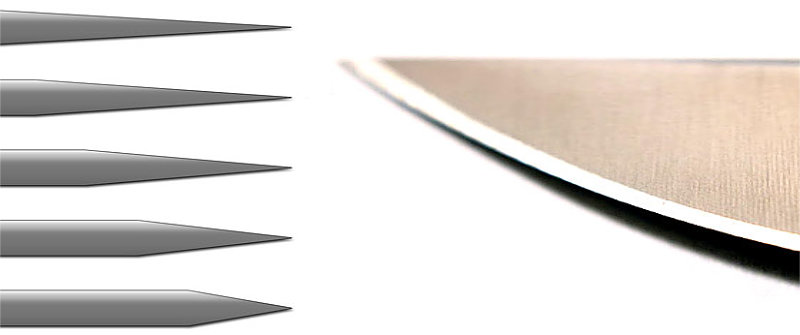
Sharpening a knife to its original performance starts with one thing: using the correct sharpening angle and keeping it consistent. Every knife such as kitchen, pocket, hunting, or tactical, has a manufacturer-specified bevel angle (DPS: degrees per side). Maintaining that angle preserves sharpness, edge retention, and the knife’s intended cutting characteristics.
The problem? Most people don’t know their knife’s factory angle.
That’s why I researched and compiled this common knife sharpening angles chart, drawing from major manufacturers such as Wüsthof, Zwilling/Henckels, Shun, Global, Victorinox, Buck, Benchmade, Gerber, SOG, and others. Whether you sharpen by hand, use a guided system, or prefer an adjustable tool, knowing the correct DPS gives you a clear starting point and better results.
Below is a quick-reference angle chart followed by a detailed breakdown by brand and knife type. If you don’t know your knife’s factory bevel, use the angle that most closely matches the edge already on the blade. You’ll maintain sharpness without changing the knife’s geometry.
Contents (Jump to a Section)
What Is the Best Knife Sharpening Angle? (Quick Answer)
The best knife sharpening angle depends on the knife’s purpose, but most blades fall between 15° and 22° per side (DPS).
- 15–16° DPS → razor-sharp, thinner edges (Asian kitchen knives, fillet knives)
- 18–20° DPS → balanced sharpness and durability (most pocket and everyday carry knives)
- 20–22° DPS → stronger working edges (hunting, outdoor, and Western kitchen knives)
- 25–30° DPS → heavy-duty or tactical blades that prioritize toughness over razor sharpness
If you’re unsure of your knife’s factory angle, match the existing bevel. Maintaining the original geometry gives the best combination of sharpness, durability, and edge life.
Knife Sharpening Angle Chart (Quick Reference Table)
This quick-reference chart shows the most common sharpening angles (DPS = degrees per side) for typical knife categories. These angles represent standard factory bevels across major manufacturers.
Typical Angles by Knife Type
Common Knife Sharpening Angles (Degrees Per Side)
| Knife Type | Typical Angle (DPS) | Purpose / Why This Angle |
|---|---|---|
| Tactical / Survival Knife | 22–25° | Maximum toughness; resists chipping under heavy use |
| Bushcraft / Outdoor Knife | 22–25° | Strong for wood processing, batoning, carving |
| Hunting Knife | 22° | Durable edge for bone, hide, and outdoor field dressing |
| Pocket Knife / EDC | 20° | Balanced sharpness and edge retention |
| Kitchen Knife (Western/European) | 20° | Durable for chopping and general kitchen tasks |
| Kitchen Knife (Asian/Japanese) | 15–16° | Razor-sharp slicing; thinner steel |
| Fillet Knife | 15–16° | Fine, flexible edge for smooth, precise cuts |
| Specialized Ultra-Fine Edges (Sushi/Chef) | 12–15° | Maximum sharpness; less durable, precision slicing |
DPS vs Inclusive Angle (Important!)
Understanding the difference between DPS (degrees per side) and the inclusive angle is essential for sharpening a knife correctly.
DPS (Degrees Per Side)
DPS is the angle applied to each side of the blade.
Manufacturers almost always list sharpening angles in DPS.
Inclusive Angle
The inclusive angle is the total angle created by both sides of the knife edge.
It is simply:
Inclusive Angle = DPS × 2
Quick Examples
| DPS (Per Side) | Inclusive Angle (Total) | Typical Use |
|---|---|---|
| 15° per side | 30° total | Japanese kitchen knives, fillet knives |
| 20° per side | 40° total | Western kitchen knives, EDC pocket knives |
| 22–25° per side | 44–50° total | Hunting, bushcraft, survival knives |
Why This Matters
The DPS value determines how sharp and durable the edge will be:
- Lower angles (12–16° DPS) → Extremely sharp, but more delicate
- Mid-range angles (18–20° DPS) → Balanced sharpness and durability
- Higher angles (22–25° DPS) → Strong, durable edges for outdoor or heavy use
If your goal is to maintain the factory geometry, always match the DPS, not the inclusive angle.
Best Adjustable Angle Knife Sharpener (14°–24°)
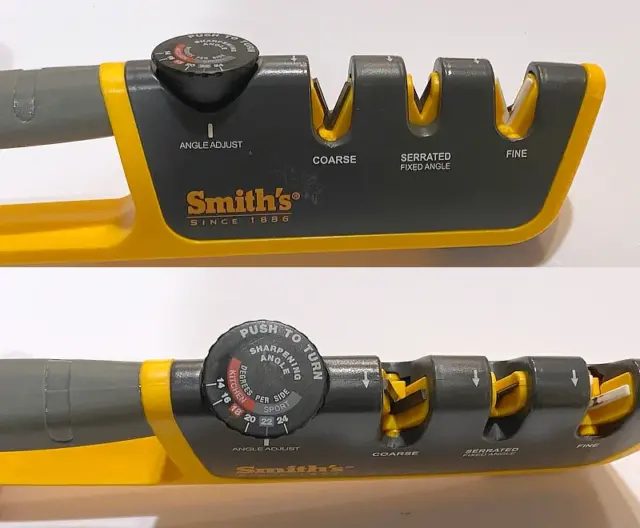
Maintaining the correct sharpening angle is much easier when you use a tool that can match your knife’s factory bevel. Adjustable sharpeners allow you to set a precise DPS angle, which is especially helpful if your knives vary between 14°, 18°, 20°, or 22° per side.
One tool I regularly use for quick edge restoration is the Smith’s Adjustable Angle Knife Sharpener. It lets you choose exact settings from 14°, 16°, 18°, 20°, 22°, and 24°, so you can match almost any kitchen, pocket, or outdoor knife without guesswork.
As an Amazon Associate I earn from qualifying purchases.
(no extra cost) Thank you
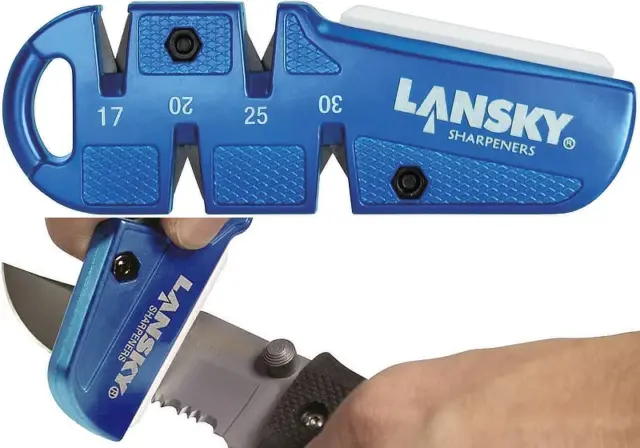
Lansky QuadSharp with Preset Angles (17°, 20°, 25°, 30°)
For a compact option, the Lansky QuadSharp offers preset angles. It’s handy when you want consistency without adjustment. It’s also one of the few pocket sharpeners capable of handling serrated edges.
Knife Sharpening Angle Chart by Brand & Manufacturer
Different knife makers use different factory bevel angles depending on steel hardness, intended use, and blade geometry. Below are the most commonly published DPS (degrees per side) angles from major manufacturers.
Use this section to match your knife’s factory angle as closely as possible.
Want the full original list?
→ Jump to the complete knife angle reference section (all manufacturers).
Zwilling / Henckels Knife Sharpening Angles
| Knife Type | Angle (DPS) |
|---|---|
| Zwilling / Henckels (Cronidur) | 12.5° |
| All Other Zwilling / Henckels | 15° |
| Wüsthof → appears below (14° and 11° depending on style)** |
Wüsthof Knife Sharpening Angles
| Knife Type | Angle (DPS) |
|---|---|
| Chef’s Knife | 14° |
| Santoku | 11° |
| Paring Knife | 14° |
| Utility Knife | 14° |
Victorinox Knife Sharpening Angle
| Knife Type | Angle (DPS) |
|---|---|
| All Victorinox Knives | 15–20° |
Global Knife Sharpening Angles
| Knife Type | Angle (DPS) |
|---|---|
| Chef’s Knife | 17° |
| Santoku | 17° |
| Paring / Utility | 17° |
Shun Knife Sharpening Angles
| Knife Type | Angle (DPS) |
|---|---|
| Chef’s Knife | 16° |
| Santoku | 16° |
| Paring Knife | 16° |
| Utility Knife | 16° |
Gerber Knife Sharpening Angle
| Knife Type | Angle (DPS) |
|---|---|
| All Gerber Knives | 15° |
SOG Knife Sharpening Angles
| Blade Type | Angle (DPS) |
|---|---|
| Flat Grind | 22° |
| Hollow Grind | 18–20° |
Buck Knife Sharpening Angles
| Knife Type | Angle (DPS) |
|---|---|
| All Buck Knives | 13–16° |
Benchmade Knife Sharpening Angles
| Knife Type | Angle (DPS) |
|---|---|
| All Benchmade Knives | 18–20° |
Kershaw Knife Sharpening Angles
| Knife Type | Angle (DPS) |
|---|---|
| All Kershaw Knives | 20–22° |
Cold Steel Knife Sharpening Angles
| Knife Type | Angle (DPS) |
|---|---|
| All Cold Steel Knives | 23–25° |
CRKT (Columbia River Knife & Tool) Sharpening Angles
| Designer / Model | Angle (DPS) |
|---|---|
| Most CRKT Knives | 17–22.5° (varies by designer) |
Al Mar Knife Sharpening Angles
| Knife Type | Angle (DPS) |
|---|---|
| All Al Mar Knives | 20° |
Knives of Alaska – Sharpening Angles
| Knife Type | Angle (DPS) |
|---|---|
| All Knives of Alaska | 18–20° |
Outdoor Edge Knife Sharpening Angles
| Knife Type | Angle (DPS) |
|---|---|
| All Outdoor Edge Knives | 20° |
KA-BAR Knife Sharpening Angles
| Knife Type | Angle (DPS) |
|---|---|
| Most KA-BAR Knives | 15° (varies by model) |
| Hunting / Fixed Blades | ~20° |
Winchester Knife Sharpening Angles
| Knife Type | Angle (DPS) |
|---|---|
| Winchester Knives | Use Smith’s recommended angle for the knife type (no published standard) |
>> Jump down to my Original List below
Specialty Knife Sharpening Angles (Fillet, Hunting, Tactical)
Different knife types require different angles based on their intended use. These specialty categories have consistent, widely accepted DPS (degrees per side) ranges across almost all major manufacturers.
Fillet Knife Sharpening Angles
Fillet knives need a very fine edge to glide cleanly through fish and delicate meat. Their flexibility means they perform best with low-angle bevels.
| Knife Type | Typical Angle (DPS) |
|---|---|
| Fillet Knives (All Brands) | 15–16° |
Why this angle:
A lower angle creates a thin, razor-like edge ideal for precise, smooth cuts.
Hunting Knife Sharpening Angles
Hunting knives must balance sharpness with toughness for field dressing, hide work, cartilage, and intermittent contact with bone.
| Knife Type | Typical Angle (DPS) |
|---|---|
| Hunting / Outdoor Knives | 20–22° |
Why this angle:
These angles provide durability while still being sharp enough for controlled slicing tasks.
Tactical / Survival Knife Sharpening Angles
Tactical and survival knives are designed for heavy-duty use including wood processing, bushcraft tasks, prying, scraping, and emergency situations.
| Knife Type | Typical Angle (DPS) |
|---|---|
| Tactical / Fixed-Blade Survival Knives | 22–25° |
Why this angle:
Higher angles resist chipping and deformation when used for demanding or abrasive tasks.
Knife Sharpness Scale (Durability vs Sharpness)
Every sharpening angle involves a trade-off between sharpness, edge retention, and durability. Lower angles slice more easily but are more delicate. Higher angles are stronger but not as razor-sharp.
This scale shows how sharpening angles translate into real-world performance.
Sharpness Scale by Angle (From Strongest to Sharpest)
| Angle (DPS) | Sharpness Level | Durability | Typical Use |
|---|---|---|---|
| 25°+ | Moderate | Maximum | Tactical, survival, heavy-duty |
| 22–24° | Good | Very High | Hunting, bushcraft, outdoor knives |
| 20° | Very Good | High | EDC pocket knives, Western kitchen |
| 17–18° | Sharp | Medium | Premium EDC, high-quality steels |
| 15–16° | Razor Sharp | Lower | Japanese kitchen knives, fillet knives |
| 12–14° | Ultra Fine | Very Low | Sushi knives, precision slicing |
When to Choose a Lower vs Higher Angle
Choose a LOWER angle (12–16° DPS) when you want:
- Maximum slicing performance
- Paper-shaving or hair-popping sharpness
- Thin cuts with minimal resistance
- Precision food prep (sushi, fillet, vegetables)
Downside: Chips more easily and dulls faster on hard materials.
Choose a MID-RANGE angle (18–20° DPS) when you want:
- A balance of sharpness and strength
- Versatility in daily tasks
- General kitchen use
- Most pocket knife applications
This is the “sweet spot” for most blades.
Choose a HIGHER angle (22–25° DPS) when you want:
- Maximum toughness and edge stability
- Resistance to roll, chip, and deformation
- Strength for wood, bone, and outdoor tasks
Perfect for survival, hunting, field dressing, and bushcraft knives.
Knife Sharpening Abrasives (Quick Overview)
Different sharpening tools remove metal at different rates. Choosing the right abrasive helps you maintain your knife’s sharpening angle more effectively and avoid unnecessary wear.
Diamond Abrasives
- Fastest metal removal
- Stay perfectly flat
- Excellent for very dull or hard-steel knives
Carbide Sharpeners
- Very aggressive
- Good for quickly restoring a working edge
- Not ideal for fine finishing
Ceramic Rods & Stones
- Remove very little metal
- Ideal for polishing, honing, and edge maintenance
- Great for touching up your angle without reshaping it
Arkansas Stones
- Natural novaculite
- Very smooth, refined finish
- Best for final honing and razor-sharp edges
Synthetic Stones
- Available in many grits
- Versatile for both shaping and finishing
- Consistent results for controlled angle sharpening
How to Sharpen a Knife at the Correct Angle
Sharpening technique matters, but holding a consistent angle matters even more. Whether you sharpen by hand or with a guided system, these steps help you match your knife’s factory bevel and maintain the correct DPS.
How to Hold the Correct Angle by Hand
Maintaining angle manually is a skill that improves with practice.
1. Visualize the angle
- Start by resting the knife flat on the stone.
- Slowly lift the spine until the existing bevel “lays flat” against the surface.
- That’s the angle you want to keep throughout the stroke.
2. The 45° → half-angle trick
- Hold the knife at a clear 45° angle.
- Cut that in half → ~22°.
- Slightly reduce it again → ~20°.
This gets you close to most pocket and kitchen knives.
3. Use light to moderate pressure
Too much pressure widens the angle and removes excess metal.
4. Sharpen one smooth arc
Sweep from heel to tip in a single motion to contact the full edge.
5. Repeat evenly on both sides
Same number of strokes per side keeps the bevel symmetrical.
Using a Rod or Guided Sharpener
Rod-style and guided systems help maintain the correct angle with less guesswork.
Diamond Rod:
- Best for very dull or damaged edges
- Fast metal removal
- Use a light trailing stroke at your target DPS
Ceramic Rod:
- Ideal for maintaining sharpness
- Very gentle metal removal
- Perfect for touching up the edge angle between full sharpenings
Guided Systems:
Tools like the Lansky QuadSharp or Smith’s Adjustable Sharpener let you select precise angles such as 14°, 16°, 18°, 20°, 22°, or 24° – perfect for matching factory bevels.
Stropping for a Razor Edge
Stropping is the final polishing step that refines your angle and removes microscopic burrs.
- Always use trailing strokes (pulling the knife away from the edge).
- Keep pressure light to avoid rounding the bevel.
- Leather strops with compound produce the sharpest, cleanest edge.
A few passes on a strop can dramatically improve sharpness without changing your knife’s DPS.
Knife Sharpening FAQ
Most knives fall between 15° and 22° per side (DPS). Lower angles are sharper, while higher angles are more durable.
Western kitchen knives are typically sharpened at 20° per side, while Japanese kitchen knives are usually 15–16° per side.
Most pocket knives and EDC blades use a 20° per side angle for a balance of sharpness and toughness.
Hunting and outdoor knives perform best at 20–22° DPS, offering a stronger, more durable edge.
Fillet knives use a low 15–16° DPS for a thin, precise slicing edge.
DPS stands for degrees per side, the angle applied to one side of the blade. The total or “inclusive” angle is double the DPS.
Yes, lower angles (12–16° DPS) are sharper, but they are also less durable and better suited for slicing tasks, not heavy-duty use.
Stropping removes burrs and polishes the edge, improving sharpness and edge retention. It is recommended after sharpening.
Yes, but it requires removing additional steel to reshape the bevel. If unsure, match the existing factory angle for best results.
Full Knife Sharpening Angle Reference List (Original Data)
Below is the full detailed list of knife sharpening angles exactly as originally compiled from manufacturers. This comprehensive section preserves all data, including models and categories not widely published elsewhere.
Chef’s Knife Sharpening Angle:
Global – 17
Shun – 16
Wusthof – 14
Zwilling Henckel / Cronidur – 12.5
All other Zwilling Henckel – 15
Serrated Knife:
All Brands – Manual Sharpening; Serrated Slot ONLY
Santoku Knife Sharpening Angle:
Global – 17
Shun – 16
Wusthof – 11
Zwilling Henckel / Cronidur – 12.5
All other Zwilling Henckel – 15
Paring Knife Sharpening Angle:
Global – 17
Shun – 16
Wusthof – 14
Zwilling Henckel / Cronidur – 12.5
All other Zwilling Henckel – 15
Utility Knife Sharpening Angle:
Global – 17
Shun – 16
Wusthof – 14
Zwilling Henckel / Cronidur – 12.5
All other Zwilling Henckel – 15
Boning Knife Sharpening Angle:
Global – 17
Shun – 16
Wusthof – 18
Zwilling Henckel / Cronidur – 12.5
All other Zwilling Henckel – 15
Everyday Pocket Knives/Multi-Tools:
Al Mar – 20
Benchmade – 18-20
Blade-Tech – 20-22
Boker USA – 20-22
Buck – 13-16
Camillus – 23
Case – 19-22
Cold Steel – 23-25
Columbia River (CRKT) – 17-22.5(depending on designer)
KA-BAR – Listed on their website on a per knife basis, but generally 15 degrees per side
Kershaw – 20-22
Knives of Alaska – 18-20
Outdoor Edge – 20
SOG knife sharpening angle – 22 for flat grinds; 18-20 for hollow grinds
Spyderco – 20
Victorinox – 15-20
Winchester – Suggest using Smith’s recommended angle for knife type
Hunting/Outdoor – Fixed Blade:
Al Mar – 20
Benchmade – 18-20
Blade-Tech – 20-22
Boker USA – 20-22
Buck – 13-16
Camillus – 23
Case – 19-22
Cold Steel – 23-25
Columbia River (CRKT) – 17-22.5(depending on designer)
KA-BAR – Listed on their website on a per knife basis, but generally 20 degrees per side
Kershaw – 20-22
Knives of Alaska – 18-20
Outdoor Edge – 20
SOG – 22 for flat grinds; 18-20 for hollow grinds
Spyderco – 20
Winchester – Suggest using Smith’s recommended angle for knife type
Hunting knives / Folders:
Al Mar – 20
Benchmade – 18-20
Blade-Tech – 20-22
Boker USA – 20-22
Buck – 13-16
Camillus – 23
Case – 19-22
Cold Steel – 23-25
Columbia River (CRKT) – 17-22.5(depending on designer)
Gerber – 15 (apparently all Gerber knives angle at 15 degrees)
KA-BAR – Listed on their website on a per knife basis, but generally 15 degrees per side
Kershaw – 20-22
Knives of Alaska – 18-20
Outdoor Edge – 20
SOG – 22 for flat grinds; 18-20 for hollow grinds
Spyderco – 20
Winchester – Suggest using Smith’s recommended angle for knife type
Fillet Knives Sharpening Angle:
All Brands – 15-16
Tactical Knives Sharpening Angle:
Al Mar – 20
Benchmade – 18-20
Blade-Tech – 20-22
Boker USA – 20-22
Buck – 13-16
Camillus – 23
Case – 19-22
Cold Steel – 23-25
Columbia River (CRKT) – 17-22.5(depending on designer)
KA-BAR – Listed on their website on a per knife basis, but generally 15 degrees per side
Kershaw – 20-22
Mil-Tac – Generally 25 for Folders and 30 for Fixed Blades
SOG – 22 for flat grinds; 18-20 for hollow grinds
Spyderco – 20
Surefire – 28
Custom Knives:
A.G. Russell – 15
Chris Reeves – 18-20
William Henry – 17-22
Reader Tips:
- Run the blade through the same number of sharpening strokes on EACH side. NEVER do more on one side.
- Personally, I find maintaining the edge with a strop and once every few uses with an ultra fine stone or plate is best, just easier to maintain rather than restore.
- If you have very sharp kitchen knives, some guests who visit may need to be warned about the sharpness of your blades. A sharp knife is a safe knife – but some people still need to be warned 🙂
Diamond & Ceramic Rods
A knife sharpening rod works well because every blade has a different degree of bevel or angle.
The rod allows you to let the edge guide you, while keeping the rest of the knife away from the sharpening device.
A diamond rod is for a knife blade with severe damage or a very dull blade.
The ceramic rod is for “freshening up” a dull-ish blade. I keep one on my bench as well as in the kitchen and field pack.
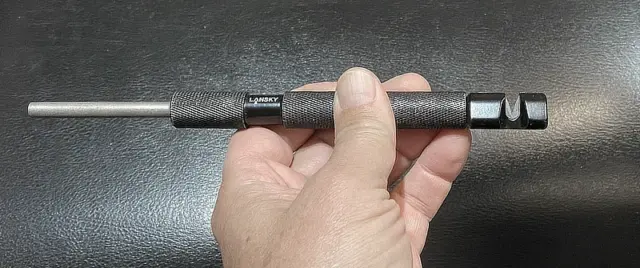
I use the following knife sharpening rods:
The Lansky LCD02 is designed to maintain the existing angle on your blade.


Sharpening a Knife to a Razor Edge with a Strop
This is the process in “how to sharpen a knife” where you can get your knife RAZOR SHARP!
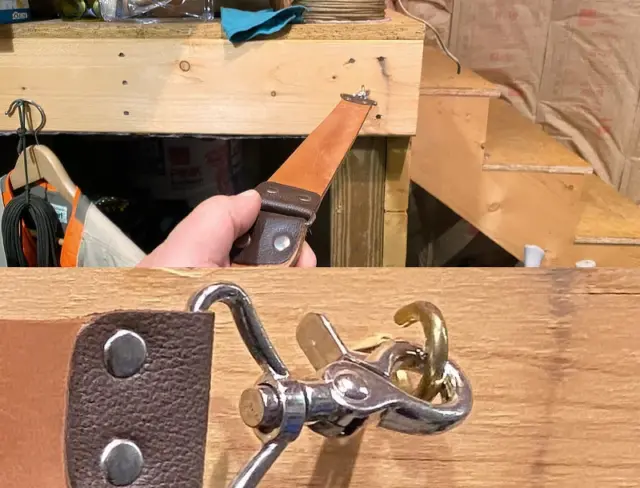
Here’s my leather strop, clipped onto a screw-eye attached to a wall (or whatever). That way, you can pull it tight while stropping your knife for that razor edge.
This is the last step in the process of sharpening knives.
Stropping is a motion which pulls the cutting edge away from a substrate.
The direction of stropping strokes:
Drag the edge backwards over the strop. In other words, it’s a “trailing stroke” by pulling the knife edge rather than “leading strokes” (as you would with a stone or rod).
Use a light touch and maintain the angle of the knife edge.
Alternate sides with each stroke.
Use Stropping Compound to further enhance results:
How to Sharpen a Pocket Knife by Hand
Here’s one way.. The basic technique for sharpening kitchen knives and pocket knives is the same as the steps listed above.
Here’s a basic method to sharpen a knife! It works!
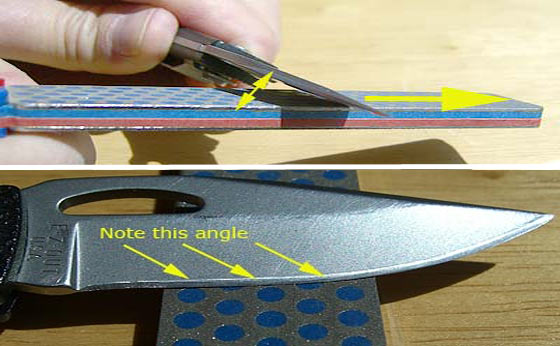
Sharpening my pocket knife:
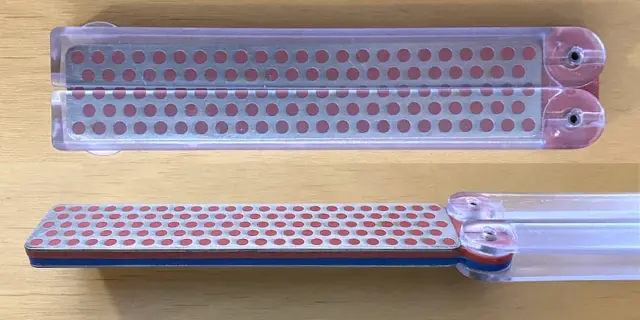
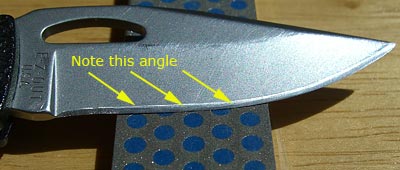
The portable knife sharpener shown in the picture is one that I often use.
It has microscopic diamonds embedded in each of the two sides (one side is finer grit than the other).
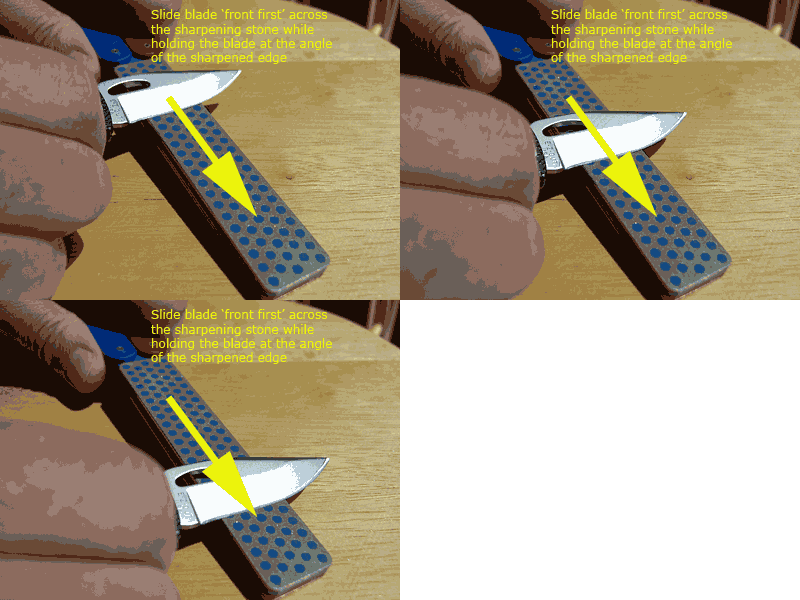
Sharpening Technique:
Hold the knife against the sharpening stone at the same angle as the sharpened edge itself. Then push it forward across the sharpening tool while maintaining that same angle.
After sliding the knife across the stone, don’t slide it back up against the stone… Lift the knife and start over from the top of the knife sharpener, sliding it down across its surface again.
More specifically, you should sweep the knife such that you are contacting the entire surface of the blade in one arcing motion down the sharpening tool (therefore sharpening evenly). The longer the blade, the more dramatic the sweep, to get the entire blade in one smooth motion.
You will get into a steady rhythm while practicing. Apply light to moderate pressure.
Maintain The Angle
The key when sharpening by hand (without a jig) is to hold and maintain the knife blade at the proper angle.
To determine that angle, it may help to first rest the knife on the edge of the stone. Look closely at the blade’s sharpened edge. Then adjust the knife’s angle until you see that the sharpened edge sits ‘flat’ against the knife sharpener tool’s surface.
Once you’ve visualized the proper angle, just go with it…
What sharpening angle to use for your pocket knife? Check the list above, and you might find yours. Otherwise, typically the angle for a generic pocket knife is somewhere around 20 degrees.
One trick is to first hold the knife at a 45-degree angle against the sharpening tool (which is easy to visualize) and then adjust the knife to slightly less than half that angle, which will be close to what you want.
[ Read: Your Favorite Small Pocket Knife ]
Keeping your knife at the correct sharpening angle is the key to restoring performance, edge life, and safe, predictable cutting. Whether you sharpen by hand or use an adjustable-angle tool, matching the original factory bevel will always give the best results.
Use the quick-reference chart and manufacturer list above to find the proper DPS for your specific knife, and maintain that angle consistently throughout the sharpening process. With the right technique and the right angle, your knives will stay sharper, longer.
Read the full article here