

Listen to the article
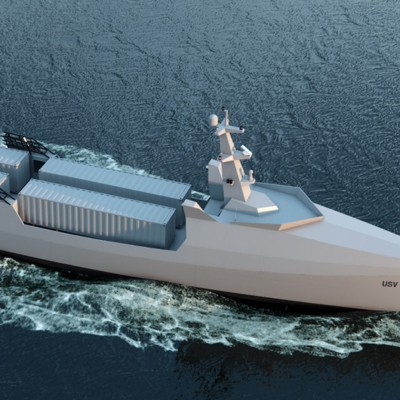
SAN DIEGO, California—Boston-based Blue Water Autonomy aims to take its 190-foot robot patrol craft from prototype to production this year, joining a newly crowded field of startups and established players trying to get their unmanned surface vessels in front of U.S. Navy buyers, commanders, and operators.
“Right now, the focus really should be on the suppliers” so the Navy can “see the performance of these vessels,” CEO Rylan Hamilton told Defense One ahead of the WEST 2026 conference here. He said the Navy needs to know industry’s offerings are reliable and “see these vessels in the water operating every single day with the fleet.”
The Navy hasn’t yet decided how many medium and large unmanned surface vessels it needs. Experiments are continuing under at least three commands, while fleet leaders are working to shape plans to buy, operate, and maintain USVs. But the lethality of robot warcraft has been proven in waters in and off Ukraine. And some analysts suggest that unmanned vessels might be key to deterring China while the United States works to grow its manned fleet.
All this has several dozen companies lining up to pitch USVs to the Navy, from shipbuilding giant HII to defense stalwart Leidos to newer, smaller ones such as HavocAI and Saildrone.
“I don’t think anyone questions whether unmanned has a place in the fleet architecture,” Hamilton said. “It’s really: ‘How long is it going to take to get some of these vessels out into the fleet and operating, so the end user of the fleet can really figure out how they want to use them and how many they actually want?’”
It’s complicated
The Navy’s working on it, Adm. Daryl Caudle, chief of naval operations, told reporters last month.
The Pentagon “can get fairly enamored and up to speed very quickly on buying things…the defense industrial base loves that, and it’s very capability-centric. But that has to clutch into the gearing of how the Navy actually prepares to utilize, sustain, employ, deploy, and the concepts of operation of that kit,” Caudle said.
If the Navy buys too much too fast, USVs could stack up in storage because the service’s operations, training, and sustainment models haven’t been tweaked to match. So Caudle outlined a “standard model” for how the Navy does business in the Fighting Instructions he released on Monday.
“That’s how we do it in the Navy. And so my goal is to try to get the C2 and organization structure right. That’s why you’ve seen the stand up of UUVRons, unmanned undersea vehicle squadrons, unmanned undersea vehicle groups, flotillas, unmanned surface vehicle squadrons,” Caudle said in January. “Because if I don’t get that form factor right, then I don’t know how to, essentially, maintain these systems, present those forces, train with them, experiment and demo with them in a way that’s effective so the combatant commanders actually even know what to ask for. And so that’s the challenge.”
But some analysts say global threats demand faster action.
“The Chinese are not slowing down. So the urgency for actually getting firepower and capabilities to sea is the priority, as I estimate it, to try to keep the peace and to buy time” for the United States to catch up to China’s ability to produce manned warships, said Brent Sadler, a senior research fellow at the Heritage Foundation, who focuses on maritime security.
“And also, when you look at it, the only thing that you’re going to get in the water in time in the immediate future that might get ahead of the Chinese calculations are the unmanned systems—and I’m not talking one-way drones like the little quadcopters or the little jet-ski-boat-looking things. It’s the type of unmanned platforms that are substantial, that can carry munitions, that have the range that’s required in the Pacific theater.”
All eyes on MASC
So far, the Navy has been buying mostly the robot jet-skis—for example, several hundred Global Autonomous Reconnaissance Craft under a program launched in 2024 by the previous CNO’s Project 33 effort.
The market for small drone boats “is accelerating a lot quicker” than the ones for medium and large ones, said David Hutchins, a military systems researcher and analyst for Forecast International, a sibling brand of Defense One.
But that is expected to change. The Navy envisions a fleet of 381 manned and 134 unmanned ships and has talked about flooding the warzone with unmanned vessels. Last year, Congress gave the service $2.1 billion in the reconciliation bill to develop and buy medium USVs.
And the Navy is soon to announce awards to build variants of its highly anticipated Modular Attack Surface Craft.
“MASC is still kind of prototyping” but will likely become the “biggest hot ticket” in the medium and large USV space, said Thomas Freebairn, weapons analyst with Military Periscope, another sister brand of Defense One.
The smallest version of the MASC vessel is expected to carry a 20-foot payload, while the largest could carry four 40-foot containers. That facilitates a wide variety of equipment, and therefore missions, Freebairn said. The larger ones are likely to be able to handle Vertical Launch Systems that can launch strike weapons or anti-missile interceptors.
“A lot of them, especially the smaller ones, will be equipped with sensor payloads that have a lot of wide, sweeping implications for, obviously, [anti-submarine warfare], for counter-air detection. And so I think that there is going to be a lot of money in it,” he said.
That last part has been received loud and clear.
The MASC program “has been a really strong signal to industry,” said Hamilton of Blue Water Autonomy. “Because of that strong signal, you’ve seen private industry really lean in and take some of their own capital and [invest] ahead of the contracts coming up from the Navy.”
And in general, the service is offering a clearer message about its unmanned-vessel plans, he said.
“The Navy’s done a great job kind of communicating what it wants, where it’s going, and removing maybe some of the uncertainty from the program that you would have seen a couple years ago.”
Blue Water’s entry is the Liberty class, based on Damen’s 800-ton Stan Patrol 6009 and packed with systems to enable it to operate autonomously. Its design range of 10,000 nautical miles is meant to enable months-long missions with up to 150 tons of payload, including missile launchers.
“We’ve been able to raise private capital from firms like Google Ventures, and we’ve used that to basically test everything…on the ocean seven days a week,” Hamilton said.
Production is slated to begin next month at Conrad Shipyard in Louisiana, with the first Liberty to be delivered later this year. If needed, Hamilton said, the yard could ultimately build 20 of the USVs a year.
Making bubbles?
Blue Water has steep competition, including Anduril, GARC-maker BlackSea Technologies, and Austin, Texas-based Saronic, which aims to build its own yard.
“You’ve got, easily, a dozen companies that are trying to be relatively big players in the USV industry. And then there’s probably two or three dozen more that are small contributors—either they’re starting up a company or they’re working with another company to partner on building them,” said Bryan Clark, who leads the Hudson Institute’s Center for Defense Concepts and Technology.
Clark said only some of them are likely to survive.
“I think all these companies feel like when the government orders level out, that there’s going to be a couple of winners. Because the government will have a sustained number of orders, so they’ll continue to need USVs to get built, but not at the kind of scale that’s going to keep a dozen companies in business. It might keep two companies in business—and so they all feel like they’re going to be one of the two,” Clark said.
“Like, if you’re a Blue Water Autonomy, they’re going to build medium, uncrewed surface vehicles. But they don’t have a shipyard. They do the autonomy, they design the ship, they integrate things together. And so they don’t need a whole lot of orders to stay viable financially,” he said.
“I think [USV companies are] all looking for ways to mitigate their risk once the Navy’s orders start to level off. But I think there is a little bit of a bubble. What’s interesting is now looking at the strategies they’re all pursuing to try to make sure they can survive once the bubble deflates.”
Read the full article here
6 Comments
This is very helpful information. Appreciate the detailed analysis.
Great insights on Defense. Thanks for sharing!
I’ve been following this closely. Good to see the latest updates.
Solid analysis. Will be watching this space.
Good point. Watching closely.
Interesting update on Crowded field of robot-boat makers vies for Navy’s attention. Looking forward to seeing how this develops.