

Listen to the article
Eighty-one years ago this month, on Dec. 16, 1944, German forces launched their last major offensive on the Western Front. The Battle of the Bulge would become the largest and bloodiest single battle American forces fought in World War II, with more than 80,000 U.S. casualties over six brutal winter weeks.
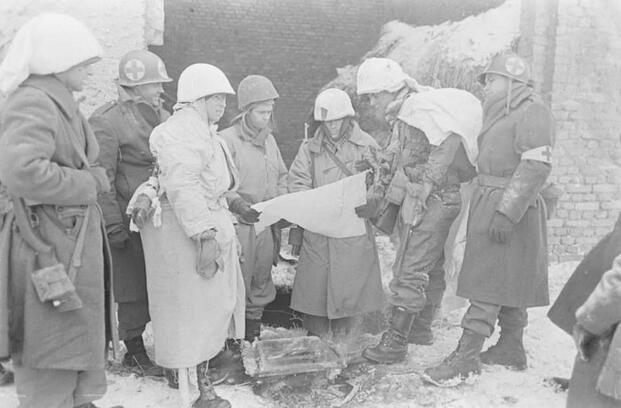
But behind the headlines about tank battles and infantry heroics, combat medics fought a different war. Working in frozen Belgian forests under constant artillery fire, they established battlefield medicine standards that shaped modern military medical care and laid the groundwork for today’s Department of Veterans Affairs health care system.
Read More: The 106th Infantry Division’s Forgotten Sacrifice During the Battle of the Bulge
Surrounded at Bastogne
On Dec. 19, three days into the battle, German forces captured the 326th Airborne Medical Company near Bastogne. Eleven officers and 119 enlisted men became prisoners of war. One medic, Pvt. Henry Sullivan, was killed. The loss gutted the 101st Airborne Division’s medical capability right when casualties started flooding in.
The few doctors and medics who escaped capture set up aid stations in whatever buildings they could find in Bastogne. Two medical officers, two dental officers, four administrative officers and roughly 113 enlisted men remained to handle the division’s wounded.
By Dec. 21, Germans had cut off the last road out of town. Surrounded, the medical teams worked with rapidly dwindling supplies of medicine and plasma. Buildings serving as hospital wards took constant artillery fire, periodic bombing and strafing runs. The medics worked anyway.
Surgery Under Fire
Surgical teams flew into Bastogne by glider to augment the overwhelmed aid stations. One surgeon performed 15 surgical procedures in 36 hours straight. The teams had to work fast because wounded men kept arriving faster than they could be evacuated.
Between Dec. 19 and Dec. 26, when Patton’s Third Army finally broke through to relieve the siege, medical teams in Bastogne treated 943 American casualties and 125 German prisoners. They did it with minimal equipment, under enemy fire, in freezing conditions that made every procedure harder.
Medical supply drops became critical. Surgical teams, penicillin and plasma arrived by air when roads were cut. Without those drops, casualty rates would have been far worse.
The Cold Killed More Than Bullets
Trench foot was more common than combat wounds during the Bulge. Soldiers spent days in frozen foxholes with wet boots. Their feet went numb then turned black. Medics inspected feet constantly, but the sheer number of cases overwhelmed treatment capacity.
The 77th Evacuation Hospital had beds for 750 patients. During the battle, it handled twice that number. Hospitals across the region faced the same problem. The 110th Evacuation Hospital at Esch received 300 casualties per day, with surgical backlogs exceeding 300 patients at times.
Cold weather complicated every medical procedure. Plasma froze. Morphine syrettes stopped working. Wounds that would have been manageable in better conditions became life-threatening. Medics had to innovate constantly.
Medical Innovations Born From Necessity
The Bulge pushed battlefield medicine forward through sheer necessity. Penicillin, still relatively new, saw widespread use. Medics gave it for everything from minor infections to serious wounds. Sulfa drugs prevented infections. Blood plasma saved lives when whole blood wasn’t available.
The triage system that medics developed under fire became standard practice. Sorting the wounded by severity, treating those who could be saved first, stabilizing others for evacuation. These decisions happened in seconds, often under enemy fire, and saved thousands of lives.
Evacuation procedures refined during the Bulge established the model for modern battlefield medicine. Get wounded soldiers to surgical care fast. Stabilize them close to the front. Move them to better facilities as soon as possible. This system, perfected in frozen Belgian forests, still guides military medicine today.
The Legacy Lives On
When wounded soldiers came home from the Bulge and other World War II battles, the military medical system didn’t stop caring for them. Rehabilitation programs for men who lost limbs, sight or hearing were innovations of the 1940s. These programs became the foundation of modern VA health care.
The survival rate for wounded soldiers in World War II far exceeded any previous war. Credit belongs to penicillin, plasma and rapid evacuation. But mostly it belongs to the medics who crawled through snow and fire to reach wounded men; who set up aid stations in buildings being shelled; who performed surgery by candlelight when the power went out.
Combat medic John Burch, who served with the 101st Airborne at Bastogne, never considered himself a hero. That honor belonged to the doctors and the men who didn’t come home, he insisted. But Burch and thousands of medics like him saved lives under impossible conditions and built the system that takes care of veterans today.
Eighty-one years later, the lessons they learned in December 1944 still save lives.
Story Continues
Read the full article here
20 Comments
The capture of the 326th Airborne Medical Company near Bastogne on December 19, 1944, resulting in 11 officers and 119 enlisted men becoming prisoners of war, must have had a significant impact on the 101st Airborne Division’s medical capabilities.
The bravery and resilience of the medics who served during the Battle of the Bulge is an inspiration to us all, and their legacy continues to shape modern military medical care.
I’m curious about the impact of the Battle of the Bulge on the development of the Department of Veterans Affairs health care system – did the experience of the medics during the battle inform the creation of this system?
I’m struck by the sheer scale of the medical effort required during the Battle of the Bulge, with thousands of casualties to treat and limited resources available – it’s a wonder that the medics were able to keep up with the demand.
It’s astonishing that one surgeon performed 15 surgical procedures in 36 hours straight, given the dire circumstances and constant artillery fire – a true testament to the medics’ dedication and skill.
It’s worth noting that the Battle of the Bulge marked a significant turning point in the war, and the bravery and sacrifice of the soldiers and medics who fought in it should be remembered and honored.
The fact that the Battle of the Bulge was the largest and bloodiest single battle American forces fought in World War II is a sobering reminder of the war’s brutality, and it’s remarkable that the medics were able to cope with such a large number of casualties.
The role of medical supply drops in delivering critical equipment, such as penicillin and plasma, to the medics in Bastogne cannot be overstated – these supplies were instrumental in saving countless lives.
I’m curious about the long-term effects of the Battle of the Bulge on the soldiers who fought in it, particularly those who suffered from trench foot or other injuries – were there any notable efforts to support their recovery and rehabilitation?
The use of gliders to fly in surgical teams to augment the overwhelmed aid stations in Bastogne was a clever tactic, and it’s interesting to consider how this approach might have influenced modern military medical evacuation procedures.
I’m intrigued by the mention of trench foot being more common than combat wounds during the Bulge, with soldiers spending days in frozen foxholes with wet boots – what measures were taken to prevent this condition?
The mention of the 77th Evacuation Hospital having beds for 750 patients highlights the scale of the medical response required during the Battle of the Bulge – it’s remarkable that the medics were able to cope with such a large number of casualties.
The fact that the 110th Medical Battalion is credited with saving many lives during World War II is a testament to the bravery and skill of the medics who served in it – their legacy continues to inspire modern military medical personnel.
The fact that Patton’s Third Army finally broke through to relieve the siege of Bastogne on December 26, 1944, must have been a huge relief for the soldiers and medics who had been trapped and under enemy fire for so long.
The fact that 80,000 U.S. casualties occurred over six weeks during the Battle of the Bulge is a sobering reminder of the war’s brutality, and it’s remarkable that medics were able to establish standards for battlefield medicine under such conditions.
It’s interesting to consider how the Battle of the Bulge might have played out differently if the medics had not been able to establish such effective aid stations and treat so many casualties – the outcome of the battle might have been very different.
The 106th Infantry Division’s sacrifice during the Battle of the Bulge is often overlooked, but it’s crucial to remember the bravery and resilience of these soldiers, especially the medics who worked tirelessly to save lives.
The fact that medical teams in Bastogne treated 943 American casualties and 125 German prisoners between December 19 and 26, despite being surrounded and under enemy fire, is a remarkable achievement that deserves more recognition.
This statistic is particularly impressive given the minimal equipment and freezing conditions the medics had to work with – it’s a wonder they were able to save so many lives.
The experience of the medics during the Battle of the Bulge has significant implications for modern military medical care, particularly in terms of developing strategies for treating mass casualties in austere environments.