

Listen to the article
Newer email correspondence from the Pentagon inviting individuals to partake in a Christian prayer service within the Department of Defense was sent to at least eight U.S. defense contractors, Military.com has learned.
Emails scribed by DoD and sent last week to an undisclosed number of individuals were shared with Military.com, inviting the persons to join a “Christian prayer and worship service” between 12-12:30 p.m. on Wednesday, Jan. 21, in the Pentagon auditorium. The correspondence was sent from Defense Secretary Pete Hegseth’s office, labeled the “Department of War.”
The correspondence was strongly chastised by groups like the Military Religious Freedom Foundation (MRFF), whose founder, Mikey Weinstein, told Military.com that he believes it was the first time such correspondence was sent to defense contractors.
He said the eight of them that received the message contacted MRFF, which for decades has challenged the lack of separation of church and state within military and government ranks. The contractors were from small, medium, and some of the largest defense contractors in the United States.
“There is no doubt that [the Pentagon has] now started to include defense contractors or ‘war contractors’ in their vicious violation of the constitution, proselytizing outreach directly from Hegseth himself,” said Weinstein, whose organization includes more than 100,000 service members—about 95% of whom are self-described Christians.
Hegseth has been accused by Weinstein, MRFF and others of pushing Christian nationalism in the military ranks since he became secretary in early 2025, with such efforts also exhibited in other government agencies.
Last September, MRFF chided U.S. Department of Transportation (DOT) Secretary Sean Duffy moved and restored a giant decades-old painting of Jesus guiding sailors through stormy seas, which according to DOT at the time “symbolized President Trump and Secretary Duffy’s commitment to protecting expressions of faith,” per the DOT.
Pentagon Defends Invitation
The email shared with Military.com was sent on Friday, Jan. 16, from an email address listed as “OSW [Office of the Secretary of War] Protocol Prayer Service.”
That email reads as following, verbatim:
Good afternoon,
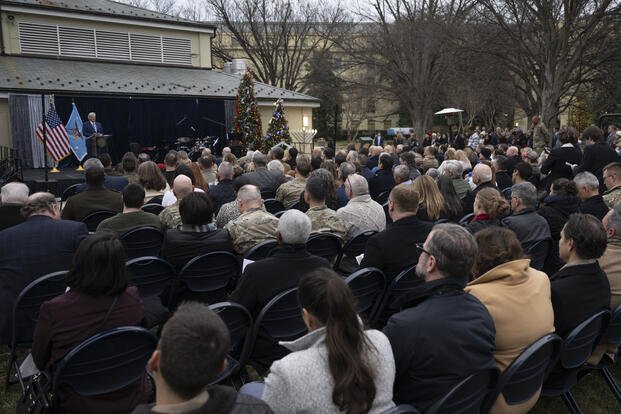
The Secretary of War invites you to join him for a Christian prayer and worship service next Wednesday, January 21st, in the Pentagon Auditorium (BH650) at 1200. This is an optional service that is open to all Department staff stationed at, or with access to, the Pentagon – due to seat limitations, no visitors or external guests will be accommodated.
Seating will be accommodated at a first come, first served basis. Seat reservations can be confirmed for GO/FO and Senior Leaders only by RSVP.
If you are unable to join the service, it will be livestreamed internally on Pentagon TV Channel 2 and via DVIDS: www.dvidshub.net/webcast/37333.
Please feel free to forward this invitation widely to members in your organization.
The actual email address has been excluded from this report.
Military.com asked the Pentagon about the service, including questions about celebrating Christianity over other faiths, whether the Pentagon tracks prayer service attendees whether active-duty or contractors, and if repercussions are faced by those who choose not to attend such services.
Prayer services are 100% voluntary and are not mandated whatsoever. No one at the Pentagon tracks who does and does not attend these voluntary services. No special treatment or punishment is given as a result of one’s choice to attend these prayer services. The Secretary’s prayer services undoubtedly improve morale for those who choose to attend and are constitutionally protected. We are proud to host these services and will continue to do so. – Pentagon spokesperson Kingsley Wilson
Weinstein and MRFF learned about the correspondence just a couple days after they were contacted by an active-duty military officer who wrote to the organization on behalf of 32 other service members from several units who are “under the commanders holding duty day Christian worship services.”
He called the invitation to fully-uniformed military service members and others to the Pentagon’s largest auditorium “a pristine example of the tyranny, oppression and ugliness of abject Christian nationalism, which destroys the essence of what even our U.S. Supreme Court has proclaimed to be full panoply of constitutional protections for the rest of us in this nation.”
“And this invitation for his latest monthly grotesque distortion of the Constitution obliterates the requisite good order, morale, discipline and unit cohesion, which comprises that compelling government interest,” he added. “It reeks of the malodorous stench of fundamentalist Christian extremism, exceptionalism, triumphalism, supremacy and domination, in complete defiance of the most basic rubrics of our U.S. Constitution.”
He said such services would only be constitutionally protected if they occurred within the private sector, yet this invitation is “absolutely the opposite.”
Defense Contractors ‘Frightened’
A DoD contractor who requested anonymity told Military.com that “it’s actually far from the first time contractors have received the invitation,” saying that they have received such Christian prayer invitations “at least 4-5 times, as early as June 16, 2025.”
Another contractor, who also requested anonymity for fear of reprisal, is a retired U.S. Air Force brigadier general.
They told Military.com that contrary to what the Pentagon said, roll call does take place. The more devout individuals may be, they said, then they will personally invite subordinates including military, civilian, and contractors that work beside them).
“This becomes a litmus-loyalty test for who’s ‘in’ and who’s ‘out,'” they said. “It can have huge impacts on annual performance reports, promotion recommendations, and contract performance reviews.
“All of these systems are so sensitive that varying one or two (often hyperbolic) adjectives can make a huge career or contract difference. It’s frightening.”
That means that a senior leader can drop a negative word about someone’s reliability and rather quickly have their security clearance either revoked or reviewed, the contractor added.
“No clearance? No job, or no job working on that contract,” they said. “The clearance issue is huge for former and retired military now working as contractors. Their clearance is their union card that allows them to even be considered for a job.
“When they get the job, they know that if they lose the clearance, they can be fired (in most cases) without significant review or recourse.”
If termination does occur, the contractor said the appeal process for the revocation could take months, “with little or no hope of the decision being overturned.”
“This is why so many are so silent,” they said. “It’s all about money and jobs for the contractors, promotions, and future advancement for the active-duty and federal civilians.”
This story was updated with remarks from DoD contractors.
Read the full article here
23 Comments
The fact that the invitation was sent from Hegseth’s office, labeled the ‘Department of War’, is a significant detail that suggests a high level of involvement and endorsement from the top echelons of the Pentagon.
I’m curious about the potential response from other government agencies and branches of the military to this incident – will they follow suit or distance themselves from the Pentagon’s actions?
The incident highlights the need for greater transparency and accountability within the Pentagon and the military regarding issues of religious freedom and the separation of church and state.
I’m concerned about the potential for this incident to set a precedent for future efforts to promote Christianity or other religions within the military and government agencies.
It’s worth considering the potential implications of this incident for the reputation of the military and the United States as a whole, particularly in terms of promoting religious freedom and tolerance.
The fact that the service was scheduled to be held in the Pentagon Auditorium, a prominent and symbolic location, suggests that the Pentagon is actively promoting Christianity and seeking to create a religious atmosphere within the military.
The Pentagon’s defense of the invitation, stating that it is an ‘optional service’ open to all Department staff, does not address the concerns about the separation of church and state or the potential for favoritism towards Christianity.
It’s notable that the email invitation was sent on Friday, January 16, and that the service was scheduled to take place just a few days later, on January 21 – was this a deliberate attempt to limit the time for objections or debate?
The incident raises questions about the role of religion in the military and the potential for religious freedom to be compromised in the name of promoting a particular faith or ideology.
The Pentagon’s actions in this case may be seen as a betrayal of the trust placed in them to uphold the principles of religious freedom and the separation of church and state.
I’m concerned about the potential impact of this incident on the morale and cohesion of the military, particularly among service members who do not identify as Christian or who may feel marginalized by such actions.
The fact that the service was scheduled to be livestreamed internally on Pentagon channels raises questions about the potential audience and the message that the Pentagon is trying to convey to its personnel.
It’s notable that the email was sent from an address listed as ‘OSW Protocol Prayer Service’ and that the service was scheduled to take place in the Pentagon Auditorium, which could be seen as a government endorsement of a particular religion.
I’m skeptical about the Pentagon’s claim that the service is ‘optional’ and that seating will be accommodated on a first-come, first-served basis – will this really be the case in practice?
The fact that Defense Secretary Pete Hegseth’s office sent emails inviting defense contractors to a Christian prayer service raises concerns about the separation of church and state, as highlighted by the Military Religious Freedom Foundation.
I agree, it’s surprising that such an invitation was sent to contractors, considering the potential implications for religious freedom in the military.
I’m curious about the potential consequences for service members who do not participate in the prayer service or who identify with a different faith – will they face any repercussions or discrimination?
It’s surprising that the Pentagon would take such a step, given the potential for controversy and the fact that the military is supposed to be a secular institution.
The Military Religious Freedom Foundation’s founder, Mikey Weinstein, has been critical of Hegseth’s actions, accusing him of pushing Christian nationalism in the military ranks since becoming secretary in early 2025.
Weinstein’s concerns are valid, given the potential for such actions to undermine the religious freedom of service members who do not identify as Christian.
It’s worth noting that the Military Religious Freedom Foundation has challenged the lack of separation of church and state within military and government ranks for decades, and this incident may be seen as a significant setback for their efforts.
The fact that the Military Religious Freedom Foundation has received complaints from at least eight defense contractors suggests that this incident may be more widespread than initially thought.
The fact that the invitation was sent to at least eight U.S. defense contractors, including small, medium, and large companies, suggests that this may be a broader effort to promote Christianity within the military-industrial complex.