

Listen to the article
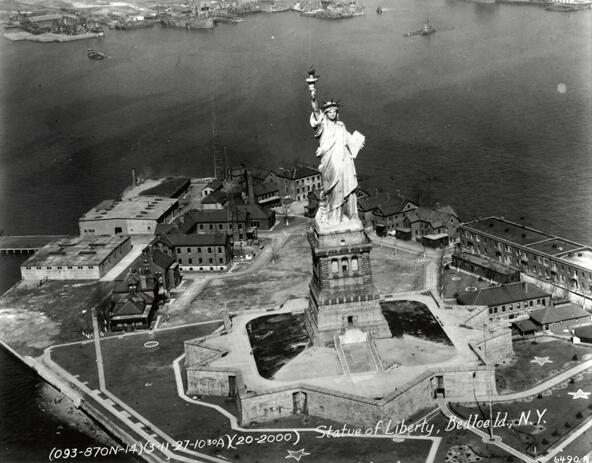
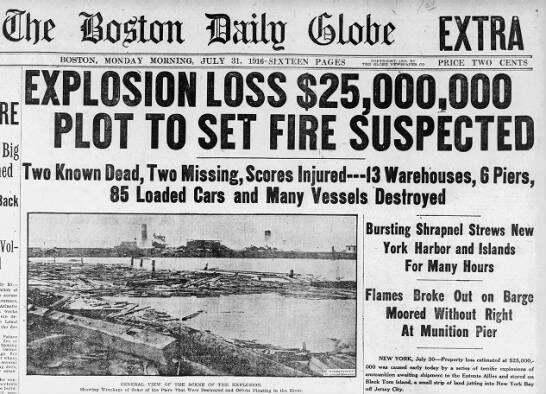
Just after 2 a.m. on July 30, 1916, a freight car loaded with TNT exploded at a munitions depot on Black Tom Island in New York Harbor. The blast registered as a 5.5 magnitude earthquake and was felt 90 miles away in Philadelphia. Windows shattered from Times Square to Brooklyn. The Statue of Liberty took shrapnel damage. Firefighters were blown out of their boots.
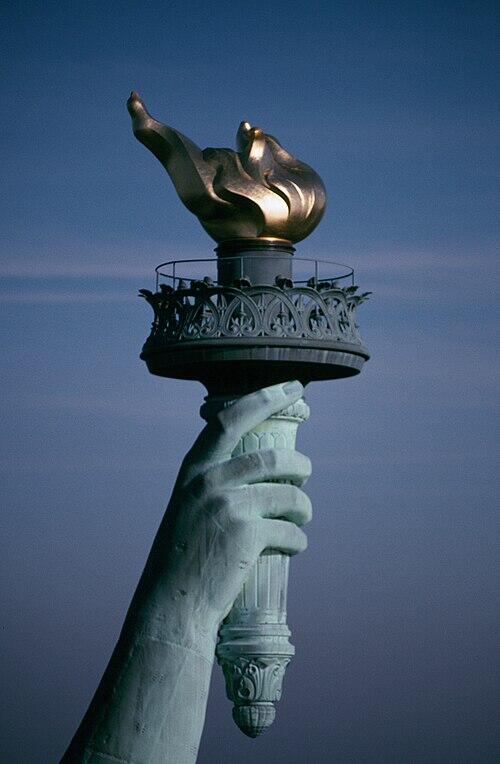
Seven people died that night. The attack’s most lasting impact affects visitors to the Statue of Liberty today as the torch has been permanently closed ever since due to damage it sustained in the blast.
The explosion was not an accident. German saboteurs had spent years planning and carrying out attacks on American munitions facilities, and Black Tom became their biggest success.
Why Germany Targeted American Munitions
When World War I began in 1914, the United States declared neutrality. American munitions manufacturers sold to any buyer. But the British Royal Navy imposed a blockade on Germany that made it nearly impossible for American ships to reach German ports. Britain and France became the only customers.
By 1916, roughly 75 percent of ammunition and armaments shipped from the United States to Europe departed within five miles of Lower Manhattan’s City Hall. Black Tom Island served as the single most important assembly and shipping center in America for munitions headed to Britain, France and Russia. The island probably housed the most extensive arsenal anywhere outside the war zones of Europe.
The German government sent intelligence operatives to the United States with orders to sabotage munitions production and shipping. Between 1914 and 1918, German agents carried out more than 50 acts of sabotage on American soil. Nearly 30 of those attacks occurred in the New York area.
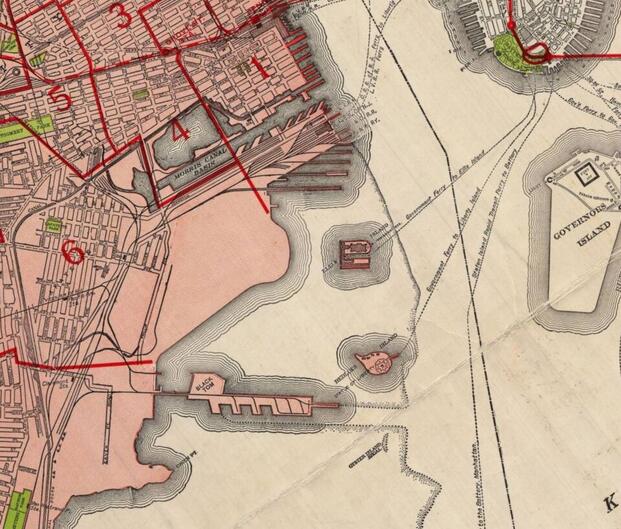
Black Tom Island was an obvious target. Originally a small rocky outcrop in New York Harbor, the Lehigh Valley Railroad Company filled in marshland between 1905 and 1916 to create a 25-acre peninsula connected to Jersey City by a causeway and railroad. The island housed a mile-long pier with 13 warehouses operated by the National Dock and Storage Company.
Security, however, was minimal. The facility had no entrance gate and no lighting. On the night of July 29, 1916, nearly 70 railroad freight cars sat on Black Tom loaded with two million pounds of small arms and artillery ammunition. Johnson Barge No. 17 floated at the pier with 100,000 pounds of TNT and 417 cases of detonating fuses.
Jersey City Commissioner of Public Safety Frank Hague later said he was told the barge had been “tied up at Black Tom to avoid a $25 towing charge.”
Eight guards patrolled the island that Saturday night.
The Sabotage Plan
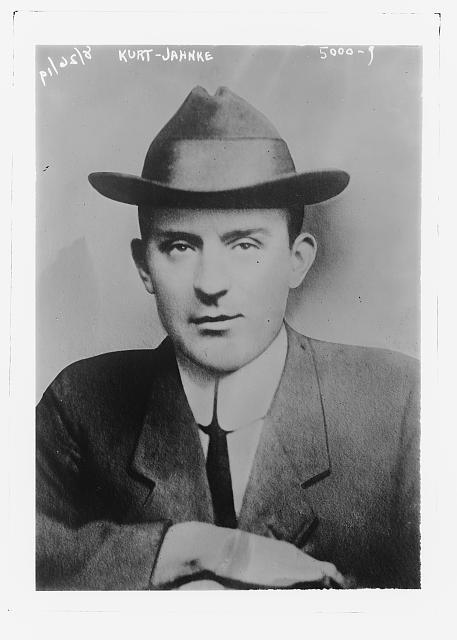
Three German agents carried out the attack. Kurt Jahnke was a German-American who had served in the U.S. Marines before becoming a saboteur working for German Naval Intelligence. Lothar Witzke was a German naval officer who escaped from internment in Chile and made his way to San Francisco in May 1916. Michael Kristoff was a 23-year-old Austrian immigrant and former U.S. Army soldier who worked for the German agents in return for cash payments.
German Ambassador Count Johann Heinrich von Bernstorff ran a network of spies and saboteurs from Washington. Captain Franz von Rintelen, a German naval intelligence officer, provided funding and technical support. Dr. Walter Scheele developed incendiary devices called “cigar bombs,” small glass tubes filled with chemicals that would ignite after a delay.
Von Rintelen bribed Kristoff to provide access to the pier. Shortly after midnight on July 30, Kristoff walked onto Black Tom and began placing incendiary devices on freight cars and the Johnson Barge. Jahnke and Witzke rowed across the harbor in a small boat and placed additional explosives.
The devices had roughly a 20-minute delay. The three saboteurs then fled the area. Kristoff fled on foot to his aunt’s house in nearby Bayonne, Jahnke and Witzke left by boat.
Kristoff reportedly ran into his aunt’s home shouting, “Oh, my God, what did I do?”
The Explosion
Around 12:40 a.m., small fires began burning on the pier. Some of the guards fled immediately, fearing what would happen when the flames reached the explosives. Others attempted to fight the fires and called the Jersey City Fire Department.
Firefighters arrived at 1:20 a.m. but the fires had turned into an inferno. They could not get close enough to do anything. They stood and watched as more freight cars and vessels caught fire.
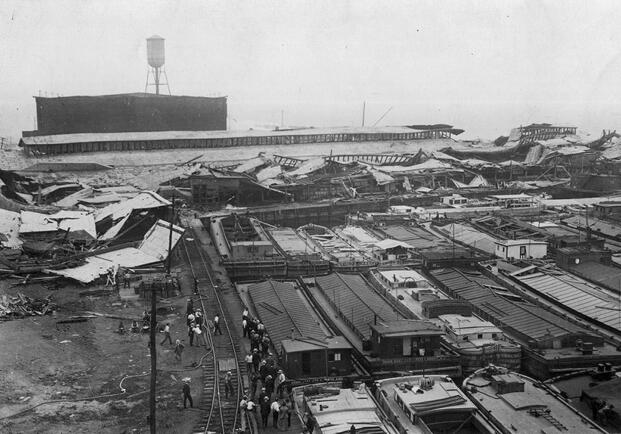
At 2:08 a.m., the entire load of dynamite on Johnson Barge No. 17 exploded. The detonation wave traveled at 24,000 feet per second. The force lifted firefighters into the air and threw Jersey City residents from their beds. The blast excavated a crater so deep it went below sea level and water seeped in to create a large pond covered with wreckage.
Shrapnel hit the clock tower of the Jersey Journal building in Journal Square more than a mile away. The clock stopped at that moment. Fragments from the explosion embedded themselves in the right side of the Statue of Liberty facing Black Tom. The shock wave pushed the torch arm against the crown, damaging the statue’s internal framework.
A second smaller explosion occurred around 2:40 a.m. as more freight cars detonated. Explosions and fires continued for hours. Flying bullets and shrapnel made it impossible for firefighters to approach until late morning.
The blast destroyed 13 warehouses, more than 100 railroad cars and six piers. Windows shattered across Lower Manhattan from Times Square to Wall Street. Stained glass windows at St. Patrick’s Cathedral broke. The Brooklyn Bridge shook. The walls of Jersey City’s City Hall cracked. Immigrants being processed at Ellis Island were evacuated to Manhattan by ferry.
People as far as Maryland felt their houses shake. Many thought it was an earthquake.
Jersey City Police officer James Doherty died in the explosion. Lehigh Valley Railroad police chief Cornelius Leyden was killed. The captain of Johnson Barge No. 19 died at the pier. A 10-week-old infant named Arthur Tosson was thrown from his crib in a nearby tenement and died from his injuries.
Total casualties varied depending on the source, but at least seven people died. Hundreds were injured. Property damage reached $20 million, equivalent to roughly $580 million today.
The Investigation
Within 24 hours, Jersey City police arrested senior officials from the Lehigh Valley Railroad and the National Dock and Storage Company on charges of manslaughter. Authorities assumed the fires began from negligence, perhaps sparks from a passing freight train or careless guards who had lit smudge pots to ward off mosquitoes.
The chief of the Bureau of Investigation, the forerunner to the FBI, filed a preliminary report noting “our investigator seems to think that the explosion was an accident.” The New York Times reported on July 31 that investigators agreed “the fire and subsequent explosions cannot be charged to the account of alien plotters against the neutrality of the United States.”
President Woodrow Wilson called it “a regrettable incident at a private railroad terminal.” He showed no interest in pursuing the possibility of German sabotage despite multiple suspicious explosions at American factories and shipping facilities in the previous two years.
It is still unknown why investigators overlooked possible German involvement. Germany had a clear motive as the munitions leaving U.S. ports ended up killing German soldiers. Moreover, Americans had plenty of reason to suspect Berlin was responsible. A year earlier, German Army reserve Lt. Werner Horn was arrested for trying to blow up an international railway bridge at Vanceboro, Maine. Another German national named Robert Fay had been arrested in New Jersey for building bombs to blow up ships headed to Europe.
But the United States had no national intelligence service beyond individual diplomats and a few military and naval attaches. The country had no federal laws forbidding espionage or sabotage during peacetime. Without these preventative measures, investigators found it nearly impossible to connect any suspects to the crime.
Nevertheless, many Americans blamed Germany for the blast.
The Aftermath
Kristoff was arrested on the suspicion of being involved with the explosion in August 1916 after a tip, but he was released for lack of evidence. He drifted in and out of prison for petty crimes and died of tuberculosis in 1928. Jahnke and Witzke escaped capture and continued sabotage operations for years. Witzke was eventually arrested at the Mexican border in February of 1918 on espionage charges unrelated to Black Tom.
The truth actually did not fully emerge until years later. After World War I ended, the Treaty of Berlin in 1921 created the German-American Mixed Claims Commission to settle U.S. claims against Germany. The Lehigh Valley Railroad hired a young New York lawyer named John McCloy to pursue damages relating to the Black Tom explosion, even though there was still no concrete proof that Germany itself was involved.
McCloy spent years amassing evidence. More than 40 insurance companies hired detectives. A small army of lawyers sifted through mountains of witness statements and circumstantial evidence. In 1934, McCloy found new evidence that allowed him to reopen the case.
The commission still faced several potential causes. Had the fire come from spontaneous combustion, carelessness, or German sabotage? Investigators pieced together the German sabotage network. They documented bribes paid to Kristoff. They tracked Jahnke and Witzke’s movements. They found evidence of Dr. Scheele’s incendiary devices.
In 1939, 23 years after the explosion, the Mixed Claims Commission ruled that Imperial Germany had been responsible for the sabotage. The commission awarded $50 million in damages, the largest single claim from World War I.
But Nazi Germany under Adolf Hitler refused to pay anything. World War II was on the horizon and Hitler had no desire to pay any money to the U.S. or accept any German responsibility. The issue remained unresolved until 1953, when the Federal Republic of Germany agreed to a settlement of $95 million covering Black Tom and other war claims. Germany made its final payment in 1979, 63 years after the explosion.
Impact on American Intelligence and the Statue of Liberty
The Black Tom explosion directly influenced American entry into World War I. Along with Germany’s unrestricted submarine warfare campaign and the Zimmermann Telegram proposing an alliance with Mexico against the United States, the ongoing sabotage campaign turned American public opinion against Germany. Congress declared war on April 6, 1917.
Congress immediately passed the Espionage Act, which outlawed crimes associated with German agents. In 1918, Congress passed the Sabotage Act. The Bureau of Investigation gained primary jurisdiction over these laws and expanded dramatically to pursue national security investigations. German sabotage operations on American soil stopped altogether.
New York Police Commissioner Arthur Woods argued after Black Tom, “The lessons to America are clear as day. We must not again be caught napping with no adequate national intelligence organization. The several federal bureaus should be welded into one and that one should be eternally and comprehensively vigilant.”
That organizational consolidation eventually created the FBI and modern American intelligence services.
The explosion also influenced future presidential elections. Franklin D. Roosevelt had served as Assistant Secretary of the Navy during World War I and knew about Black Tom. In 1942, when discussing the internment of Japanese Americans after Pearl Harbor, Roosevelt told his advisers: “We don’t want any more Black Toms.”
The Statue of Liberty was permanently damaged. After engineers surveyed the damage, they determined the public could no longer safely access the torch. The 1984-1986 restoration of the statue included repairs to the arm and installation of a new gold-plated copper torch, but the torch remained closed to the public.
Today, visitors can climb to the Statue of Liberty’s crown by climbing 162 narrow stairs. But the torch ladder that once offered spectacular views of New York Harbor has been off-limits for 109 years.
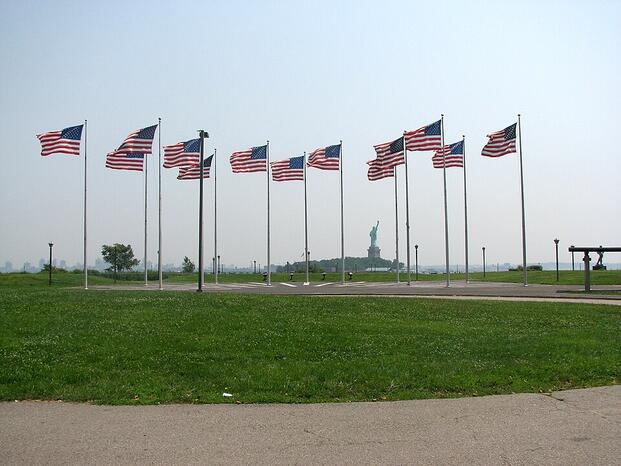
A memorial plaque at Liberty State Park in Jersey City marks the explosion site. A circle of American flags surrounds the plaque, which informs visitors they are “walking on a site which saw one of the worst acts of terrorism in American history.”
Black Tom Island itself no longer exists. Landfill projects after the explosion incorporated it into Liberty State Park. The park’s southeastern corner, at the end of Morris Pesin Drive, is where the munitions depot stood.
A stained glass window at Our Lady of Czestochowa Catholic Church in Jersey City memorializes the victims. The window shows the Polish inscription, “Funded by the Parishioners after the explosion of 1916.”
Story Continues
Read the full article here
17 Comments
The significance of the Black Tom Island explosion in the context of World War I, and the fact that it was one of over 50 acts of sabotage carried out by German agents on American soil, highlights the global nature of the conflict and the reach of German intelligence operations.
I’m surprised that Black Tom Island had such minimal security, with no entrance gate and no lighting, considering it housed a mile-long pier with 13 warehouses operated by the National Dock and Storage Company.
The lack of security is even more surprising given that the facility was located just a few miles from Lower Manhattan’s City Hall, and was a key assembly and shipping center for munitions headed to Britain, France, and Russia.
The fact that Johnson Barge No. 17 was tied up at Black Tom to avoid a $25 towing charge, and ended up being a key part of the sabotage plan, is a remarkable coincidence.
It’s also worth noting that the barge was carrying 100,000 pounds of TNT and 417 cases of detonating fuses, which made it a prime target for the German saboteurs.
The impact of the Black Tom Island explosion on the Statue of Liberty, which has had its torch closed ever since, is a lasting reminder of the attack and its significance in American history.
The British Royal Navy’s blockade on Germany, which made it nearly impossible for American ships to reach German ports, likely contributed to Germany’s decision to target American munitions facilities, including Black Tom Island.
The explosion’s impact on the surrounding area, including the shattering of windows from Times Square to Brooklyn, and the fact that firefighters were blown out of their boots, is a testament to the massive scale of the blast.
It’s concerning that German saboteurs were able to spend years planning and carrying out attacks on American munitions facilities, and the fact that they were able to detonate 2 million pounds of explosives in New York Harbor is alarming.
It’s worth considering the potential consequences if the Black Tom Island explosion had occurred during the day, when more people would have been in the area, and the potential death toll could have been much higher.
The fact that the blast from the Black Tom Island explosion registered as a 5.5 magnitude earthquake and was felt 90 miles away in Philadelphia is astonishing, and it’s a wonder that only seven people died that night.
Yes, and the shrapnel damage to the Statue of Liberty was so severe that the torch has been closed ever since, which is a lasting impact of the attack.
The role of Jersey City Commissioner of Public Safety Frank Hague in responding to the explosion, and his later comments about the barge being tied up at Black Tom to avoid a towing charge, highlights the importance of local authorities in responding to such incidents.
The fact that the Black Tom Island explosion was not an accident, but rather a deliberate act of sabotage, raises questions about the effectiveness of American intelligence and security measures at the time.
The fact that the Lehigh Valley Railroad Company filled in marshland between 1905 and 1916 to create a 25-acre peninsula connected to Jersey City by a causeway and railroad, which became the site of the Black Tom Island explosion, is an interesting footnote in the history of the area.
Kurt Jahnke’s background as a German-American who had served in the U.S. Marines before becoming a saboteur working for German Naval Intelligence is fascinating, and raises questions about how he was able to infiltrate American society so effectively.
The statistic that nearly 30 of the over 50 acts of sabotage carried out by German agents on American soil between 1914 and 1918 occurred in the New York area is staggering, and highlights the significance of the Black Tom Island explosion.