Listen to the article
The Navy has a new fitness test for active-duty “combat arms personnel,” including members of Naval Special Warfare and Naval Special Operations commands. It is called the Navy Combat Fitness Test (Navy CFT). These groups will now take a new fitness test once a year in addition to the standard Navy Physical Fitness Assessment, as the second fitness test of the yearly cycle. SEAL team members, surface warfare combat crewmen (SWCC) and the explosive ordnance disposal (EOD)/diver communities start taking this test in 2026.
Note to recruits: The Navy Physical Screening Test (PST) to enter these communities has not changed. It is still the 500-yard swim, pushups, situps, pullups and 1.5-mile run. Here are workouts and information on the Navy PST.
The New and the Old Fitness Test (for Combat Arms)
The two fitness tests that will be given once per year for the combat arms communities will look like this:
Navy Physical Readiness Test
The Navy PRT is the same fitness test that the entire Navy takes, and it will be one of the tests combat arms sailors will take each year. The regular Navy will continue to take this test twice a year. The Navy PRT consists of the following:
- Pushups completed in 2 minutes
- Plank pose
- 1.5-mile run
Navy Combat Fitness Test (2026)
The Navy CFT is the new fitness test, taken once a year in place of the Navy PRT’s second testing cycle each year. The new Navy CFT comprises of the following (with the SEAL and SWCC maximum scores needed for 100% for ages under 30):
- Swim 800 meters with fins (11:20), 10 min. rest
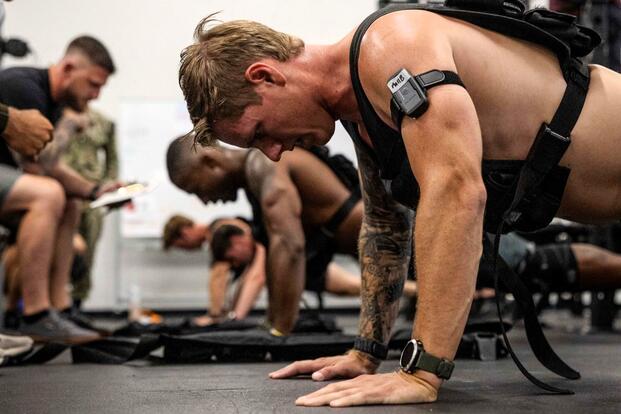
- Pushups with a 20-pound weight vest (54), 2 min. rest
- Pullups with a 20-pound weight vest (21), 10 min. rest
- Run 1 mile with a 20-pound weight vest (8:00)
You can find all of the age ranges and scores for grading using the Official Navy Physical Readiness Program Guide 5B.
Elements of Fitness for the Tactical Athlete
The new Navy CFT is somewhat job-related, as a member of this community will always be wearing at least 20 pounds of gear when moving during training or missions. Building a body that is used to near-constant load-bearing is logical. However, if you consider all the elements of fitness for the tactical athlete, especially the Special Warfare/Operations member, this test focuses on endurance (run/swim), muscle stamina and some high-intensity interval training (HIIT) durability. This test omits several fitness requirements for the tactical athlete in combat arms communities.
The tactical athlete must excel across multiple fitness areas, not just a few. Training has expanded beyond muscle stamina and endurance to encompass strength, power, speed, agility, flexibility, mobility, durability, work capacity and grip strength. These updated priorities align with an understanding of the practical challenges encountered in real-world scenarios. See the Army Holistic Health and Fitness Program as an example of a well-rounded program for the tactical athlete.
Education in health, wellness and nutrition for optimal performance and recovery is also a key addition to the tactical athlete in today’s military. Many new combat fitness tests, all evolving during the 2010s, include all the elements of fitness above.
The elements of fitness measured by the Navy Human Performance Test, the previous fitness test used by these communities, were more holistic for the tactical athlete. The HPT measures strength, power, speed, agility, muscle stamina, endurance and grip. The current Navy Combat Fitness Test is less well-rounded than the former Human Performance Test, as it misses several important components of fitness. They all miss flexibility and mobility, which could be tested but should not be ignored by all military members, as these last two elements are the key to longevity and optimal performance.
Want to Learn More About Military Life?
Whether you’re thinking of joining the military, looking for fitness and basic training tips, or keeping up with military life and benefits, Military.com has you covered. Subscribe to Military.com to have military news, updates and resources delivered directly to your inbox.
Read the full article here
13 Comments
The inclusion of a 20-pound weight vest in the Navy CFT’s pushups, pullups, and 1-mile run events acknowledges the heavy gear these personnel often wear, making the test more relevant to their actual duties.
The Navy’s decision to implement the new fitness test in 2026 for SEAL team members, SWCC, and EOD/diver communities indicates a recognition of the need for more specialized and challenging physical assessments for these roles.
Considering the Army’s Holistic Health and Fitness Program as a model, it seems the Navy CFT could benefit from a more comprehensive approach, incorporating education in health, wellness, and nutrition for optimal performance and recovery.
It’s interesting that the Navy Physical Screening Test to enter these communities remains unchanged, still requiring a 500-yard swim, pushups, situps, pullups, and 1.5-mile run, despite the introduction of the new Navy CFT.
The introduction of the Navy CFT alongside the Navy PRT suggests an effort to better evaluate and improve the physical readiness of combat arms sailors, acknowledging the unique challenges they face.
The maximum scores needed for 100% on the Navy CFT, such as completing the 800-meter swim with fins in 11:20 minutes, provide clear benchmarks for SEAL and SWCC members under 30 to strive for.
I’m skeptical about the Navy CFT’s ability to fully prepare SEALs and SWCC members for real-world scenarios, given its focus on endurance and muscle stamina, while omitting other critical elements of fitness like strength, power, and agility.
It’s worth noting that the Navy CFT’s emphasis on near-constant load-bearing exercises, like the weighted vest, is logical given the gear these personnel wear, but it may not fully address the varied physical demands of their missions.
The fact that the Navy CFT will be taken once a year, in addition to the standard Navy Physical Fitness Assessment, shows the Navy’s commitment to ensuring combat arms personnel are physically prepared for their duties.
Yes, and it’s worth noting that the regular Navy will continue to take the Navy PRT twice a year, highlighting the different physical demands on combat arms communities.
While the Navy CFT is a step towards more job-specific fitness testing, its lack of components assessing strength, power, and speed may leave gaps in the physical preparation of SEALs and SWCC members for the full range of tasks they may encounter.
The new Navy Combat Fitness Test, which includes an 800-meter swim with fins and a 1-mile run with a 20-pound weight vest, seems to be a more job-related assessment for SEALs and SWCC members, as they often wear heavy gear during missions.
I agree, the test’s focus on endurance and muscle stamina is crucial for these roles, but I wonder if it adequately assesses other essential skills like strength and agility.