
Listen to the article
The assault that captured the president of Venezuela was the result of months of intense rehearsal to ensure that hundreds of aircraft and thousands of troops could carry out myriad interlocking tasks to the second, the Joint Chiefs chairman said Saturday.
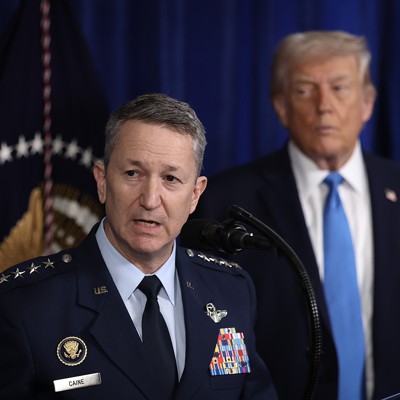
“The word ‘integration’ does not explain the sheer complexity of such a mission,” Gen. Dan Caine said at a press conference held at President Trump’s Florida compound. “An extraction so precise it involved more than 150 aircraft launching across the Western Hemisphere in close coordination, all coming together in time and place to layer effects for a single purpose, to get an interdiction force into downtown Caracas while maintaining the element of tactical surprise. Failure of one component of this well-oiled machine would have endangered the entire mission.”
“We think, we develop, we train, we rehearse, we debrief, we rehearse again and again, not to get it right, but to ensure that we cannot get it wrong,” Caine said.
For months, the general said, U.S. intelligence teams had been watching Venezuelan President Nicolás Maduro and his wife, Cecilia Maduro. The teams sought “to find Maduro and understand how he moved, where he lived, where he traveled, what he ate, what he wore, what were his pets.”
In the meantime, Caine said, leaders and troops in all branches of the military, plus officials with intelligence and law-enforcement agencies, developed plans and began to rehearse the operation.
In early December, he said, “our force was set pending a series of aligned events,” including finding “the right day to minimize the potential for civilian harm and maximize the element of surprise, and minimize the harm to the indicted personnel [the Maduros] so, as the president said, they could be brought to justice.”
ABC News has reported that Christmas Day had been considered for the Venezuelan operation, which was pushed back while the U.S. military bombed targets in Nigeria in actions against “ISIS terrorist scum,” as Trump put it last week.
Caine said weather in particular was a factor in the timing of the Venezuelan operation, dubbed Absolute Resolve.
“Last night the weather broke just enough, clearing a path that only the most skilled aviators in the world can maneuver through—ocean, mountain, low cloud, ceilings, but when tasked with a mission, this organization does not quit,” he said in apparent reference to the Army’s 160th Special Operations Aviation Regiment (Airborne).
At 10:46 p.m. Eastern time on Jan. 2, Trump gave the order to proceed, Caine said.
More than 150 aircraft and drones began launching from about 20 bases and warships “across the Western Hemisphere,” he said, including F-22, F-35, and F/A-18 fighters; EA-18G electronic warfare aircraft; B-1 bombers; reconnaissance planes; and more. Aerial tankers likely took part as well.
“Our youngest crew member was 20 and our oldest crew member was 49,” he said.
Helicopters carrying an “extraction force” of U.S. troops and Justice Department personnel took off and flew at 100 feet above the water toward the Venezuelan shore, he said.
The force also included members of Delta Force, elite special operators often assigned to hostage-rescue missions, Task and Purpose reported.
As this team approached Venezuelan airspace, Caine said, “the United States began layering different effects provided by SpaceCom, CyberCom, and other members of the interagency to create a pathway.”
This included airstrikes on military facilities, he said: “dismantling and disabling the air defense systems in Venezuela, employing weapons to ensure the safe passage of the helicopters into the target area.”
U.S. forces plunged Venezuela’s capital city into darkness, Trump said at the press conference.
“The lights of Caracas were largely turned off, due to a certain expertise that we have,” he said.
Caine said that tactical aircraft overhead covered the extraction force as mission commanders monitored their approach.
“As the force crossed the last point of high terrain, where they’d been hiding in the [radar] clutter, we assessed that we had maintained totally the element of surprise.”
The helicopters touched down at Maduro’s palace at 2:01 a.m. local time (1:01 a.m. Eastern) on Jan. 3, and soon came under fire, to which the U.S. team responded with “overwhelming force in self-defense,” he said. “One of our aircraft was hit, but remained flyable.”
Meanwhile, he said, “The apprehension force descended into Maduro’s compound and moved with speed, precision, and discipline towards their objective, and isolated the area to ensure the safety and security of the ground force while apprehending the indicted persons.”
Caine continued, “As the operation unfolded at the compound, our air and ground intelligence teams provided real-time updates to the ground force, ensuring those forces could safely navigate the complex environment without unnecessary risk. The force remained protected by overhead tactical aviation. Maduro and his wife, both indicted, gave up, and were taken into custody by the Department of Justice, assisted by our incredible U.S. military with professionalism and precision, with no loss of U.S. life.
Finally, the general said, “After securing the indicted persons, the force began to prep for departure. Helicopters were called in to exfiltrate the extraction force, while fighter aircraft and remotely piloted aircraft provided overhead coverage and suppressive fire. There were multiple self-defense engagements as the force began to withdraw out of Venezuela. The force successfully exfiltrated and returned to their afloat launch bases, and the force was over the water at 3.29 a.m. Eastern Standard Time, with indicted persons on board. And both Maduro and his wife were embarked aboard the USS Iwo Jima.”
No U.S. troops were killed, nor any U.S. aircraft lost, Caine said.
“While the past two decades have honed the skills of our special operations forces, this particular mission required every component of our joint force, with soldiers, sailors, airmen, marines and guardians, working in unison with our intelligence agency partners and law enforcement teammates in an unprecedented operation,” he said. “We leveraged our unmatched intelligence capabilities and our years of experience in hunting terrorists. And we could not have done this mission without the incredible work by various intelligence agencies, including the CIA, NSA and NGA.”
Read the full article here
26 Comments
The mention of ‘the right day to minimize the potential for civilian harm and maximize the element of surprise’ suggests that the military was attempting to balance competing priorities in the planning of the operation.
The fact that the operation was launched at 10:46 p.m. Eastern time on Jan. 2, after receiving the order from President Trump, highlights the rapid response capabilities of the U.S. military.
The use of reconnaissance planes and electronic warfare aircraft in the operation suggests that the military was seeking to gather intelligence and disrupt any potential resistance.
The mention of F-22, F-35, and F/A-18 fighters, as well as EA-18G electronic warfare aircraft and B-1 bombers, demonstrates the extensive air power deployed during the operation.
The success of the Absolute Resolve operation will likely be seen as a significant achievement for the U.S. military, but it also raises questions about the implications of such actions for international relations and global stability.
I’m curious about the role of the 160th Special Operations Aviation Regiment in the operation, particularly in navigating through challenging weather conditions with low cloud ceilings and oceanic and mountainous terrain.
I’m concerned about the potential consequences of such a large-scale military operation, particularly in terms of its impact on the people of Venezuela and the region as a whole.
The goal of bringing the indicted personnel to justice is a noble one, but the means by which it was achieved are certainly up for debate.
The fact that the military was willing to delay the operation until the weather conditions improved highlights the importance of safety and risk management in military planning.
The involvement of U.S. intelligence teams in monitoring President Nicolás Maduro’s movements and habits for months prior to the operation highlights the extensive planning and intelligence gathering that went into Absolute Resolve.
The fact that Christmas Day was initially considered for the operation but was pushed back due to other military actions against ISIS in Nigeria raises questions about the prioritization of military operations.
It’s possible that the situation in Nigeria required more immediate attention, and the Venezuelan operation could be delayed.
The role of aerial tankers in supporting the operation is not explicitly mentioned, but it’s likely they played a crucial role in refueling the aircraft involved.
The level of integration and coordination required for the Absolute Resolve operation, involving multiple branches of the military and intelligence agencies, is a testament to the capabilities of the U.S. military.
The timing of the operation, which was delayed until the weather conditions improved, shows that the military was willing to wait for the right moment to launch the mission.
I’m supportive of the goal of bringing President Nicolás Maduro to justice, but I have concerns about the methods used to achieve this goal and the potential consequences for the people of Venezuela.
The situation in Venezuela is complex, and it’s difficult to determine the best course of action, but the U.S. military’s actions will certainly have significant implications.
I’m skeptical about the claim that the operation was planned to minimize harm to civilians and the indicted personnel, given the complexity and scale of the mission.
The generals involved have a lot of experience with such operations, so it’s possible they took extensive precautions to minimize harm.
The level of planning and rehearsal that went into the Absolute Resolve operation is staggering, with over 150 aircraft and thousands of troops involved in a complex interlocking mission to capture the president of Venezuela.
The fact that Gen. Dan Caine mentioned the operation involved ‘more than 150 aircraft launching across the Western Hemisphere’ highlights the scale and complexity of the Absolute Resolve mission.
The level of detail provided by Gen. Dan Caine about the operation, including the weather conditions and the involvement of specific aircraft, suggests a high degree of transparency and confidence in the mission’s planning and execution.
The fact that the youngest crew member was 20 and the oldest was 49 highlights the diversity and range of experience among the personnel involved in the Absolute Resolve mission.
The extraction force of U.S. troops and Justice Department personnel, carried by helicopters, was a critical component of the mission to capture the president of Venezuela.
I’m curious about the role of the Justice Department personnel involved in the extraction force and how they will be involved in the next steps of the process.
The Absolute Resolve operation demonstrates the capabilities of the U.S. military in terms of planning, coordination, and execution, but it also raises important questions about the use of military force and its consequences.