

Listen to the article
Multiple polls released before and after the United States’ capturing and arrest of Venezuelan President Nicolas Maduro show a stark divide in how Americans view military might at home and abroad, as well as whether the U.S. should take over control of the Latin American nation.
Maduro and his wife, Cilia Flores, were seized from their home in Caracas over the weekend and are accused of “transporting thousands of tons of cocaine to the United States,” as well as conspiring with drug traffickers to financially enrich themselves and their family. The couple was arraigned Monday in a Manhattan courtroom and both pleaded not guilty to multiple charges.
“This is not a regime change. This is a demand for change of behavior by a regime.” – House Speaker Mike Johnson
The capture of Maduro has drawn global attention and varied sentiments from citizens, notably in Venezuela and the United States, as to how the situation has unraveled and how the U.S. plans to oversee the installation of a new government.
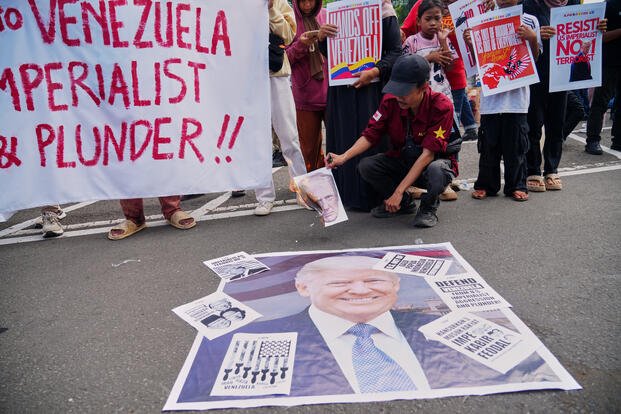
Questions remain as to how the role of drugs, highlighted by months of military strikes against alleged narcotics traffickers in the Caribbean, and the pursuit of oil plays into the broader U.S. foreign policy. Regime change, which President Donald Trump said he was against myriad times on the presidential campaign trail, now seems to be a reality.
What Polls Are Showing
The various polls released in the past month show both partisan agreements and divisions on U.S. strikes and policy remedies.
A two-day Reuters/Ipsos poll conducted Sunday and Monday found that one-in-three Americans approve of the U.S. military strike on Venezuela. However, 72% of respondents expressed worry that the U.S. will become too involved in Venezuelan affairs.
The online poll of 1,248 U.S. adults nationwide showed splits along party lines, which was common in other polling. Roughly 43% of Republicans in this poll said they agreed with the statement: “The United States should have a policy of dominating affairs in the Western Hemisphere,” compared with 19% who disagreed. The rest were unsure or did not answer the question.
Approximately 60% of Republicans also said they supported sending U.S. troops to be stationed in Venezuela, compared to 30% of Americans overall. Another 59% of Republicans expressed support for the U.S. overtaking of Venezuelan oil fields.
Roughly 4-in-10 respondents to a poll conducted by The Washington Post and SSRS over the weekend via text message said they approved of using the U.S. military to capture Maduro, while roughly the same share opposed such measures. Another 2 in 10 respondents were unsure.
About 45% of respondents were opposed to the U.S. taking control of Venezuela and choosing a new government, with another roughly 9 in 10 respondents saying that the Venezuelan people should have the final say of who will be their new leader.
Responses showed Republicans approving of the strikes and capture while Democrats largely opposed it.
Trust, Confidence ‘Very Partisan’
Polling conducted even before the Maduro capture revealed ambivalence on behalf of the American public.
A Quinnipiac poll in December showed nearly 6 in 10 registered voters opposing U.S. military intervention in Venezuela. Republicans surveyed in that poll also shared varied views, with half supporting military action while about 33% opposed it.
Roughly 64% of respondents said it was better for the U.S. to be more engaged and take an international lead rather than the 33% who preferred a more reactive approach, according to the Dec. 4 release of the 2025 Reagan National Defense Survey. That included 75% of Republicans (79% of MAGA Republicans) and 57% of Democrats.
“Americans, broadly speaking, do not view Venezuela as an adversary like the other axis of authoritarians, and that’s the key nuance.”
Both Republicans and Democrats also shared similar views when asked if they view Venezuela as an adversary, with 54% overall calling them an enemy—including 50% of Democrats and 60% of Republicans (62% of MAGA Republicans).
“The survey showed that [respondents] are supportive of President Trump having a muscular foreign policy, broadly speaking, and that support for muscular foreign policy engagement that leads with its strength is not limited to one region of the world per se,” Roger Zakheim, Washington director of the Reagan Institute, told Military.com.
But it’s not so cut and dry, Zakheim said, as the strikes in the Caribbean are now just one part of a multi-part story that now includes Maduro’s capture and some semblance of regime change.
“I think the part where there’s more nuance…is because Americans, broadly speaking, do not view Venezuela as an adversary like the other axis of authoritarians, and that’s the key nuance,” he said. “In other words, while we had been building up a significant military presence in the Caribbean…that didn’t necessarily translate in the minds of the Americans that Venezuela was an adversary—an enemy at the level of an Iran, a China, a Russia.
Americans will, however, “get a deeper sense” of the situation as they find out more about Maduro through his prosecution in addition to how the Trump administration explains its rationale for the operation and what it’s doing next, he added.
The partisanship in the most recent Reagan survey, which began in 2018, becomes clearer when asked about U.S. military and force and focusing on military resources at home rather than abroad.
Almost two-thirds of respondents (62%) said they approved of using U.S. military force against suspected drug traffickers in Latin America and the Caribbean, including 85% of Republicans (90% of MAGA Republicans) but just 36% of Democrats.
Less than half (49%) of respondents overall encourage a priority shift of military presence from Europe, the Middle East, and Africa and toward the Western Hemisphere. The shift garnered support from 68% of Republicans and 75% of MAGA Republicans, but 62% of Democrats oppose the foreign policy change.
The survey also showed that among the biggest cited threats to the U.S., China came in at No. 1 and Russia at No. 2. Zakheim said nothing in the survey suggested that an emphasis on the Western Hemisphere should come at the exclusion of focus on other regions of the world.
“Trust and confidence as an institution, it’s become a very partisan issue,” he said. “We’ve seen it basically decline from over 70% with trust and confidence to now, over the past couple of times I’ve asked the question, it’s roughly 50%.
“My own take on that is that it’s a function of the politicization of the military by elected officials, whether it’s the Biden administration and therefore conservatives, Republicans losing trust and confidence in the military during the Biden years, or flip it now, where during the Trump administration, you have Democrats losing trust and confidence in the military over sort of domestic, political, social issues, social policy issues.”
More Questions Than Answers
The situation in Latin America remains fluid, with mixed messages coming from the president, his administration, and those now purportedly running Venezuela.
Trump announced that “interim authorities in Venezuela will be turning over” between 30-50 million barrels of sanctioned oil to the US, writing in a Truth Social post: “This oil will be sold at its market price, and that money will be controlled by me, as president of the United States of America, to ensure it is used to benefit the people of Venezuela and the United States!”
After Trump told NBC News on Sunday that the U.S. was “in charge” of Venezuela, Delcy Rodriguez—the country’s acting leader—said in a televised address on Tuesday, “The government of Venezuela is in charge in our country, and no one else.”
U.S. Secretary of State Marco Rubio has sent mixed messages about U.S. involvement, implying no day-to-day oversight of the nation while adding that oil exports remain a domestic priority.
U.S. House Speaker Mike Johnson, when asked by the press whether Maduro’s capture is the definition of regime change, said the following: “The way this is being described—this is not a regime change. This is a demand for change of behavior by a regime.”
Johnson added that he expected there would be no “troops on the ground” and assured that an election would occur “in short order.”
Story Continues
Read the full article here
20 Comments
The fact that Maduro and his wife, Cilia Flores, were accused of ‘transporting thousands of tons of cocaine to the United States’ raises questions about the extent of their involvement in drug trafficking.
House Speaker Mike Johnson’s statement that ‘This is not a regime change. This is a demand for change of behavior by a regime’ raises questions about the true intentions of the U.S. government.
I agree, it seems like a contradiction to what President Donald Trump previously stated about being against regime change.
I’m curious to know more about the role of oil in the U.S. foreign policy, especially since 59% of Republicans expressed support for the U.S. overtaking of Venezuelan oil fields.
It’s likely that the U.S. is interested in gaining control of Venezuela’s oil resources to secure its own energy interests.
It’s interesting to note that the U.S. government is pursuing a policy of ‘dominating affairs in the Western Hemisphere,’ as stated by 43% of Republicans in the Reuters/Ipsos poll.
The capture of Maduro has drawn global attention, but I’m concerned that 72% of respondents expressed worry that the U.S. will become too involved in Venezuelan affairs, as stated in the Reuters/Ipsos poll.
The Reuters/Ipsos poll found that one-in-three Americans approve of the U.S. military strike on Venezuela, but I wonder what the long-term consequences of this action will be.
I’m concerned that the U.S. involvement in Venezuelan affairs could lead to a proxy war, especially given the country’s strategic location in the Western Hemisphere.
The polls suggest that there is a significant partisan divide in opinions on U.S. strikes and policy remedies, with Republicans generally supporting a more interventionist approach.
I’d like to know more about the potential consequences of the U.S. taking control of Venezuela’s oil fields, especially in terms of the environmental impact.
The U.S. military strike on Venezuela has sparked a lot of debate, and I think it’s essential to consider the potential consequences of such actions on the global stage.
I’m skeptical about the U.S. government’s ability to install a new government in Venezuela without exacerbating the situation, especially given the country’s complex political history.
It’s worth noting that the Washington Post and SSRS poll found that roughly 4-in-10 respondents approved of using the U.S. military to capture Maduro, while roughly the same share opposed such measures.
I’m curious to know more about the role of the U.S. military in the capture of Maduro and how this will affect the relationship between the U.S. and Venezuela in the long term.
The situation in Venezuela is complex, and I think it’s essential to consider the perspectives of the Venezuelan people, who should have a say in their country’s future.
The U.S. government’s actions in Venezuela raise questions about the limits of military power and the importance of diplomacy in resolving international conflicts.
The fact that 45% of respondents were opposed to the U.S. taking control of Venezuela and choosing a new government suggests that there is a significant divide in public opinion on this issue.
It’s interesting to note that approximately 60% of Republicans support sending U.S. troops to be stationed in Venezuela, while only 30% of Americans overall share the same opinion.
President Donald Trump’s previous statements about being against regime change seem to contradict the current situation, and I’d like to know more about what changed his stance.