

Listen to the article
During tactical fitness lift cycles, the primary focus is to build strength and, for some, gain mass, especially for athletes with an endurance background who need to put on weight. However, the secondary focus is to maintain cardiovascular conditioning through running, rucking and/or swimming, depending on the training or job the athlete is preparing for.
Here is a typical leg day routine we have the athletes do who need a foundation of strength, load-bearing stamina, and to maintain their cardio fitness for the variety of testing and events in military training:
Warmup: Squat/Toe Touch/Run Pyramid
Build up to 10 reps; jog 100 meters between sets; then run 1 mile to finish the leg warmup. It looks like this:
- 1 squat, 1 toe touch, jog 100 meters
- 2 squats, 2 toe touches, jog 100 meters
- 3/3 …
- 4/4 …
- Up to 10/10 for a total of 55 reps of both warmup exercises and 1,000 meters of jogging
- Now, run a mile to finish the warmup.
Read More: Should I Take a Scuba Course Before Military Dive School?
Lift Section
This is obviously not your typical lift cycle. The goal is not just to get stronger, but to maintain and develop other elements of fitness and conditioning required for the job and/or future training and testing in the military. These will usually include running, rucking, swimming, calisthenics and load bearing (with some lifting). The following two circuits focus on moderate weightlifting, with reps of 5 to 10. Go heavier for fewer reps per set to focus on strength, and go lighter with your weight selection for more reps in the 8-12 rep range to focus on muscle development.
Your choice is to go heavier with a barbell or hex barbell for the deadlift sets. Many tactical fitness tests now include deadlifting, so it should be included in your regular training. If you want to go lighter, try the kettlebell version of the deadlift using the Romanian deadlift (RDL) exercise for more reps. The hanging knee-ups are a decompression core exercise after lifting for 10-15 reps followed by an active rest for a few minutes of running or biking; this should be about a 3-4 minute active rest before you start the next set of deadlifts.
Repeat 3 times:
- Deadlift, 5; or kettlebell RDL, 10
- Hanging knee-ups, 10
- Run 400 meters or bike 2 minutes
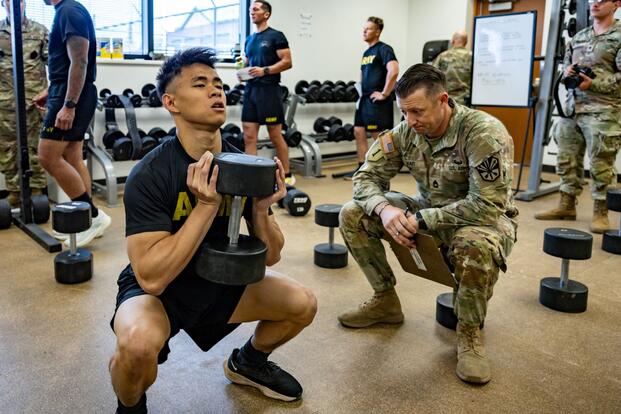
The next circuit of squats and farmer walks, with the option of heavier barbell lifts for 5 reps or lighter kettlebells for more reps, goes deep into goblet squats. Follow the squats with a fast 2x25m farmer walk with a 40- to 50-pound kettlebell in both hands. End the circuit with hanging knee-ups again. Rest as needed prior to the next set of squats.
Repeat 3 times:
- Front or back squats, 5; or kettlebell goblet squats, 10
- Farmer walk, 2×25 meters fast (two kettlebells in hands)
- Hanging knee-ups, 10
Read More: Run, Ruck or Swim: 3 Cardio-Enhancing Workouts
Conditioning Section
The calisthenics-and-fast-run half-pyramid accumulate 155 squats and 2,000 meters of running across 10 sets. This becomes a tough leg pump, turning the goal of running fast into more of a jog.
Do a squat pyramid of 11-20 reps with 200-meter fast runs in between:
- 11 squats, run 200 meters
- 12 squats, run 200 meters …
- Up to 20 squats.
Stretch, cool down, and prepare for the cardio conditioning events:
Swim or Ruck
Depending on your future challenges in the military, you may be required to swim more (diving training) or ruck more (Army, USMC special ops programs). If you need to work on your running, focus on running more miles. Pick the one you need the most work to meet the standards in front of you:
- Swim with fins 2,000 meters for time; or ruck 4 miles
Yes, these workouts take a few hours to complete, but you can do them in separate workouts (a.m./p.m.) if needed. We typically must swim in the afternoon due to pool schedules, while the running and lifting are done in the early morning hours.
For more ideas on training to become “good at everything” and not just strong, check out the tactical fitness programming at the Military.com Fitness Section. Be an asset in any situation by training like a tactical athlete.
Want to Learn More About Military Life?
Whether you’re thinking of joining the military, looking for fitness and basic training tips, or keeping up with military life and benefits, Military.com has you covered. Subscribe to Military.com to have military news, updates and resources delivered directly to your inbox.
Read the full article here
16 Comments
I’m supportive of the idea of incorporating tactical fitness training into one’s workout routine, but I’m concerned about the potential risk of injury, especially for those who are new to this type of training, are there any precautions or safety measures that should be taken?
The active rest period of 3-4 minutes after the deadlift sets, which includes running or biking, is a great way to keep the heart rate up while allowing for recovery, I might incorporate this into my own workout routine to improve my overall fitness.
I’m excited to try the calisthenics-and-fast-run half-pyramid, but I’m a bit unsure about how to pace myself to accumulate 155 squats and 2,000 meters of running across 10 sets, any tips or advice would be appreciated.
The front or back squats with the option of heavier barbell lifts for 5 reps or lighter kettlebells for more reps is a great way to cater to different fitness goals and preferences, I appreciate the flexibility in the workout routine.
I’m concerned that the conditioning section, which accumulates 155 squats and 2,000 meters of running, might be too strenuous for some athletes, especially those who are new to tactical fitness training, has anyone considered a modified version for beginners?
The repetition of hanging knee-ups after the squats and farmer walks is a great way to target the core and improve overall strength and endurance, but I’m wondering if there are any other exercises that could be used as alternatives or additions.
The option to use a kettlebell for the Romanian deadlift exercise is a great alternative for those who want to focus on more reps and muscle development, I might try incorporating this into my own workout routine.
The warmup routine’s goal of building up to 10 reps and jogging 100 meters between sets, followed by a 1-mile run, seems like a challenging but effective way to prepare for the physical demands of military training, I’m impressed by the intensity and structure of the routine.
The warmup routine described, which includes a squat/toe touch/run pyramid, seems intense, but I’m curious to know how this prepares athletes for the variety of testing and events in military training, especially with the goal of maintaining cardio fitness.
I think it’s because the combination of strength training and cardio exercises helps improve overall stamina and endurance, making it easier to handle the physical demands of military training.
I’m intrigued by the idea of using a hex barbell for the deadlift sets, has anyone compared the effectiveness of this to a traditional barbell?
The use of goblet squats as an alternative to traditional squats is a great way to target the legs and improve overall strength and endurance, but I’m curious to know more about the benefits and drawbacks of using kettlebells for this exercise.
I’m skeptical about the effectiveness of the deadlift sets with only 5 reps, wouldn’t going lighter with more reps be more beneficial for muscle development and stamina?
The combination of moderate weightlifting with reps of 5 to 10 and cardio exercises like running and biking seems like a well-rounded approach to tactical fitness, but I’m curious to know more about how this routine is tailored to specific military training and testing requirements.
The inclusion of hanging knee-ups as a decompression core exercise after lifting is interesting, I’ve never thought about using it for active rest, but it makes sense to help with recovery and prepare for the next set of exercises.
The use of farmer walks with a 40- to 50-pound kettlebell in both hands seems like an effective way to improve strength and endurance, but I’m wondering if there are any variations or alternatives for those who don’t have access to kettlebells.