

Listen to the article
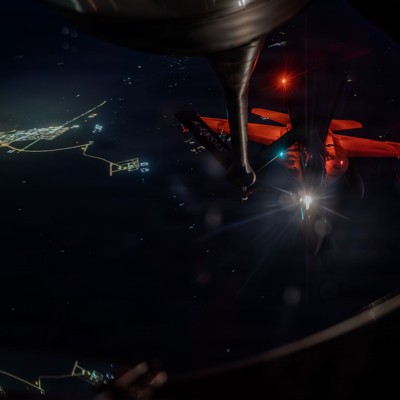
The Air Force must upgrade its KC-135 tankers to give aircrews more battlespace awareness, say former air-mobility leaders who warn that more tragedies might follow a recent deadly crash.
On March 12, two KC-135s were involved in the deadly mishap over friendly airspace that was not the result of hostile or friendly fire, according to U.S. Central Command. One of the refuelers crashed in western Iraq, the other landed safely in Israel. A photo purporting to be of one of the tankers with a damaged tail rudder began circulating shortly after the crash. The serial number matched a KC-135 shown on flight radar flying from Israel to Iran, before its transponder stopped broadcasting, and then returning with a distress call hours later before landing near Tel Aviv. Another KC-135 aircraft was spotted on radar flying from Israel towards Jordan before it stopped transmitting. Six airmen died in the crash.
Navy Capt. Tim Hawkins, a CENTCOM spokesperson, declined to provide or confirm any additional details about the incident, and said “it would be inappropriate to comment” given the pending investigation. He did not comment when asked if either tanker had been flying without transponders or other communications networks.
Last week’s tragedy was the deadliest KC-135 crash in more than a decade, but followed other recent near-misses with Air Force refueling aircraft. In December, in two separate incidents, Air Force tankers had close calls with civilian aircraft near Venezuela. At least one of those tankers reportedly did not have its transponder on.
In recent years, Air Mobility Command leaders have warned that the service’s mobility fleet lacks the key upgrades needed to communicate and have full awareness of enemy, friendly, and civilian aircraft in chaotic combat zones. Now, some former Air Force leaders are calling for a modernization of the aircraft’s communications networks, instead of continuing to rely on the current, and mostly civilian, systems onboard.
“We should never put mobility crews, especially tanker crews, in a position during combat operations where they have to choose between being seen by everyone, including the enemy, or being seen by no one, including the joint force and civil aviation,” Mike Minihan, the former head of Air Mobility Command, wrote on LinkedIn last week.
“Enough,” he said. “Mobility force connectivity now. Write the damn check.”
While it’s not clear if a lack of communications or visibility contributed to the deadly KC-135 crash, many tankers have limited battlespace awareness when trying to stay safe from enemy air defenses.
Jacqueline Van Ovost, a retired Air Force general who last served as the head of U.S. Transportation Command, told Defense One that KC-135s possess standard radios that are capable of some encrypted communications. They’re also equipped with a Traffic Alert and Collision Avoidance System, or TCAS, a transponder meant to prevent mid-air collisions. But in combat zones, tankers may choose to limit even their most basic systems and rely on visual identification so they’re not spotted by the enemy.
“You don’t want to beacon out your position like you normally do when you’re dealing with [Air Traffic Control] traffic. You would want your lights on, you turn your radar on, everybody can see you,” Van Ovost said. “But when you are close to bad guy land, you don’t want to be seen. So you turn those off.”
Van Ovost said most KC-135s communications networks are “not the type of battle space awareness that shows you where the red is, where the blue is, and the actions that are being taken in real time in a conflict.”
“All you have is the intelligence you took off with when you got the brief two hours prior to take off,” she said. “Not what is actually happening in the air at the time.”
Top Air Force officials have repeatedly called for upgrades to the KC-135, the last of which was built more than 60 years ago. Last year, the Air Force weighed keeping the tanker in service past its originally planned 2050 retirement date.
Some KC-135s do not have access to Link 16, the secure U.S. military and NATO communication networks. Efforts to upgrade the tanker’s comms through programs such as the Real-Time Information in the Cockpit system began years ago.
But access to Link 16 is still not widespread in the mobility fleet. Air Mobility Command confirmed to Defense One that “almost half of the KC-135 fleet is equipped with real-time information in the cockpit (RTIC)” which was described as “an important step in expanding connectivity across the fleet to ensure mobility aircraft can operate effectively in increasingly contested environments.” The service has just shy of 400 KC-135s across the active, Air National Guard, and reserve fleets, according to an Air Force fact sheet.
The Air Force has said accessing the network would allow aircrews to make safer decisions, according to a January Congressional Research Service report.
“According to the Air Force, the tankers’ ability to access tactical data links could increase mission success in contested environments by improving survivability, agility, and situational awareness for command-and-control elements and aircrews,” the report said. “The connectivity could provide aircrews with such information as potential threats, fuel availability, and safer landing sites. In addition, tanker aircraft could serve as a backup information conduit for other aircraft in a degraded communications environment.”
Current and former Air Mobility leaders had been asking for upgraded communications well before the KC-135 crash.
Lt. Gen. Reba Sonkiss, the interim head of Air Mobility Command, told reporters last month that service had been “woefully negligent” in prioritizing connectivity for the mobility fleet and stressed that updated “connectivity and survivability” was necessary, as tankers continue to fly in austere environments.
Last year, Gen. John Lamontagne, then-head of Air Mobility Command, said connectivity and “being able to sense and make sense of threats” was a top priority. In 2024, in his final months as head of AMC, Minihan urged a House Armed Services subcommittee to push to upgrade battlespace awareness for the aging tanker and airlift fleets.
“The quality and quantity of our connectivity equipment and ability to project and sustain the Joint Force can be the difference of life or death for our aircrews in a tactical environment,” Minihan said at the time.
The Air Force requested $124 million in modifications to the KC-135 in the service’s 2026 budget request. Additionally, the reconciliation bill passed last summer includes $84 million specifically for the KC-135’s connectivity upgrades.
Air Mobility Command said it’s a start.
“While this is a significant step in the right direction, we continue to partner across the [Air Force] to build the connected mobility force the Joint Force needs—resilient, adaptable, and ready to operate in contested battlespaces,” an AMC spokesperson said.
This month’s KC-135 crash was the deadliest for the aircraft in more than a decade. A crew of three crashed in the Kyrgyz Republic in 2013 after the flight control system malfunctioned during a combat aerial refueling mission.
Keeping mobility aircrews connected in the fog of war is something that needs to be taken seriously, Van Ovost said.
“It is a thing that keeps me up at night,” Van Ovost said. “In a contested environment, you have to be able to think for yourself, and so you need the information to do so.”
Read the full article here
6 Comments
Great insights on Defense. Thanks for sharing!
I’ve been following this closely. Good to see the latest updates.
Good point. Watching closely.
Interesting update on KC-135 crash in Iraq spurs calls for communications upgrades. Looking forward to seeing how this develops.
Solid analysis. Will be watching this space.
This is very helpful information. Appreciate the detailed analysis.