
Listen to the article
The head of Air Mobility Command has been nominated to be the Air Force’s vice chief of staff, and the Oklahoma Air National Guard commander to be the service’s top judge advocate general—nearly 300 days after the previous ones were fired with little to no explanation.
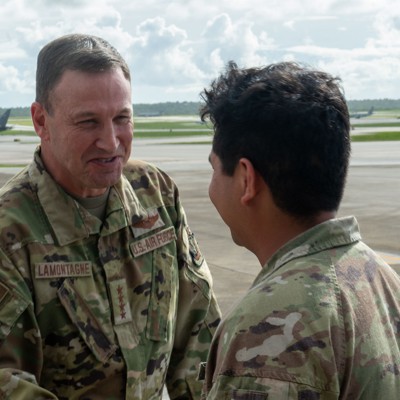
Gen. John Lamontagne was nominated Monday, according to a Congressional notice. Since 1992, he has accumulated more than 4,000 flight hours as a command pilot in the C-12 aircraft, KC-135 tanker, and C-17 transport. He has served as deputy commander of U.S. Air Forces in Europe-Air Forces Africa and as U.S. European Command’s chief of staff.
Brig. Gen. Christopher Eason is the Oklahoma Air National Guard’s commander and chief of staff. He has served as the Oklahoma ANG’s assistant adjutant general and a state staff judge advocate. He entered the Air Force after graduating from the University of Oklahoma’s law school in 2004. As a civilian, he works as a federal prosecutor.
Neither Air Mobility Command or the Air Force headquarters provided comment on the nomination by publication time.
If confirmed, Lamontagne will serve under Air Force Chief of Staff Gen. Kenneth Wilsbach, who was sworn in last month after Gen. David Allvin announced his sudden retirement in August.
He would take office at a time of change for the service. Wilsbach and Air Force Troy Meink have been unraveling Biden-era changes intended to help prepare for a war with China, while keeping intact programs to develop various weapons, including the Sentinel ICBM, the B-21 bomber, the F-47 fighter jet, and drone wingmen.
Mike Minihan, a retired general and former head of Air Mobility Command, told Defense One that Lamontagne’s nomination is a positive sign for much-needed upgrades to the service’s refueling and tanker programs. Minihan has pushed for the Next-Generation Air Refueling System, NGAS, or Next-Generation Air Lift, dubbed NGAL, both in, and out of uniform.
“Johnny Lamontagne becoming the vice chief of staff of the Air Force is exactly the kind of credibility this moment demands,” Minihan said. “I am optimistic the chief and the vice chief can win the resourcing conversations now to secure connectivity, NGAS, NGAL, and the lethality required to deter and decisively defeat China and any other potential adversary.”
Lamontagne is not the first person the Trump administration has nominated to replace the previous vice chief. This summer, the White House nominated Gen. Thomas Bussiere, then-head of Air Force Global Strike Command, but later withdrew the nomination. In September, Bussiere announced his retirement.
“Johnny is an amazing person and will do a great job as the vice,” Bussiere told Defense One in a message on Tuesday.
The Air Force vice chief position has been vacant since Feb. 21, when Defense Secretary Pete Hegseth purged Gen. James Slife, along with the Joint Chiefs chairman, chief of naval operations, and the judge advocates general of the Army, Navy, and Air Force. Hegseth has not publicly explained why he fired Slife, a helicopter pilot and special operations commander.
But other Republicans had criticized Slife for expressing mild concern about racism while leading Air Force Special Operations Command. In a since-deleted memo in May 2020, Slife wrote “we’d be naive to think issues of institutional racism and unconscious bias don’t affect us.”
Hegseth had also purged Lt. Gen. Charles Plummer, the Air Force’s judge advocate general, and his Army and Air Force counterparts. The defense secretary said they were not “well-suited” to their jobs and that he wanted top lawyers who would not act as “roadblocks” to his preferred policies. The purge led Congress to add to the 2026 defense policy act a section requiring an explanation should future JAGs be fired. Maj. Gen. Rebecca Vernon, who had served as the service’s deputy JAG, became acting TJAG earlier this year but stepped away from the job in October and is set to retire by Jan. 1.
Read the full article here
16 Comments
The nomination of Lamontagne and Eason comes at a time of significant change for the Air Force, with the service seeking to develop new weapons and technologies, such as the F-47 fighter jet and drone wingmen, and it will be important for them to navigate these efforts effectively.
The fact that Lamontagne will serve under Air Force Chief of Staff Gen. Kenneth Wilsbach, who was sworn in last month, means that the two will need to work closely together to implement changes and priorities for the service, including unraveling Biden-era changes.
The fact that Brig. Gen. Christopher Eason, the Oklahoma Air National Guard commander, has been nominated as the service’s top judge advocate general, despite having a background as a federal prosecutor, raises questions about his qualifications for the role and how he will balance his judicial and military responsibilities.
As a former military lawyer, I think Eason’s experience as a federal prosecutor will actually be an asset in his new role, bringing a unique perspective to the position.
It’s notable that the nomination of Gen. Lamontagne comes after the withdrawal of Gen. Thomas Bussiere’s nomination over the summer, and I’m curious to know what factors contributed to this change in decision.
The fact that Lamontagne has served as deputy commander of U.S. Air Forces in Europe-Air Forces Africa and as U.S. European Command’s chief of staff gives him a unique perspective on international relations and operations, which will be valuable in his new role.
Gen. Mike Minihan’s endorsement of Lamontagne’s nomination, citing his credibility and ability to secure resources for the service’s refueling and tanker programs, carries significant weight, given Minihan’s own experience as head of Air Mobility Command.
The Air Force vice chief position has been vacant for nearly 300 days, and the lack of explanation for the previous vice chief’s firing has raised concerns about the stability of the service’s leadership, which Lamontagne will need to address.
The vacancy has indeed been a concern, but with Lamontagne’s nomination, I’m hopeful that the Air Force can move forward and focus on its priorities, such as the development of the Sentinel ICBM and the B-21 bomber.
As someone who has followed the developments in the Air Force’s leadership, I’m skeptical about the ability of Lamontagne and Wilsbach to effectively implement changes and secure resources, given the service’s history of challenges and controversies.
Gen. Lamontagne’s experience as a command pilot with over 4,000 flight hours in various aircraft, including the C-12, KC-135, and C-17, makes him a strong candidate for the position, but I wonder how his background will influence his decisions on the Next-Generation Air Refueling System.
I’m concerned that the nomination of Lamontagne may be seen as a continuation of the Trump administration’s efforts to shape the military in its image, and I worry about the potential implications for the Air Force’s independence and effectiveness.
The lack of comment from Air Mobility Command or the Air Force headquarters on the nomination is notable, and I wonder what this silence might indicate about the service’s internal dynamics and priorities.
I’m curious to know more about how Lamontagne plans to address the issue of connectivity and lethality in the Air Force, particularly in the context of potential conflicts with China, and how his experience will inform his decisions.
As a veteran, I’m heartened to see the nomination of Gen. Lamontagne, who has a strong record of service and leadership, and I believe he will bring a much-needed sense of stability and direction to the Air Force.
The nomination of Gen. John Lamontagne as Air Force vice chief of staff comes nearly 300 days after the previous vice chief was fired without explanation, and it will be interesting to see how he navigates the role under Air Force Chief of Staff Gen. Kenneth Wilsbach.